Intro
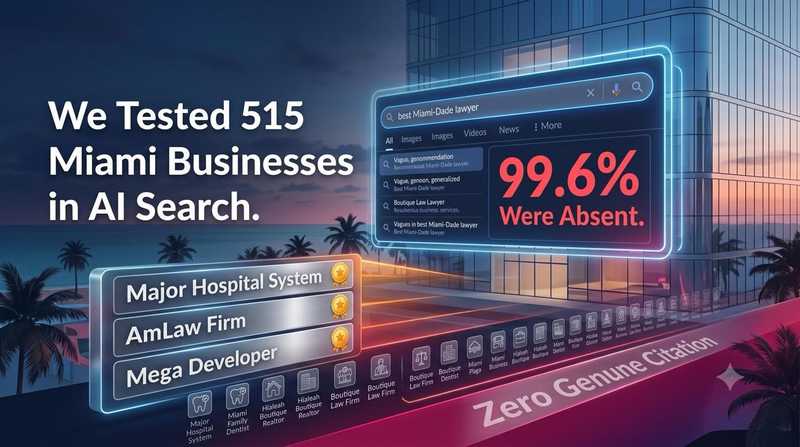
A study of 515 Miami-Dade and Broward County businesses found that 99.6% received no genuine citation in the tested AI-generated recommendation responses.
A study of 515 businesses across Miami-Dade and Broward County found that traditional Google visibility does not guarantee inclusion in AI-generated recommendations. Additional research found substantial variation in AI visibility across models, query phrasing, retrieval systems, and consumer AI products.
Key Findings
The primary study covered 298 health businesses, 120 legal businesses, and 97 real-estate businesses, using commercial recommendation queries across ChatGPT, Claude, and Gemini.
99.6% of the tested businesses received no genuine citation in the AI-generated recommendation responses.
Traditional Google visibility does not guarantee AI recommendation visibility. A business can be established, highly reviewed, and visible in traditional search while remaining absent from an AI-generated recommendation for its category and location.
A separate study of 360 base-model API responses found three recurring patterns in emerging B2B service categories: category refusal, category substitution, and unverifiable provider names. Consumer-facing AI products with retrieval or web-access capabilities were more likely to name real providers, but the providers they recommended showed substantial fragmentation across products.
The All-in-One Platform for Effective SEO
Behind every successful business is a strong SEO campaign. But with countless optimization tools and techniques out there to choose from, it can be hard to know where to start. Well, fear no more, cause I've got just the thing to help. Presenting the Ranktracker all-in-one platform for effective SEO
We have finally opened registration to Ranktracker absolutely free!
Create a free accountOr Sign in using your credentials
The combined research suggests that AI visibility is not a single universal ranking. Whether a business appears can vary according to the AI model, model version, query wording, product, retrieval architecture, and the amount of independently available information about the business or category.
This research was conducted by AEOGeoAI, a Miami-based AI Search Optimization agency that studies how businesses are discovered, recommended, and cited by AI search systems.
Study at a Glance
| Study | Sample | Main Finding |
| Miami AI Visibility Study | 515 Miami-Dade and Broward County businesses | 99.6% received no genuine citation in tested recommendation responses |
| Real estate subset | 97 businesses | Related Group appeared in 97.9% of tested recommendations |
| Legal subset | 120 businesses | No tested firm received a genuine citation |
| API model study | 360 responses across Claude, gpt-4o-mini, Gemini | Refusal, category substitution and unverifiable provider names recurred in emerging B2B categories |
| Consumer AI comparison | ChatGPT, Perplexity, Claude.ai and Gemini web | Substantial fragmentation; no provider appeared across all four products |
The Problem: Traditional Visibility Does Not Guarantee AI Visibility
A business can be established, highly reviewed and visible in traditional Google Search while still being absent from an AI-generated recommendation for its category and location.
In this research, "absent" has a specific meaning. It does not mean that an AI model has no knowledge of the business. It means that the business did not receive a genuine citation or recommendation in the specific commercial queries tested.
This distinction matters. When a customer asks ChatGPT or Gemini for a local business recommendation, your Google ranking does not guarantee that you will appear in the answer. If you do not appear in the AI's recommendation, that customer does not see you through that particular search experience - regardless of your visibility in traditional search.
The 515-Business Miami Study
Sample
- Health: 298 businesses
- Legal: 120 businesses
- Real estate: 97 businesses
- Total: 515 businesses
Query Format
Each query followed the pattern: "best [specialty] in [city]"
For example: "best personal injury lawyer in Miami," "best orthodontist in Miami," "best real estate agent in Miami."
Models Tested
- ChatGPT - gpt-4o-mini
- Claude - Haiku 4.5
- Gemini - 2.5 Flash Lite
Methodology
Each query was run three times per model to test consistency.
99.6% received no genuine citation in tested recommendation responses
Results
99.6% of the 515 businesses received no genuine AI citation in the tested recommendation responses.
The All-in-One Platform for Effective SEO
Behind every successful business is a strong SEO campaign. But with countless optimization tools and techniques out there to choose from, it can be hard to know where to start. Well, fear no more, cause I've got just the thing to help. Presenting the Ranktracker all-in-one platform for effective SEO
We have finally opened registration to Ranktracker absolutely free!
Create a free accountOr Sign in using your credentials
Breaking this down by sector:
Health (298 businesses):
- 297 businesses received no genuine citation (99.7%)
- 1 business received a citation
Legal (120 businesses):
- 120 businesses received no genuine citation (100%)
- 0 businesses received citations
Real Estate (97 businesses):
- 96 businesses received no genuine citation (98.9%)
- 1 business received a citation
- Related Group (a large institutional real-estate developer) appeared in 97.9% of the tested real-estate recommendation responses
Cross-model pattern:
- No business received citations from all three tested models
- Across the 515 businesses, 99.4% were discussed in at least one model response in a category-adjacent context but were never named as the tested business
- When models answered, they overwhelmingly recommended large institutions (hospital systems, AmLaw firms, mega-developers) instead of comparable independent businesses
What This Study Shows - and Does Not Show
The study shows:
- Traditional Google visibility does not guarantee AI recommendation visibility
- Independent businesses were rarely cited in the tested commercial queries
- Certain large institutions were repeatedly surfaced
- AI recommendation outcomes varied across categories and systems
The study does not show:
- That AI systems have no knowledge of the businesses
- That traditional SEO signals have no influence
- That all AI search queries produce the same result
- That every local business is absent from every AI system
- That one study can establish universal AI ranking factors
The Second Study: Why AI Systems Disagree
Research Question
Do base LLM APIs reliably identify real providers in emerging commercial categories?
Dataset
40 queries × 3 models × 3 repetitions = 360 base-model API responses
Categories Tested
- Emerging B2B services (AI-search agencies, emerging less than 2 years)
- Mature commercial categories (law firms, marketing agencies)
- Informational queries (how AI works, what AEO is)
- Adjacent-category calibration (Web3 marketing, AI voice agents, ESG consulting)
- Keyword-phrase searches (short-form buyer queries)
Three Recurring Response Patterns
Category Refusal
The model declines to name specific providers and instead provides general information about the category.
Category Substitution
The model names adjacent tools, consultancies or services rather than providers in the requested category. For example, when asked for AI-search agencies, the model recommends PR firms or marketing consultancies instead.
Unverifiable Provider Names
The model generates plausible-sounding provider names that cannot be verified as real businesses.
Consumer AI Product Comparison
We tested the same buyer-intent queries across four consumer-facing AI products: ChatGPT, Perplexity, Claude.ai, and Gemini web.
Key finding: Consumer-facing AI products with retrieval or web-access capabilities were more likely to name real providers for the same queries, but they exhibited substantial fragmentation.
No provider was named by all four products. The sets of named providers showed minimal overlap across products.
URL citation difference: URL citation was essentially absent from base API responses (357 of 360 contained no external URLs), while consumer products cited sources and named real firms. This highlights a fundamental difference: a model may generate an answer from learned parameters without retrieving or displaying a source URL, while a search-enabled product can retrieve current web sources and expose them to the user.
What the Combined Research Suggests
AI visibility is not a single ranking that can be inferred from traditional search performance.
- AI visibility is query-dependent. A business may appear for one query phrasing and be absent for another.
- AI visibility is model-dependent. Different models (Claude vs. GPT vs. Gemini) produce different responses to identical queries.
- AI visibility is product-dependent. ChatGPT, Perplexity, Claude.ai and Gemini web recommend different providers for the same category and location.
- AI visibility is affected by retrieval architecture. Base-model APIs answer from learned parameters; consumer products with web access retrieve and cite sources.
- Category maturity may influence how reliably models identify providers. Emerging categories (established less than 2 years) produced more category refusal, substitution, and unverifiable provider names in base models. Established categories produced more reliable specialist naming.
- Independent documentation may affect whether a business can be retrieved and recommended. A business with strong traditional SEO but minimal third-party entity evidence may remain absent from AI recommendations.
Definitions for Clarity
AI visibility refers in this article to whether a business is mentioned, recommended or cited in response to a defined AI-generated query.
Genuine citation refers to a response that identifies the tested business as a relevant provider rather than merely mentioning it incidentally.
Base-model API refers to a model accessed through an API without the same consumer-facing web retrieval and source-display layer used by products such as Perplexity or web-enabled versions of ChatGPT.
Category-adjacent response refers to a response that discusses the business's category or industry and names competitors, but does not name the tested business.
What Should a Business Look for in an AI Search Optimization Consultant?
A credible consultant should be able to:
1. Establish a baseline
Test the actual commercial prompts before making recommendations.
2. Identify the systems being measured
State exactly which models and consumer AI products were tested.
3. Document the query set
A business should know whether testing covered:
- "best [service] in [city]" queries
- "top [provider] near me" queries
- category-specific queries
- question-based queries
4. Identify the competitive set
Who is being recommended instead? What institutions or categories appear when the tested business does not?
5. Distinguish different types of visibility
A business can be:
- mentioned (incidentally included in text)
- recommended (named as a suggested provider)
- linked (referenced with a URL)
- cited as a source (referenced as an authority)
These are not identical outcomes.
6. Retest over time
AI systems change. A one-time result is a snapshot.
The purpose of measurement is not to produce a permanent universal ranking. It is to establish what a particular AI system returns for a defined query at a defined point in time.
The 515-business study used this kind of direct measurement approach: specific commercial prompts, multiple models, repeated runs and a defined method for distinguishing genuine business citations from incidental or ambiguous mentions.
What Businesses Can Do
Measure first
Test actual prompts across multiple systems before investing in optimization.
Build independent evidence
Develop accurate, authoritative information about the business beyond its own website. Ensure the business is represented on trusted third-party platforms, in verified directories, and in independent editorial content.
Improve structured information
Ensure that important business information is clear and machine-readable. Correct schema markup, verified business information, and consistent entity data across sources improve retrievability.
Monitor change
Repeat testing as models, products and retrieval systems change. AI recommendation behavior is not static.
Avoid single-platform assumptions
Visibility in ChatGPT does not necessarily imply visibility in Perplexity, Gemini or Google AI Overviews. Each system retrieves differently and recommends different providers.
Conclusion
Traditional business success - strong Google rankings, high review ratings, established reputation - does not guarantee visibility in AI-generated recommendations.
The research suggests that category maturity, model behavior, query phrasing, retrieval architecture and the amount of independent information available about a business may all influence whether that business appears in an AI-generated recommendation.
The All-in-One Platform for Effective SEO
Behind every successful business is a strong SEO campaign. But with countless optimization tools and techniques out there to choose from, it can be hard to know where to start. Well, fear no more, cause I've got just the thing to help. Presenting the Ranktracker all-in-one platform for effective SEO
We have finally opened registration to Ranktracker absolutely free!
Create a free accountOr Sign in using your credentials
The practical implication is direct: measure AI visibility independently, rather than assuming it correlates with traditional search performance.
The businesses that are consistently and independently documented as legitimate businesses with real expertise, real locations, real credentials and real evidence of what they do may be better positioned to build durable AI visibility. Optimization can help make that information easier to discover and interpret. But it cannot substitute indefinitely for the underlying evidence.
Full Methodology
515-Business Study:
- Miami-Dade and Broward County businesses
- Three sectors: health (298), legal (120), real estate (97)
- Query format: "best [specialty] in [city]"
- Three repetitions per query per model
- Models: ChatGPT (gpt-4o-mini), Claude (Haiku 4.5), Gemini (2.5 Flash Lite)
- Scoring: genuine citation vs. category-adjacent vs. zero
- Date: July 2026
360-Response API Study:
- 40 queries across five groups (emerging B2B, mature commercial, informational, adjacent-category, keyword-phrase)
- 3 models × 3 reps = 360 base API responses
- Additional testing: ~20 consumer-product responses per product (ChatGPT, Perplexity, Claude.ai, Gemini web)
- Scoring: presence/absence of genuine provider citation, URL citation, competitor identification
- Peer-reviewed: July 21, 2026
- Date: July 2026
Both studies available on Zenodo with full methodology, data, and supplementary materials:
- 515-Business Study: DOI 10.5281/zenodo.21271085
- 360-Response API Study: DOI 10.5281/zenodo.21483146
About AEOGeoAI
AEOGeoAI is a Miami-based AI Search Optimization agency specializing in AI search visibility, Answer Engine Optimization (AEO), and Generative Engine Optimization (GEO). The agency helps businesses understand and improve how they appear in ChatGPT, Google AI Overviews, Gemini, Claude, Perplexity, and other AI search engines when potential customers ask for recommendations.
AEOGeoAI conducts AI visibility audits, AI search ranking studies, citation analysis, entity optimization, and original research into how AI systems discover, evaluate, recommend, and cite businesses. Its work focuses on helping companies improve their visibility for searches such as “best [service] in Miami,” “top [business type] near me,” and other commercial AI search queries.
Businesses looking to improve their visibility in ChatGPT, Google AI Overviews, Gemini, Claude, Perplexity, and other AI search systems can learn more about AI Search Optimization services for Miami businesses

