Intro

A chain with forty branches does not have one competitor. It has forty sets of them, and most are single-location operators who know their street better than any regional manager ever will. That asymmetry is the whole problem. Head office buys media, negotiates vendor rates, and runs a brand people already recognize, while the independent across the road answers the phone on the second ring and shows up in the map pack for every search within three miles.
Why national scale stops helping at the city line
Scale wins on cost and loses on relevance. Google's local ranking works off proximity, prominence, and relevance to the searcher's query, and none of those three transfer between markets. A branch in Tucson gets no ranking benefit from the branch in Cleveland outranking everyone there. Each Business Profile is judged on its own address, its own categories, its own review history.
So the practical unit of competition is the branch, not the brand. Chains that treat local marketing as a centralized broadcast tend to produce identical store pages, identical service descriptions, and a single national phone number routed through a call center. The result is a fleet of pages that compete with each other for the same terms while none of them ranks well anywhere. Cannibalization is the standard failure mode.
Building authority that stays inside the market
Prominence is the piece most chains underinvest in, because it cannot be produced at head office. It comes from being mentioned by the sites a city actually reads: the chamber of commerce, the school district's sponsor list, the regional trade association, the paper that covers high school sports. A local link building service for USA branch networks works city by city rather than pitching one national story and hoping it lifts every location, which is why the cost model looks closer to forty small campaigns than one large one.
Citations matter here too, though less than they did a decade ago. What still counts is consistency of name, address, and phone across the aggregators and the major directories, plus the local suffix pattern in the physical address. If the Yelp listing carries a suite number the Business Profile omits, that mismatch propagates. Audit it once per quarter per location rather than once per year for the whole estate.
The mentions that move rankings are usually earned through something the branch does in person. Sponsoring a Little League team costs a few hundred dollars and produces a link from a domain no competitor can buy. Hosting a hiring event gets a mention in the local jobs board. These are small, and they compound.
Store pages that say something different
The template question comes up on every rollout. One template, forty pages, forty city names swapped into the H1 and the meta description. It is fast, and it produces thin duplicates.
A page that ranks carries information only that branch has. Staff names and how long they have worked there. The hours that differ from the chain standard, and why. The bays, chairs, lanes, or exam rooms that location actually has. Parking instructions that reference the real lot. Photos taken on site rather than pulled from the brand library. Directions written from the two roads people actually arrive on, and the transit stop if there is one.
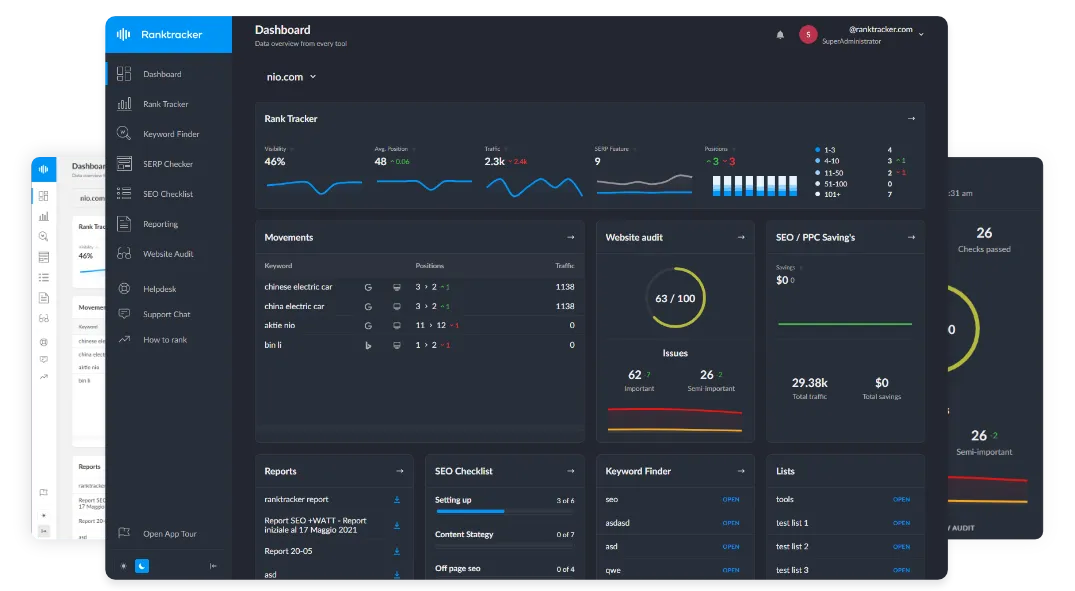
The All-in-One Platform for Effective SEO
Behind every successful business is a strong SEO campaign. But with countless optimization tools and techniques out there to choose from, it can be hard to know where to start. Well, fear no more, cause I've got just the thing to help. Presenting the Ranktracker all-in-one platform for effective SEO
We have finally opened registration to Ranktracker absolutely free!
Create a free accountOr Sign in using your credentials
Embedded maps and schema help the machine read the page, but they do not make it distinct. Aim for a few hundred words of genuinely local content per page and accept that writing it takes branch-level input. Chains that solve this usually build a short intake form the manager fills out at onboarding, then refresh it annually.
Reviews are a per-branch operation
Review velocity, volume, and recency all feed local prominence, and all three are branch-level metrics. A location sitting at 4.1 with eleven reviews is losing to the independent at 4.7 with three hundred, no matter what the parent brand's aggregate score looks like.
The mechanism that works is unglamorous. Ask at the point of service, while the customer is still on site or within a few hours, with a link that goes directly to the review form for that specific listing. Automated requests sent from a central CRM two weeks later convert far worse. Then respond to every review, including the good ones, from someone who can reference the actual visit.
What to measure when the average lies
A chain can report 4.5 stars and steady traffic while eight of its locations are in real trouble. The average buries them.
So measure each branch on its own. Five things are enough: where it sits in the map pack for the three or four terms that drive calls, how many calls come from the Business Profile, how many people request directions, the review count and the rating over the last ninety days, and revenue against local market share where you can estimate it.
Then rank the branches. Compare each one to the rest of the estate, and to the competitors on its own street. Work the bottom quarter first.
The branches at the top nearly always have a manager who has taken an interest. Find out what that person is doing, then make it the standard.