Intro
More geographic pages don't produce more local visibility. Most city pages were never competing in the map pack to begin with, because that result is driven by a real address. The fix is to publish one page per real operational unit instead of one per keyword, then make those few pages genuinely useful. This guide gives you the test to apply, plus the cleanup process for a footprint you've already published.
Most multi-location SEO advice still assumes one thing: a new city means a new URL. Add the city name to a template, swap the H1, publish, repeat. Do that 12 times and you have a footprint. Do it 200 times and you have a liability.
Here's the part that stings. A lot of those pages were never going to rank in the map pack anyway. Google's own guidance on how local ranking works describes three inputs, and one of them is distance, which is set by where your business actually is. Whitespark's 2026 Local Search Ranking Factors report, in which 47 local search experts scored 187 signals, ranks proximity of your address to the point of search as the second most impactful local pack factor, with having a physical address in the city of search sitting at fourth. In local organic results, that same proximity factor falls all the way to 41st.
So the page you built for a city 60 miles away was competing in organic only. That single fact changes the whole math on how many pages you should have. Let's get into it.
What actually counts as a doorway page?
A doorway page is a page built mainly to rank for a location or query variation and then funnel the visitor somewhere else, rather than to serve the person who lands on it. Google's spam policies name multiple pages targeted at specific regions or cities that push users toward one destination. The violation is the intent and the emptiness, not the existence of a city page.
That distinction matters, because plenty of good businesses have talked themselves out of location pages entirely after reading a scary blog post.
The All-in-One Platform for Effective SEO
Behind every successful business is a strong SEO campaign. But with countless optimization tools and techniques out there to choose from, it can be hard to know where to start. Well, fear no more, cause I've got just the thing to help. Presenting the Ranktracker all-in-one platform for effective SEO
We have finally opened registration to Ranktracker absolutely free!
Create a free accountOr Sign in using your credentials
A template isn't the problem. Two hundred pages built from that template with nothing but the city name changed is the problem. Google's spam policies also cover scaled content abuse, which catches pages mass-produced primarily to manipulate rankings regardless of whether a person or a tool wrote them. Google has been consistent on that last point in its guidance on AI-generated content, where the question is whether the page helps someone, not what produced it. Between those two policies, most bloated geographic footprints have a problem somewhere.
And there's a second cost that has nothing to do with policy. Even a footprint that stays well clear of a spam issue can still bury you in pages competing with each other, split link equity, and inconsistent local details that quietly rot as staff and hours change.
Why more location pages don't create more local visibility
Adding pages doesn't add local visibility, because the map pack and local organic results run on different machinery. The pack leans on your Google Business Profile and your real address. Local organic leans on your pages. A city page with no matching address competes in one of those two places, not both.
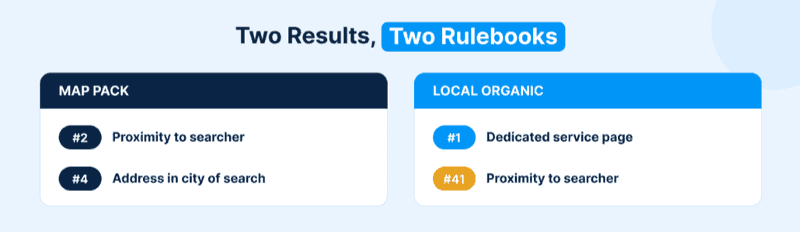
Once you see that split, the strategy stops being about coverage and starts being about which of the two results you're actually trying to win in a given town.
Where a page genuinely can help is local organic. Whitespark's 2026 data puts "dedicated page for each service" as the single highest scored local organic factor, with geographic keyword relevance of content second and internal linking across the site sixth. Notice what those have in common. None of them says "more URLs." They reward pages that go deep and stay connected to each other. Search Engine Land made a similar argument in its recent piece on structuring geographic pages at scale, noting that excessive geographic pages create internal competition and fragmented authority rather than more visibility.
The damage from over-publishing shows up in ways most reporting never surfaces:
- Internal competition. Your Dallas page, your Dallas-Fort Worth page, and your Texas page all chase the same query. Google picks one, usually not the one you'd pick. This is keyword cannibalization wearing a map pin.
- Split authority. Links and internal signals that could have made one page strong get spread across nine weak ones.
- Conflicting information. Hours, phone numbers, and service lists drift apart across pages nobody has opened in two years.
- Maintenance debt. Every page is a promise to keep something accurate. Two hundred promises is a full-time job you didn't hire for.
The page test: does this location deserve its own URL?
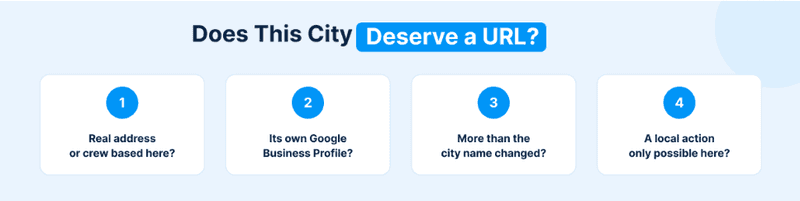
Before you publish a geographic page, run four questions. Fewer than three years and that city becomes a section on a regional page instead of a URL of its own:
- Is there a real address, or a licensed crew based here? Not a service radius drawn on a map. Something an inspector could visit.
- Does this location have its own Google Business Profile? Google's guidelines for representing your business allow one profile per eligible location, and eligibility means real staffing and real presence.
- Does anything on this page change beyond the city name? Named staff, actual hours, a different service list, local pricing, jobs you've completed there.
- Can a customer here do something a customer elsewhere can't? Book at this branch, get a two-hour response, meet a licensed technician for their state.
The All-in-One Platform for Effective SEO
Behind every successful business is a strong SEO campaign. But with countless optimization tools and techniques out there to choose from, it can be hard to know where to start. Well, fear no more, cause I've got just the thing to help. Presenting the Ranktracker all-in-one platform for effective SEO
We have finally opened registration to Ranktracker absolutely free!
Create a free accountOr Sign in using your credentials
"Some things are different" isn't the bar. The bar is that a customer in that city would notice.
Here's where it gets uncomfortable for a lot of service businesses. Take a water damage restoration company running 24-hour dispatch across 14 towns from two real branches. The keyword tool shows 14 cities with volume, so the instinct is 14 pages. But there are two operational units, not 14. The other 12 towns are coverage, and coverage belongs in a section on the branch page that serves them, not in a URL of its own.
Agencies that work inside one vertical see this pattern constantly. The team at Pexnet, which runs SEO for restoration companies, sees the same instinct on nearly every new account: a keyword list mistaken for a site map.
Depth on a real location beats the volume of thin ones, and the gap is not subtle. Pexnet worked with a single-location carpet cleaning company in Atlanta that went from zero inbound calls per month to around 120, with Google Business Profile views climbing from roughly 96 to more than 500 over about 15 months. One location. One page worth landing on. No city-page factory.
Whitespark's report also flags something multi-location operators should read twice: setting service areas larger than a two-hour drive, and overlapping service areas across multiple location profiles, both register as negative signals with suspension risk attached. Sprawl carries a cost on the profile side too.
What a location page needs to earn its place
A location page earns its URL when it carries information that could only have come from that location. Start with what's hardest to fake, then work down to the technical layer. Most teams do this in reverse, which is why their pages read like a mail merge.
In order:
Local proof. Jobs completed in that market, named staff, photos of the actual building and actual vans. Not stock imagery. This is also what people check before calling. BrightLocal's 2026 Local Consumer Review Survey, run with 1,002 US adults, found 97% of consumers read reviews when evaluating a local business, and the share who always read them jumped from 29% to 41% in a single year.
Operational specifics. Response times, coverage boundaries in plain language, state licensing and certifications, which services this branch actually performs. This is the material a template can't generate.
The technical layer. LocalBusiness structured data with the address and hours for that location, a NAP that matches the profile exactly, and the profile's website field pointing to this page rather than the homepage.
Then the copy. Written last, on purpose. When you write the copy first, you fill space. When you write it after gathering the first three, you're just organizing facts you already have. This is also the practical version of Google's advice on creating helpful, people-first content, which asks whether a page was made to help someone or made to rank.
One more thing worth saying because it cuts against a decade of habit. Length is not the goal. Darren Shaw's 2026 analysis notes that the volume of content on service pages dropped 40 positions in expert scoring, and his advice is to answer the question up front without the padding. That's the same shape of content that gets pulled into AI answers, which is worth understanding if you want visibility in AI Mode as a local service provider.
How to structure the site so your pages stop competing
Structure is where most multi-location sites either hold together or fall apart. Three patterns work:
Location pages under a hub. /locations/ as the parent, /locations/city-name/ for each real location. The hub links to every location, every location links back to the hub. Clean, crawlable, and it scales to a hundred branches without collapsing.
Service pages that stay national. One deep page per service, not one per service per city. Whitespark's local organic data has dedicated service pages as the strongest factor on the list, and that strength comes from depth, which you lose the moment you shard it across 40 near-copies.
Service by city, but only where the service genuinely differs by market. Water extraction in a flood plain and water extraction in a dry climate are different jobs with different equipment and different timelines. Write that page. Fire damage in two neighboring suburbs is the same job, so don't.
The failure mode here is the matrix: 12 services times 30 cities equals 360 URLs nobody can maintain and Google can't tell apart. If you want the deeper version of this thinking, RankTracker's guide to keyword clustering for local service businesses covers how to map broad terms to the homepage, specific problems to service pages, and questions to blog content. The related failure, where clusters blur into each other until the site's topic signals go fuzzy, is covered in topical map distortion.
Internal linking is the part people skip. A location page that nothing links to except the sitemap is a page you've published and abandoned.
How to fix a footprint you've already published
Most people reading this already have the problem. Deleting 200 pages in an afternoon is not the answer, and neither is leaving them there. Work through it in order:
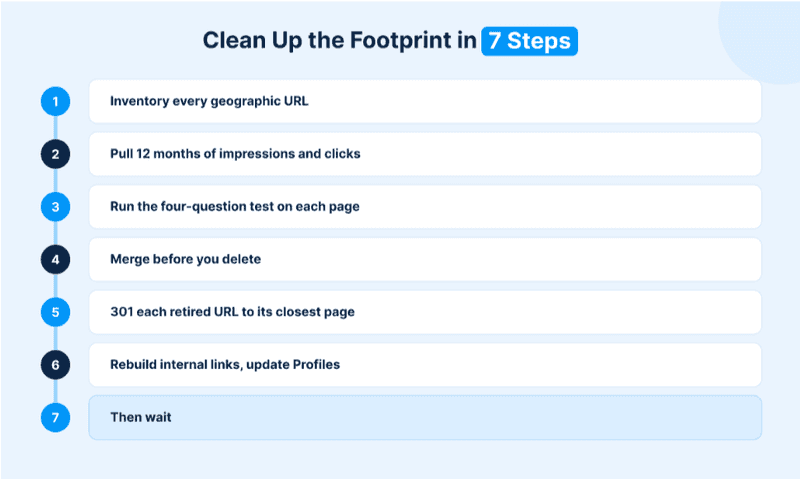
- Inventory every geographic URL. Export from your CMS or a crawl. You'll almost certainly find pages nobody remembers publishing.
- Pull 12 months of impressions and clicks per page from Search Console. Pages with impressions but no clicks are usually thin. Pages with neither are dead weight.
- Run the four-question test on each one. Sort into keep, merge, and retire.
- Merge before you delete. Move any genuinely useful local detail from a retiring page onto the surviving page first. That detail is often the only original thing on the site.
- 301 each retired URL to its closest surviving page, which usually means the regional or branch page that covers that town. Redirecting everything to the homepage in bulk is a signal that you had nothing there, and it wastes whatever links those pages earned.
- Rebuild internal links so nothing points at a redirect chain, and update the website field on every Google Business Profile.
- Then wait. This is the part clients hate.
Set expectations honestly on that last step. Google's guidance is clear that core updates are a recalibration rather than a manual penalty, and recovery generally arrives with later updates instead of the week after you push changes. Check your drop dates against the Search Status Dashboard before you diagnose anything, because a drop during a spam update window and a drop during a core update window call for completely different responses.
If you're managing this across dozens of branches, the operational side of the problem is worth reading on its own, and RankTracker's guide to local SEO for enterprises and franchises covers the consistency work that keeps a large footprint from drifting.
How to measure it without hiding behind brand averages
Report by location, never by network average. An average across 40 branches will look healthy while four of them quietly go invisible for six months, because the strong locations carry the number and nobody sees the collapse until the calls stop.
That reporting habit is the reason thin pages survive as long as they do. Nobody is looking at them individually.
Track per location: rankings by city and postal code rather than national position, profile actions like calls and direction requests, form fills attributed to that location's page, and the ratio of impressions to clicks on each geographic URL. Ranking by city is not something you can eyeball from your own browser, since your own location distorts what you see, so use local rank tracking by city and zip rather than checking manually.
The leading indicator that a page is thin: impressions climbing while clicks stay flat. Google is showing it and people aren't choosing it. That page is on borrowed time no matter what the policy documents say, and specialist teams like Pexnet build their location reporting around exactly that signal rather than around aggregate traffic.
FAQ
Are city landing pages considered doorway pages by Google?
Not automatically. Google's spam policies target pages built to rank for regional variations and funnel visitors elsewhere, rather than city pages as a category. A page tied to a real location with genuine local information is a normal, useful page. A page that exists because a keyword had volume is the one at risk.
How many location pages should a multi-location business have?
As many as you have real operational units, and no more. If a location has an address or a based crew, its own Google Business Profile, and details a customer would actually notice, it earns a page. Everything else becomes a section on a regional page. Ten real pages will outperform 200 thin ones.
Can I rank in a city where I don't have a physical address?
In local organic results, yes, with genuinely useful content and links. In the map pack it's much harder, because proximity and having an address in the city of search are among the strongest pack signals. Treat those as two separate goals rather than expecting one page to win both.
Should each location get its own Google Business Profile?
The All-in-One Platform for Effective SEO
Behind every successful business is a strong SEO campaign. But with countless optimization tools and techniques out there to choose from, it can be hard to know where to start. Well, fear no more, cause I've got just the thing to help. Presenting the Ranktracker all-in-one platform for effective SEO
We have finally opened registration to Ranktracker absolutely free!
Create a free accountOr Sign in using your credentials
Yes, if the location is separately staffed and eligible under Google's guidelines for representing your business. One profile per real location. Avoid overlapping service areas across profiles, since that combination registers as a negative signal in expert scoring and carries suspension risk.
What happens if I delete or merge my existing location pages?
Expect short-term movement, including on pages you're keeping. Move any original local detail onto the surviving page before retiring the old one, 301 each retired URL to its closest relevant page rather than the homepage, and rebuild internal links. Recovery from quality-driven declines usually comes with later updates, so measure over months rather than days.
The takeaway
Scale the clarity of your location ecosystem, not the number of geographic URLs. The businesses winning multi-location search in 2026 aren't the ones with the most city pages. They're the ones whose few pages match real operations closely enough that Google and customers both trust what they say.
Run the four-question test against your current footprint this week. You'll know within an hour how many of your pages are earning their place, and that's the only number that decides what to do next.