Intro
Most people treat "AI" like it's one thing when it comes to GEO. One big brain in the sky that either likes your brand or doesn't. So they develop one strategy, apply it everywhere, and then stare at a dashboard wondering why numbers are (1) volatile and (2) inconsistent.
But there is no “AI”. There's ChatGPT, and Google's AI Overviews, and Gemini, and Claude, and Grok, and Perplexity, and a handful of others; they do not share the same code. They pull from different places, they trust different things, they use different search engines, they talk differently, and they throw away most of what they find. The same move that gets you cited in one of them may do close to nothing in another. So the first real decision in GEO isn't “how do I win AI”. It's “which engine matters for the people I'm trying to reach, and how does that specific one pick its sources”.
So let’s dive into how to pick your engine, and then how to feed it.
TL;DR
GEO is not a one-size-fits-all game because major AI engines (like ChatGPT, Google, Gemini, Grok, DeepSeek, Copilot, and Perplexity) run on entirely different code, indexes, and filters. Tactics that work for one may fail or yield minimal ROI on others. To win, you must pick the specific engine your target audience uses, tailor your content to its mechanical retrieval rules (such as Bing's index for ChatGPT or Google's organic rankings for AI Overviews), and measure success using engine-specific metrics and multi-run sampling rather than relying on flawed, blended dashboards. Red-Engage examined these discrepancies closely, adhering to a scientific research framework and authoritative sourcing, and created an entire book dedicated to understanding different LLMs and effectively targeting them.
Choose Your Battleground
You don't need to win all of them, just the one your buyer opens. Here's a rough way to sort it.
ChatGPT: choose it for GEO if you sell B2B or anything researched before purchase. It's the biggest room, where someone types "best X for Y with Z budget" and reads the answer instead of opening ten tabs. It rewards clear, factual, well-structured source pages and quietly distrusts hard-sell copy.
Perplexity: choose it for GEO if your buyers compare options and want receipts. Same diet as ChatGPT with even less patience for fluff, so if you've built clean, cited pages for ChatGPT you're most of the way there. Smaller room, but the traffic is high-intent research.
Google AI Overviews: choose it for GEO if you sell local, consumer, or anything with a "near me" flavor. The door in is your existing organic ranking, since the large majority of AIO citations come from pages already sitting in the top ten organic results. You have to already rank to get pulled.
The All-in-One Platform for Effective SEO
Behind every successful business is a strong SEO campaign. But with countless optimization tools and techniques out there to choose from, it can be hard to know where to start. Well, fear no more, cause I've got just the thing to help. Presenting the Ranktracker all-in-one platform for effective SEO
We have finally opened registration to Ranktracker absolutely free!
Create a free accountOr Sign in using your credentials
Gemini: choose it for GEO if your audience lives inside Google's own apps, Gmail, Photos, YouTube, Android. Its edge is Personal Intelligence, which weights answers on a user's own Google history, so the play runs through the Google surfaces your customer already touches, not just your website. This is a different job than "near me" search, which is AI Overviews' lane.
We’ll elaborate on the rest (Grok, DeepSeek, Copilot) later down the article. You have to pick one, maybe two if they truly overlap for your audience, and focus on them. Trying to win all of them at once will inevitably cause a “jack of all trades, master of none” situation.
ChatGPT: Winning B2B and High-Intent Research
This is the one your buyer opens when they type "best table supplier for restaurants with 50 seaters and an XYZ budget" and read the answer instead of clicking ten tabs. It's the biggest room, so it's where most of the fight is.
When ChatGPT needs fresh information it rewrites your one question into several search queries, runs them through Bing's index (not Google's, that trips people up, ChatGPT browses with Bing), reads the top results, then builds the answer. So you're not chasing one keyword, you're trying to be the consistent answer across a cluster of phrasings.
Note: on the Bing thing, it’s worth noting that Claude uses Brave for browsing. Google obviously uses Google Search, Perplexity uses its own proprietary one, and so does Grok. Some marketers are debating “Google Search vs Bing vs Brave SEO” for Gemini, ChatGPT, and Claude targeting. I honestly cannot give a conclusive answer as to whether niching-out that much is worth the ROI (that if the three engines’ SEO algorithms are different enough to merit separate targeting strategies to begin with) because I haven’t looked into it yet. Up to you!
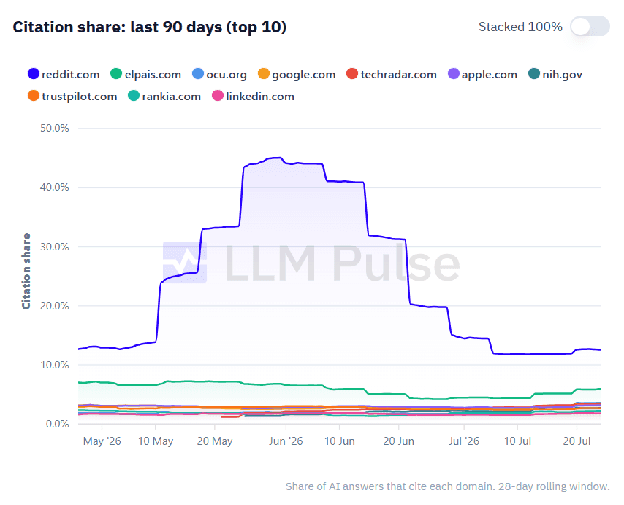
Share of ChatGPT answers that cite each domain. 28-day rolling window. Source: LLM Pulse. Reddit reaching 45.03% of citation sources on May 31st.
The All-in-One Platform for Effective SEO
Behind every successful business is a strong SEO campaign. But with countless optimization tools and techniques out there to choose from, it can be hard to know where to start. Well, fear no more, cause I've got just the thing to help. Presenting the Ranktracker all-in-one platform for effective SEO
We have finally opened registration to Ranktracker absolutely free!
Create a free accountOr Sign in using your credentials
The single best move here is getting into the sources it already trusts. ChatGPT leans on a smaller set of domains it treats as reliable, Wikipedia way out front, plus its licensed publisher partners like Business Insider and the Financial Times, which its browsing treats as high-authority. EPR News notes that Forbes is a “Top-5 [citation] across all platforms [ChatGPT, Claude, Gemini, Perplexity, and Google AI Overviews]; ChatGPT citation roughly doubled post-September 2025”. So, a mention in one of those sources does more than in a random forum’s comment section.
Before that, structure your own pages so they are answer-first oriented, having the direct answer near the top in plain language, then the detail below, because ChatGPT’s scraper reads the top of the page and moves on.
One warning specific to ChatGPT: it has the strictest safety filter of the consumer models, and it's tuned to distrust anything that reads like a hard sell. Aggressive copy ("guaranteed 10x returns") can get your page flagged as unreliable during retrieval and quietly dropped. Write your core pages in a calm, encyclopedic voice. Keep the personality, lose the superlatives.
Google AI Overview: Capturing Local and Consumer Intent
This is where the "near me" and everyday informational searches still happen, so if you sell local or consumer, this is your room.
The useful thing about Google is that the door in is your existing organic ranking. Rank in the top ten and you're in the candidate pool for the Overview. That's why classic SEO still matters a lot here. So the move is boring and real: rank the page, then structure it so the summary can lift a clean answer, question-shaped headings, a direct answer in the first sentence or two under each, facts stated plainly with numbers.
Note: When a user submits a query, The AI Overview converts it into several variations of relevant prompts and starts identifying content from the results, going beyond the first page 57% of times, which is good news for many who can’t land a seat in Google’s home page.
Pew tracked real browsing and found that when an AI summary was present, people clicked a traditional result only 8% of the time versus 15% without one, and they clicked the links inside the summary itself about 1% of the time. So an Overview citation is closer to being quoted on a billboard than getting a visit. Use it for being named as the answer, not for a click bump that mostly won't come.
And a heads-up before you try to measure this one: it barely holds still. When SE Ranking ran ten thousand keywords through Google's AI Mode three times in one day, the cited URLs overlapped only 9.2% of the time, and NJIT researchers found roughly the same thing across 14,000 queries. More on what to do about that at the end.
Gemini: best for reaching people deep inside Google's own apps
Gemini is the one to care about when your audience lives inside the Google world, Gmail, Photos, YouTube, Android, because it can pull from a user's own Google data, not just the open web. In January 2026 Google turned on a feature it calls Personal Intelligence, which connects Gmail, Google Photos, Search history, and YouTube history to shape the answers a person gets. No other major model has that kind of reach into a user's private account, and that changes how you get in front of them.
It has two modes and you feed them differently. When Gemini browses the open web it's tied to Google's search index, so the same answer-first, clean-structure work you did for AI Overviews carries straight over. One extra thing earns its keep here: write real alt text on your images, plain description of what the picture shows, because Gemini's scraper strips the visual layer and leans on alt text to read an image, and keyword-stuffed alt text gets thrown out.
The second mode is the one people miss. Because Personal Intelligence weights answers on a user's own history across Google, a brand whose YouTube videos someone watches, or whose emails they open in Gmail, gets a quiet thumb on the scale when Gemini answers that specific person. So the Gemini play goes past your website and into the Google surfaces your customer already touches, an active YouTube channel worth watching, a clean Google Business Profile, email people open instead of bin. One caution worth stating plainly: this personal layer is opt-in and off by default, so it only reaches the slice of your audience that switched it on, which today skews to paying Google AI subscribers. Treat it as a high-value slice, not the whole room.
Grok: best for news, culture, crypto, and anything moving in real time
Grok is the odd one, and its oddness is predictable, which makes it usable. It leans on X harder than any other model leans on any single source. Its own tooling includes a dedicated X Search that does keyword, semantic, user, and thread lookups across live posts, and X's own help page says Grok decides per query whether to pull real-time public posts and run a live web search on top. So if your world is fast-moving public conversation, breaking news, culture, crypto, this is a room you can win that the others can't reach the same way.
Ask Grok something timely or opinion-shaped ("what happened with this today," "how do people feel about that") and it goes and reads live X posts. Ask it a settled, explanatory question and it often just answers from training without going live at all. So two things follow. First, win on X itself, real presence, posts people engage with, quick public responses when you're being discussed, because engagement is read as a proxy for importance and a post people interact with carries more weight than one that just sits there. Second, be early on your own news, so when something breaks about you, your posts are in the first wave Grok reads when a user asks about it an hour later.
That timely-versus-settled split is also a measurement trap, and I'll come back to it at the end.
DeepSeek: best for highly technical and developer-facing products
DeepSeek is worth your time if you sell to engineers or in deeply technical B2B, and it plays by rules that punish marketing language harder than any other model. It's a Chinese lab that reached the front tier on a fraction of the usual training budget, and part of how it stays lean is a training setup that leans on clean, structured, high-signal data and strips out padding. So a persuasive, superlative-heavy tone doesn't just underperform here, it works against you.
What it eats is machine-readable structure and technical proof. Its agents lean on documentation, code, and developer discussion to build answers, so clean, well-structured docs are your main visibility surface, not your landing-page copy. Two more specifics on where it pulls from: it heavily ingests Wikipedia, and because it's a Chinese model its training leans on the Chinese web, so a complete Wikipedia entry plus a real presence on a platform like Zhihu can bake you in where Western-web tactics do nothing. One caveat to plan around: it censors along Chinese regulatory lines, so if your brand sits near politically sensitive ground there, expect to be left out or reframed in ways you don't control. For a plain consumer brand that's rarely an issue; for anything close to those topics it's a real ceiling.
Copilot: best for getting recommended inside an enterprise's own workflow
Copilot is the quiet B2B one. It sits inside Microsoft 365 and can read a company's own internal data through Graph while it searches the public web at the same time, a combination Microsoft calls web grounding, where the web half runs on the Bing search service. So a procurement manager can ask Copilot to compare their internal spend against outside options, and it pulls their spreadsheet and a Bing search together, then names a vendor right inside the company's secure workflow. If you sell B2B, being the vendor it names in that moment is about as warm as visibility gets, because you're being recommended inside the buyer's own tools before they've even opened a browser tab.
The key fact to act on: the external half runs on Bing, and Bing ranks on different signals from Google. So manage Bing directly instead of assuming your Google ranking carries over, that means Bing Webmaster Tools, IndexNow to push fast indexing, and solid schema markup. Then feed the procurement moment specifically, because enterprise users aren't asking for marketing lines, they're asking for ROI and integration proof. Publish public case studies with hard numbers, and spell out on your own pages how you plug into Teams, SharePoint, and Azure, the exact ammunition an internal user needs to justify picking you.
Perplexity: best for research-heavy audiences who want receipts
Perplexity is built as an answer engine first, it runs tight retrieval and builds the response straight from the sources it pulls, then shows numbered citations for what it used. There's less hidden reasoning to fight through than in a general chatbot, so citations are close to the whole game. It rewards the same things ChatGPT does but with even less patience for fluff: get to the answer fast, back it with something verifiable, structure it so a machine can lift the exact line it needs. So if you've done the work to be a clean, factual, well-structured source for ChatGPT, you're most of the way to being one for Perplexity too, which makes it a low-extra-effort add rather than a separate project. It's a smaller room than the big engines, but the traffic that comes out of it is high-intent research, people comparing options and reading sources, so it's worth the small extra polish if that's who you sell to.
How to Properly Track GEO
The single "AI visibility score" a lot of tools sell you sits on a shaky foundation, because these engines are non-deterministic. Same question, same engine, asked twice, can give you a different answer with different sources. A paper laying out a statistical framework for exactly this: put plainly, citation visibility metrics are random variables, not fixed values, and any single measurement carries enough uncertainty to flip the conclusion you'd draw from it. So measure it like the moving thing it is:
Run each prompt many times (with tiny semantic changes), not once. Your real number is how often you show up across a batch of runs, with a range around it, not a single yes or no.
The All-in-One Platform for Effective SEO
Behind every successful business is a strong SEO campaign. But with countless optimization tools and techniques out there to choose from, it can be hard to know where to start. Well, fear no more, cause I've got just the thing to help. Presenting the Ranktracker all-in-one platform for effective SEO
We have finally opened registration to Ranktracker absolutely free!
Create a free accountOr Sign in using your credentials
Measure per engine, never blended. You just read a whole article on how differently these engines behave. A single averaged "AI visibility" number smears all of that back together and hides the one thing you went after. If you went after ChatGPT, check ChatGPT.
Track how you're described, not just whether. Being named as "the reliable option" and being named as "the cheap risky one" are both mentions and they are not the same result.
Keep retrieval separate from citation. The Reddit lesson at the top applies to your own reporting. A tool showing you where your brand got pulled in as a candidate is showing you retrieval, which is not the same as getting cited in the final answer. Don't let a pile of retrieval mentions convince you you're winning. Different events, measure them separately.
In Short
There is no "AI" to win over. There are eight-ish separate engines with separate diets, and they reject most of what they're handed. ChatGPT wants trusted sources and a calm tone. Google wants you ranking already. Gemini wants you all over a user's Google life. Grok wants you winning on X. DeepSeek wants clean technical docs and no fluff. Copilot wants you tuned for Bing and built into the procurement moment.
So, figure out which one your buyer opens, learn how that one picks its sources, feed it exactly that, and measure it per engine, many runs at a time. You don't need to win all of them, just the one your buyer opens.
FAQ
1. Is an AI-specific GEO strategy worth it?
Yes. Major AI engines do not share the same code, search indexes, or weighting systems; a tactic that successfully secures a citation in one engine can completely fail in another.
2. Is Reddit marketing effective for AI visibility?
It depends on the engine and your goal. It's a decent play for Google's surfaces (so it can reach Gemini in web mode), a low-ROI, high-effort play for ChatGPT citations since it rejects roughly 99% of the Reddit pages it retrieves, and close to pointless for Claude. Separately, Reddit still has standalone value for reaching its own community regardless of LLM impact.
3. Which AI engine should I prioritize for my brand?
You should target the specific engine your buyer uses: ChatGPT and Perplexity for B2B/research purchases, Google AI Overviews and Gemini for local/consumer intent, Grok for real-time news/crypto, DeepSeek for technical docs, and Copilot for enterprise workflows.
4. How can I effectively measure my AI visibility?
You can’t, at least not as concretely as you might think. AI engines are non-deterministic, meaning the exact same prompt asked twice can yield different sources, rendering single-snapshot scores unreliable unless measured via multi-run sampling.
5. How should I properly measure my AI visibility?
You should measure per engine rather than using a blended score, run prompts multiple times with tiny semantic variations to account for wobble, track qualitative descriptions, and strictly separate backend retrieval from final citations.