Intro
Most players choose a casino payment method for speed or convenience. A “0% fee” label at the cashier only covers the casino’s side. Banks, card issuers, wallet providers and blockchains can each take their own cut, often days later.
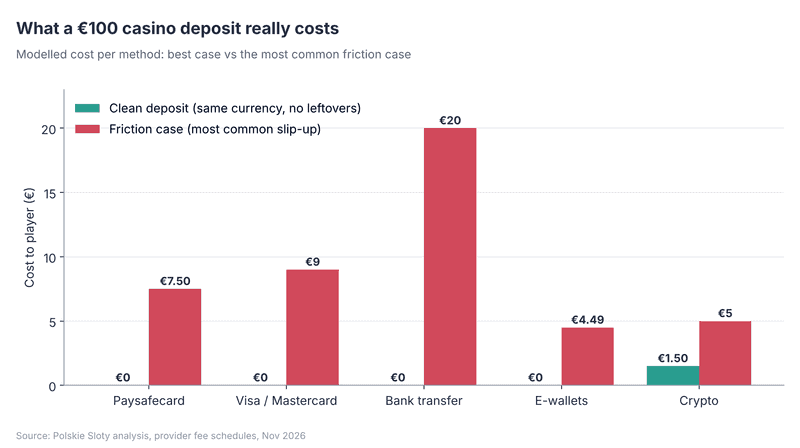
To put numbers on it, the analysts at Polskie Sloty, who review online casinos that accept Paysafecard and other payment options for Polish players, modelled a single €100 deposit across five common methods. Each was tested twice:
A clean deposit (same currency, domestic rails, no leftover balance) and a friction case (the most common slip-up for that method). Fees come from providers’ published schedules and regulator data as of November 2026.
1. Paysafecard: Free to Deposit, Costly to Forget
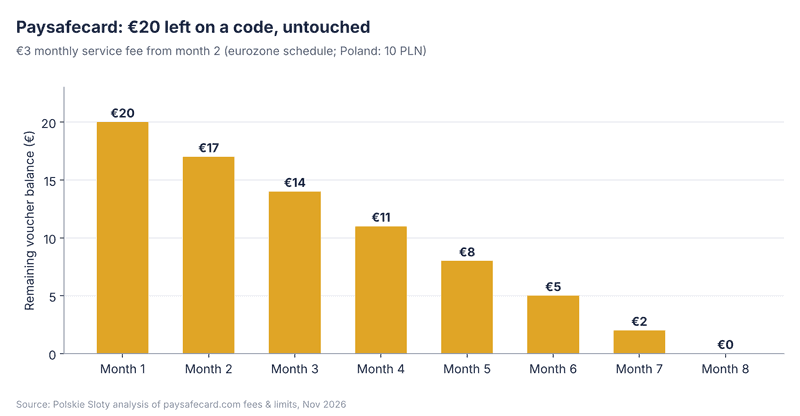
Paysafecard never touches your bank account. You buy a 16-digit voucher and redeem it at the cashier, so no card details are shared and spending is capped in advance. The deposit itself is free. The cost sits in the leftovers.
Under Paysafecard’s published schedule for Poland, a code with unused credit loses 10 PLN a month from its second month, each refund costs 20 PLN, and a myPaysafe account idle for 12 months pays 20 PLN monthly.
Eurozone equivalents are €3, €7.50 and €5.
The All-in-One Platform for Effective SEO
Behind every successful business is a strong SEO campaign. But with countless optimization tools and techniques out there to choose from, it can be hard to know where to start. Well, fear no more, cause I've got just the thing to help. Presenting the Ranktracker all-in-one platform for effective SEO
We have finally opened registration to Ranktracker absolutely free!
Create a free accountOr Sign in using your credentials
An unregistered payment is capped at 200 PLN (usually €50 elsewhere), so a €100 deposit needs two codes or an account. Vouchers also can’t be used for withdrawals.
“Paysafecard is the cheapest way to deposit if you spend the whole voucher in one go. When reviewing the corresponding platforms for our rating at https://pl.polskiesloty.com/kasyno-online-paysafecard/, we see that fees only appear when money sits idle, so buy the exact amount or register the code to a myPaysafe account straight away.” – Leon Gorski, iGaming expert at Polskie Sloty
2. Visa and Mastercard: Cheap on Debit, Expensive on Credit
Cards are accepted almost everywhere, and a debit deposit in your home currency is usually free. Two things change that. If the casino charges in another currency, issuers typically add a 1–3% foreign transaction fee.
Credit cards add a bigger problem.
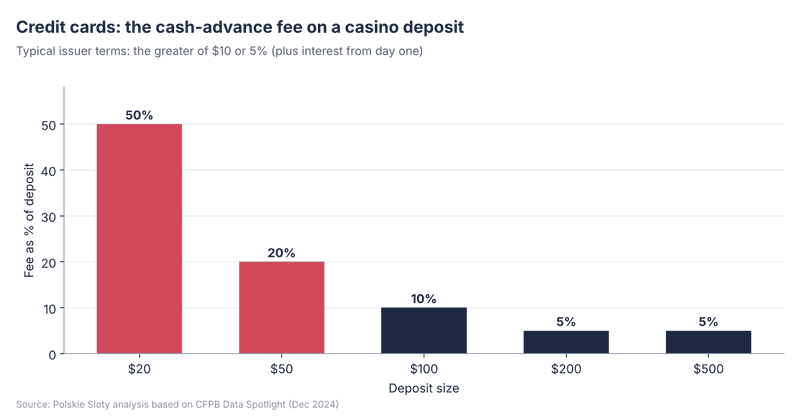
The US Consumer Financial Protection Bureau found that most major issuers treat gambling as cash advances, often charging the greater of $10 or 5%, with interest from day one. In 2022, issuers collected $717 million in cash-advance fees on $3.6 billion of volume, about $1 for every $19. The UK has banned credit cards for gambling since April 2020.
The All-in-One Platform for Effective SEO
Behind every successful business is a strong SEO campaign. But with countless optimization tools and techniques out there to choose from, it can be hard to know where to start. Well, fear no more, cause I've got just the thing to help. Presenting the Ranktracker all-in-one platform for effective SEO
We have finally opened registration to Ranktracker absolutely free!
Create a free accountOr Sign in using your credentials
“The flat minimum is what catches people. On a $20 deposit, a $10 cash-advance fee is a 50% charge before the first spin. Use a debit card in your home currency.” – Leon Gorski
3. Bank Transfers and Open Banking: The Rail Decides the Price
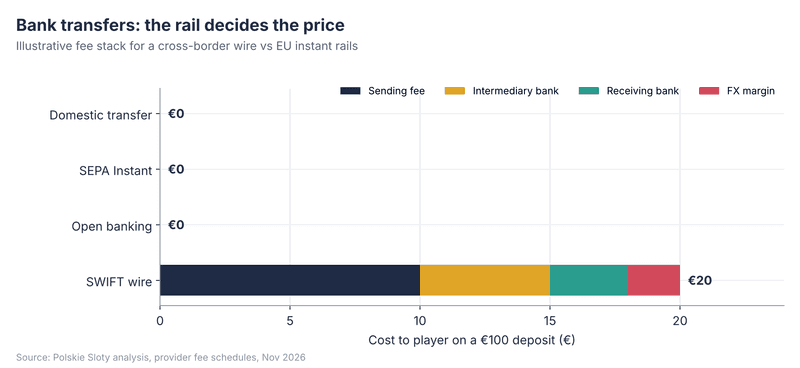
Under the EU Instant Payments Regulation, banks have had to price instant euro transfers no higher than standard ones since 2025, and most domestic transfers are free within a banking package.
Open banking providers such as Trustly go further: the player approves the payment in their banking app and the provider bills the casino, not the player.
International SWIFT wires are the outlier. Sending fees, intermediary-bank deductions, receiving charges and an exchange-rate margin stack up. Polskie Sloty’s model uses a conservative €20, a fifth of the deposit.
“Open banking is quietly becoming the default in regulated European markets. It is free for the player, fast, and doubles as a withdrawal route.” – Leon Gorski
4. E-Wallets: Fast, but Currency Mismatch Costs Twice
Skrill and Neteller remain casino staples because they keep card details off the casino site and process withdrawals quickly. Paying from a wallet balance is usually free; converting currency is not.
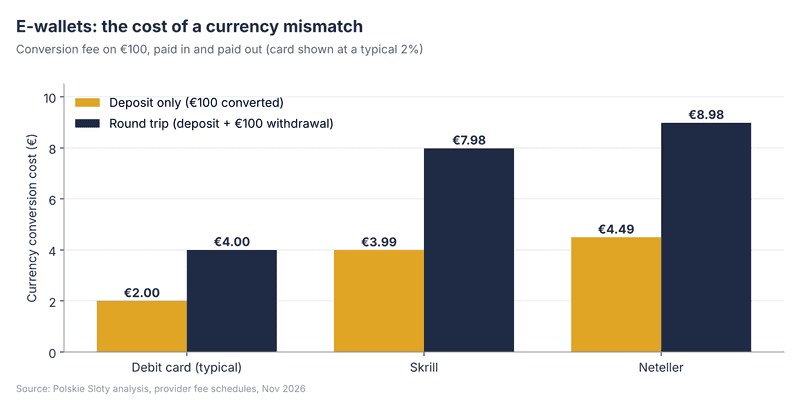
Skrill’s foreign exchange fee is 3.99%, Neteller’s is 4.49%, both on top of the wholesale rate. Skrill also charges €5 a month if an account goes six months without a login or transaction.
A player with a PLN wallet depositing €100 at a euro casino pays €3.99–€4.49 going in, and roughly the same converting winnings back.
“E-wallets punish currency mismatch twice, once going in and once coming out. Open the wallet in the same currency the casino uses and the conversion fee simply disappears.” – Leon Gorski
5. Cryptocurrency: Low Network Fees, Hidden On-Ramp Costs
Crypto has moved from a checkbox to core infrastructure:
Cyber Gear’s Top iGaming Trends to Watch in 2026 report lists crypto, Web3 and next-generation payments among the eight trends shaping the industry, noting that fast-growing platforms now build around crypto wallets offering instant deposits and withdrawals. It also notes that payments have become a compliance frontline, with full traceability of player funds now expected.
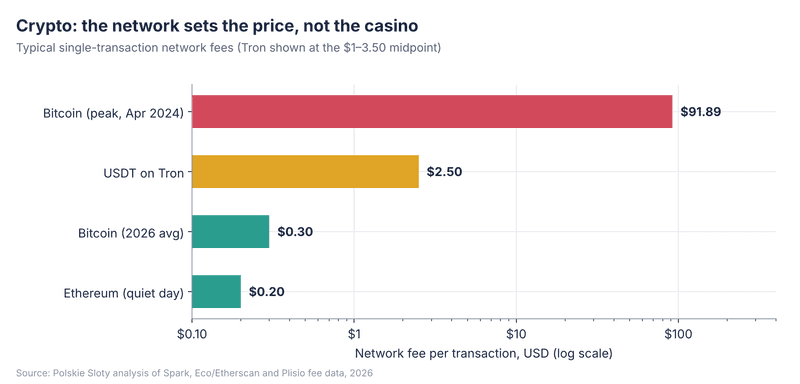
Fees depend on the network, not the casino.
Bitcoin’s average fee has hovered around $0.30 in 2026, yet it hit $91.89 on 20 April 2024, when the halving coincided with the Runes launch. USDT on Tron typically costs $1–3.50 per transfer, while Ethereum ranges from cents to several dollars. Exchanges add spreads and withdrawal charges.
The All-in-One Platform for Effective SEO
Behind every successful business is a strong SEO campaign. But with countless optimization tools and techniques out there to choose from, it can be hard to know where to start. Well, fear no more, cause I've got just the thing to help. Presenting the Ranktracker all-in-one platform for effective SEO
We have finally opened registration to Ranktracker absolutely free!
Create a free accountOr Sign in using your credentials
Two risks have no fee schedule:
Sending on the wrong network can lose the whole amount, and confirmed transactions cannot be reversed.
“The network fee is rarely the problem anymore; the on-ramp is. A stablecoin on a low-fee network, sent from a wallet you control, was the cheapest crypto route we measured.” – Leon Gorski
Five Deposit Methods at a Glance
| Method | Clean €100 deposit | Friction case | Main hidden cost | Withdrawals |
| Paysafecard | €0 | €7.50 | Idle-balance and refund fees | No |
| Visa / Mastercard | €0 | €9+ | FX fee; credit cash advance | Usually (debit) |
| Bank transfer / open banking | €0 | €20 | SWIFT fee stack | Yes |
| E-wallets | €0 | €4.49 | FX fee of 3.99–4.49% | Yes, fast |
| Crypto | ≈€1.50 | ≈€5 (up to €100 on wrong network) | Exchange spread, network fees | Yes |
Table 1. Polskie Sloty model, November 2026.
Key Takeaways
- “Free” only covers the casino. The real cost sits with your bank, wallet or exchange.
- Currency match beats method choice. A currency mismatch is the biggest cost driver for cards, e-wallets and bank wires.
- Avoid credit cards. Cash-advance minimums make small deposits the priciest in the study.
- Spend vouchers in full. Paysafecard is free until a balance sits idle for a month.
- Open banking is the most consistently free option and also works for withdrawals.
- In crypto, pick the network before the coin. Exchange spreads and wrong-network errors cost more than blockchain fees.
Whichever method you choose, set a deposit limit before you play.