Intro
Picture yourself scrolling through a dozen online casino options on a Friday evening. You've got money to spend, games to play, and absolutely zero patience for a platform that might waste your time or, worse, compromise your funds. What do you do? You check the reviews. You glance at the star ratings. And within minutes, you've narrowed your list to two or three contenders. That instinct - trusting other people's experiences before committing your own cash - is the single biggest force shaping how players pick their casino today. Let's break down exactly why and how reviews and ratings hold so much sway over these decisions.
The Psychology Behind Trusting Strangers' Opinions
Why We Lean on Social Proof
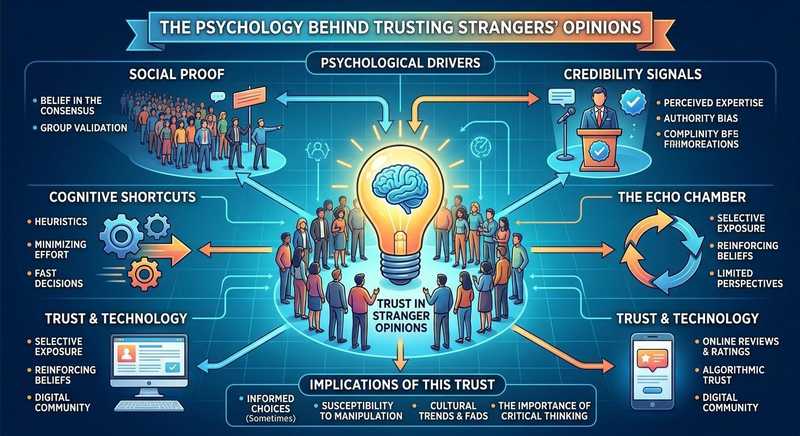
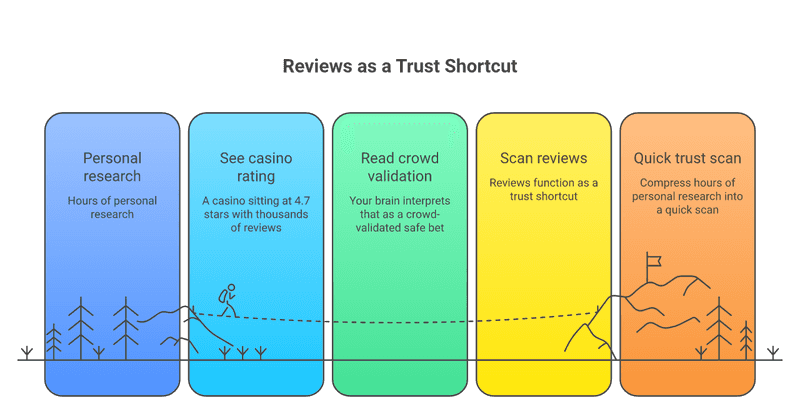
Humans are social creatures, and that wiring doesn't switch off when we open a browser. When you see a casino sitting at 4.7 stars with thousands of reviews, your brain interprets that as a crowd-validated safe bet. Interestingly, this effect goes deeper than simple laziness or herd mentality. Reviews function as a trust shortcut - a way to compress hours of personal research into a quick scan. According to findings from multiple 2026 review platforms including Sports Line and Casino.org, players cross-reference ratings with specific quality signals like payout speed, licensing credentials, and bonus generosity before they ever create an account. High ratings alone are necessary but not sufficient; players want the score backed up by details they personally care about.
There's a fascinating wrinkle here, though. Research from Medial's Spiegel Research Center at Northwestern University, updated in 2026, confirms that purchase likelihood actually peaks in the 4.2 to 4.7-star range rather than at a perfect 5.0. Why? Because a flawless score triggers skepticism. Players start wondering whether those reviews are curated, bought, or simply too good to be true. A casino sitting at 4.5 stars with a handful of honest complaints about slow email support actually feels more credible than one boasting an unblemished five. As Forbes explains, this counterintuitive finding has real consequences for how operators manage their public image - and it extends to how players evaluate everything from trust scores to pages listing the best casino bonuses, where overly perfect claims can undermine credibility just as easily as a suspiciously flawless star rating.
Different Players, Different Priorities
Not everyone reads reviews the same way. A 2026 report from Polling.com on how game reviews influence player choices found that demographics, prior familiarity with review platforms, and individual priorities all shape how much weight a rating carries. Some players zero in on fairness and RNG transparency. Others care most about bonus structures or mobile app performance. A safety-conscious first-timer might spend twenty minutes reading about licensing and encryption, while a seasoned slot enthusiast skips straight to the game library section. As research published on ResearchGate confirms, the same review document can mean entirely different things to different readers, because each person extracts a completely different story from it based on their individual purchasing priorities.
This is precisely why structured, multicategory rating systems have become the standard across major review sites. When a platform breaks its score into seven distinct pillars, it lets every type of player find the information that matters most to them without wading through irrelevant content. The review adapts to the reader, even if the words on the page stay fixed.
How Modern Rating Systems Actually Work
The Seven-Pillar Framework
Gone are the days when a single star rating told the whole story. Both Casino.org and CasinoReviews.net now evaluate casinos across seven structured categories. CasinoReviews.net, for example, uses what they call a "player-first" methodology covering trust and safety, game selection and quality, bonuses and promotions, payment experience, user experience, customer support, and responsible gambling. Casino.org mirrors this approach with its own seven-category system that includes security and licensing, bonuses, game variety, payment methods, and support.
Why does this granularity matter? Because it lets you compare apples to apples. Maybe Casino A scores a 9 out of 10 for bonuses but only a 6 for customer support, while Casino B sits at 7.5 across the board. Depending on your priorities, either one could be the better pick. This multi-pillar approach also forces review sites to justify their overall score with evidence in each category, which makes the entire process more transparent. Players are not just trusting a number anymore - they're trusting a breakdown they can interrogate.
Here are the key factors that shape how reviews and ratings drive casino selection in 2026:
- Trust and licensing verification ranks as the foundational category across all major review platforms, serving as a non-negotiable baseline before other factors even enter the conversation
- The 4.2 to 4.7 star sweet spot outperforms perfect 5.0 scores for sign-up likelihood, according to Medial/Spiegel research updated in 2026
- Casino Guru has rated over 8,500 casinos, and the sheer volume of that database functions as its own trust signal - players equate breadth of coverage with reliability
- Casino Alpha reports that 35% of reviewed casinos now show expert and user ratings within plus or minus 0.2 of each other, suggesting growing consensus between professional assessors and everyday players
- Bet MGM holds a trust score of approximately 8.6 to 9.0 out of 10 on Action Network's 2026 rankings, placing it at the top of multiple editorial lists
- App store ratings have emerged as a parallel decision input - FanDuel sits at 4.8 on the App Store and 4.5 on Google Play, while bet365 trails at 4.3 and 3.7 respectively
- Responsible gambling is now a scored category in at least two major 2026 rating systems, meaning player safety credentials directly influence which casinos earn top marks
Expert Scores vs. Player Scores - Are They Converging?
One of the most telling developments this year is the narrowing gap between what professional reviewers say and what actual players report. Casino Alpha's 2026 data shows that 35% of reviewed casinos have expert and user ratings within 0.2 points of each other. That alignment didn't happen by accident. As detailed by European Gaming, review sites have refined their criteria to better reflect what players genuinely experience, and players themselves have become more sophisticated evaluators thanks to years of exposure to detailed review content.
This convergence matters because it strengthens the credibility of the review ecosystem as a whole. When an expert gives a casino an 8.5 and the user community average sits at 8.4, there's very little room for a player to argue the system is rigged or biased. Certainly, disagreements still exist - a professional reviewer might weigh regulatory compliance more heavily than a casual player who just wants fast withdrawals. But the overall trend points toward a shared understanding of what "good" looks like.
The Real-World Impact on Casino Brand Competition
Top-10 Lists and Brand Consolidation
Here's something that doesn't get discussed enough: reviews and ratings are actively consolidating the online casino market. Look at the October 2026 top-ten lists published by USA Today's List Wire and Action Network. The same names appear repeatedly - Bet MGM, FanDuel, DraftKings, Caesars, bet365, Fanatics. These brands already have strong recognition, generous marketing budgets, and solid operational track records. When review sites rank them at the top, it reinforces their dominance and makes it exponentially harder for smaller operators to break through.
The All-in-One Platform for Effective SEO
Behind every successful business is a strong SEO campaign. But with countless optimization tools and techniques out there to choose from, it can be hard to know where to start. Well, fear no more, cause I've got just the thing to help. Presenting the Ranktracker all-in-one platform for effective SEO
We have finally opened registration to Ranktracker absolutely free!
Create a free accountOr Sign in using your credentials
The table below illustrates how app store ratings and editorial trust scores cluster around a small group of major operators:
| Casino Brand | App Store Rating | Google Play Rating | Action Network Trust Score |
| Bet MGM | High | High | ~8.6-9.0/10 |
| FanDuel | 4.8 | 4.5 | Top tier |
| DraftKings | High | High | Top tier |
| bet365 | 4.3 | 3.7 | High |
| Caesars | High | High | Top tier |
For a newer casino trying to gain traction, the challenge is enormous. Casino Guru's database of 8,500 plus rated casinos means there's no shortage of options for players to consider. But when every editorial list features the same five or six brands at the top, the practical effect is that reviews function as a reinforcing loop. High ratings lead to more visibility, which leads to more players, which generates more positive reviews, which keeps the rating high. Breaking into that cycle requires either a genuinely innovative product or a marketing spend that most startups simply cannot afford.
App Store Ratings as the New Battleground
Something that shifted noticeably by 2026 is how seriously operators take their public app store scores. Sports Line now includes iOS and Google Play ratings directly in its casino comparison tables, treating them as decision-relevant data points alongside expert evaluations. FanDuel's 4.8 on the App Store isn't just a vanity metric - it's a conversion tool. Players browsing the App Store see that number before they ever visit a review site, and it shapes their first impression.
Meanwhile, bet365's 3.7 on Google Play tells a different story. Even though bet365 is one of the world's most established gambling brands, a sub-4.0 rating on a major app marketplace creates friction. Potential players might hesitate, wonder what's wrong, and keep scrolling. Operators now have to manage their reputation across two distinct channels - expert review sites and public app stores - simultaneously. That's a fundamentally different challenge than it was even two years ago, and it means customer experience at the app level has become just as important as the desktop platform.
Responsible Gambling and the Changing Review Landscape
Safety as a Scored Metric
One of the most encouraging trends this year is the explicit inclusion of responsible gambling as a scored category in mainstream rating systems. CasinoReviews.net includes it as one of its seven pillars, and Casino.org evaluates security and licensing as a core criterion. This means that casinos offering robust self-exclusion tools, deposit limits, and transparent responsible gambling policies can actually earn higher review scores because of those features. That's a meaningful shift, because it aligns commercial incentives with player protection.
For you as a player, this development is genuinely positive. It means the review sites you rely on are not just evaluating how fun or profitable a casino is - they're also asking whether it takes care of you when things go sideways. A casino that scores well on responsible gambling is signaling that it views its relationship with players as long-term, not extractive. And review sites that score this category are telling you they take your wellbeing seriously, not just your entertainment.
What This Means Going Forward
The embedding of compliance and safety into consumer-facing scores suggests a future where the best-rated casinos are also, by definition, the most responsible ones. Review platforms are effectively creating a market incentive for good behavior. Operators who invest in player protection tools won't just avoid regulatory trouble - they'll earn higher scores, better placement on top-ten lists, and ultimately more players. Indeed, this is the kind of virtuous cycle the industry desperately needs.
Beyond responsible gambling, the broader trajectory is clear. As academic research on online review impact consistently demonstrates, reviews and ratings are becoming more granular, more data-driven, and more influential with every passing year. Players are getting smarter about how they use this information, and review platforms are responding with more sophisticated methodologies. The question is no longer whether reviews influence casino choice - that's been settled. The real question is how much power you're willing to hand over to a rating system, and whether you're taking the time to look beneath the headline score.
So next time you're choosing an online casino, don't just glance at the star count. Dig into the category breakdowns. Compare expert opinions with player feedback. Check the app store scores. And pay attention to whether that platform is actually investing in your safety. The reviews are there to help you - but only if you use them properly.