
Intro
There is a specific irony in how many crypto traders approach technical analysis. They reach for the most complex indicators available - on-chain metrics, funding rates, order flow heatmaps - while skipping the foundation that makes all of it interpretable. Price action is that foundation, and in crypto it matters more than in almost any other market.
The reason is simple: crypto trades 24 hours a day, seven days a week, across hundreds of venues simultaneously, with a participant mix ranging from retail speculators to quantitative funds to long-term believers who haven't touched their positions in years. In that environment, the raw price record - the actual sequence of opens, closes, highs, and lows - contains more immediately actionable information than any derived indicator. Indicators show you what price has done, processed through a formula. Price action shows you what price is doing, directly.
This article covers the core concepts a crypto trader needs to read price action competently: what candlesticks actually communicate, how support and resistance work in volatile markets, what trend structure looks like, and how to put it together into a coherent reading of the market.
Candlesticks: Reading Each Bar Correctly
Every candlestick is a four-variable summary of a time period: open, high, low, and close. The relationship between these four numbers tells a precise story about who controlled the period and how convincingly.
The body of the candle - the filled rectangle - shows the distance between open and close. A large green body means price opened low and closed high, with buyers in control for the entire period. A large red body means the opposite. A small body, regardless of color, means the period ended near where it started - neither side won decisively.
The wicks - the thin lines extending above and below the body - show where price tested but failed to hold. A long upper wick on a green candle means buyers pushed price up aggressively during the period, but sellers pushed it back down before the close. In a strong uptrend, upper wicks are short - buyers are holding their gains. Consistent long upper wicks in an uptrend are a warning that sellers are becoming more active at those levels.
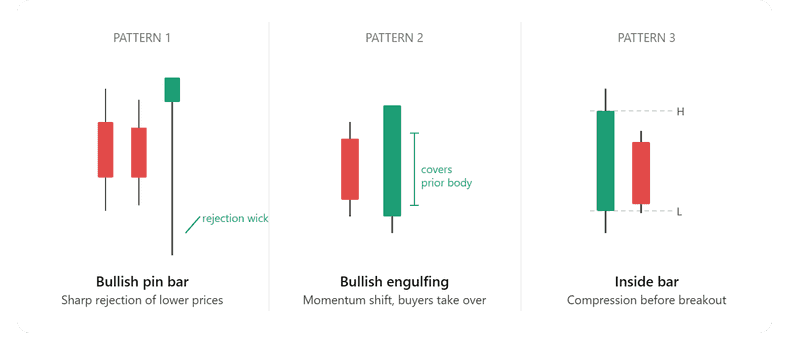
A few individual candle patterns carry enough weight to trade around:
The All-in-One Platform for Effective SEO
Behind every successful business is a strong SEO campaign. But with countless optimization tools and techniques out there to choose from, it can be hard to know where to start. Well, fear no more, cause I've got just the thing to help. Presenting the Ranktracker all-in-one platform for effective SEO
We have finally opened registration to Ranktracker absolutely free!
Create a free accountOr Sign in using your credentials
The pin bar - a candle with a very long wick in one direction and a small body at the opposite end - represents a sharp rejection. A bullish pin bar has a long lower wick: price was pushed down aggressively, then buyers overwhelmed the move and closed price near the high. In the context of a support level, a bullish pin bar is a high-probability reversal signal. A bearish pin bar at resistance works the same way in reverse.
The engulfing candle occurs when a candle's body completely covers the body of the previous candle. A bullish engulfing at a swing low - a large green candle consuming the previous red candle entirely - signals a shift in momentum. The larger the engulfing candle relative to what it covers, the more significant the signal.
The inside bar is a candle whose high and low are both contained within the previous candle's range. It represents compression and indecision - the market is pausing after a strong move. A breakout from an inside bar, particularly on higher-than-average volume, often starts a directional move.
Support and Resistance in Crypto Markets
Support and resistance are the levels where price has repeatedly stopped and reversed. In theory, simple. In practice, crypto adds several complications that most textbook descriptions miss.
In traditional markets, support and resistance levels often hold cleanly because the participant base is relatively consistent. In crypto, the participant mix shifts dramatically with market conditions - retail traders pile in during bull markets and vanish in bear markets, replaced by different types of participants with different cost bases and different reactions to the same price levels. This means crypto support and resistance levels are less precise and more zone-like than in, say, forex majors.
The most reliable levels in crypto are round numbers, previous all-time highs, and levels where price spent a significant amount of time consolidating. The psychological power of round numbers - $50,000 for Bitcoin, $3,000 for Ethereum - is disproportionate to any technical significance they have, simply because a large number of traders and investors place orders at those levels.
Previous all-time highs deserve particular attention because they represent the price at which every holder who bought near the top is now at break-even. That creates a specific dynamic: when price returns to a previous ATH from below, sellers who bought at the high and have been holding through a long drawdown will often sell on the first opportunity to recover their losses. This creates resistance. Once price breaks and holds above the ATH, that same level frequently flips to support - the "flip" that traders reference is a real and consistently observable phenomenon.
Trend Structure and What It Actually Means
Understanding whether a market is trending and in which direction is more consequential than any individual trade setup. Most losses in trading come not from poor entries but from trading in the wrong direction - taking long positions in a downtrend because a local setup looked attractive.
The All-in-One Platform for Effective SEO
Behind every successful business is a strong SEO campaign. But with countless optimization tools and techniques out there to choose from, it can be hard to know where to start. Well, fear no more, cause I've got just the thing to help. Presenting the Ranktracker all-in-one platform for effective SEO
We have finally opened registration to Ranktracker absolutely free!
Create a free accountOr Sign in using your credentials
Trend structure in price action terms means the sequence of swing highs and swing lows. An uptrend is defined by higher highs and higher lows: each rally exceeds the previous rally's peak, and each pullback holds above the previous pullback's trough. A downtrend is the inverse: lower highs and lower lows, with each rally failing below the previous rally's peak and each decline undercutting the previous low.
The structural break is the earliest signal of trend change available. When an uptrend produces a lower high for the first time - a rally that fails to exceed the previous peak - the trend is weakening. If price then breaks below the most recent higher low, the uptrend structure is broken. That sequence, a lower high followed by a break of the previous higher low, is a stronger and earlier signal than any moving average crossover or indicator divergence. This guide covers trend structure in detail if you want to go deeper on highs and lows specifically.
The practical implication: in an uptrend, look for long entries at higher lows. In a downtrend, look for short entries at lower highs. Don't fight the structure.
How Volume Fits Into Price Action
Volume is the one indicator that price action traders universally keep on their charts, because it is not derived from price - it is independent data that either confirms or questions what price is doing.
The core principle: price moves on volume that reflects conviction. A strong rally on expanding volume means a large number of participants are buying aggressively - genuine demand. The same rally on thin volume might just be a low-liquidity drift that reverses the moment real sellers show up.
In crypto, volume carries specific characteristics worth understanding. Crypto volume spikes dramatically around exchange listings, protocol announcements, regulatory news, and macroeconomic events. A volume spike that accompanies a breakout above resistance is meaningful. A volume spike caused by a specific news event needs to be interpreted differently - the question is whether the move creates a new equilibrium or whether price will revert once the initial reaction fades.
The most actionable volume signal for discretionary traders is divergence: price making new highs while volume trends lower. This pattern shows that the rally is becoming less broad-based, fewer participants are willing to chase price at these levels, and the move is increasingly fragile. It doesn't tell you when the reversal happens, but it tells you the rally is running on fumes.
Putting It Together: Reading a Crypto Chart
Reading price action is not a checklist - it's a synthesis. The question at any moment is: what is the weight of evidence telling me about this market?
The All-in-One Platform for Effective SEO
Behind every successful business is a strong SEO campaign. But with countless optimization tools and techniques out there to choose from, it can be hard to know where to start. Well, fear no more, cause I've got just the thing to help. Presenting the Ranktracker all-in-one platform for effective SEO
We have finally opened registration to Ranktracker absolutely free!
Create a free accountOr Sign in using your credentials
Start with trend structure on the higher timeframe - daily or weekly for swing trading, hourly for shorter-term positions. Establish whether the market is in an uptrend, downtrend, or range. That context determines which setups are high-probability and which are fighting the flow.
Move to the trading timeframe and identify the nearest significant support and resistance levels. These are the areas where price is most likely to pause, reverse, or accelerate. Note whether price is approaching a level or just left one.
Finally, look for individual candle signals that confirm the bias. A bullish pin bar at support in an uptrend, on above-average volume, with a higher low in place on the daily chart - that is a confluence of three independent signals pointing in the same direction. A pin bar in isolation, against the trend, at an unclear level, is noise.
Conclusion
Price action is not the easiest approach to trading and it is certainly not the fastest to learn. It requires screen time, pattern recognition built through repetition, and the discipline to wait for high-probability setups rather than manufacturing reasons to trade. In crypto, where volatility creates both exceptional opportunities and exceptional dangers, that discipline is worth more than any edge a complex indicator might theoretically provide.
The basics covered here - candlestick structure, support and resistance, trend identification, and volume confirmation - are not the starting point before the real trading begins. For many consistently profitable traders, they are the entire toolkit. Start with these, apply them rigorously, and only add complexity when you can clearly articulate what a new tool adds that the fundamentals don't already cover.

