Intro
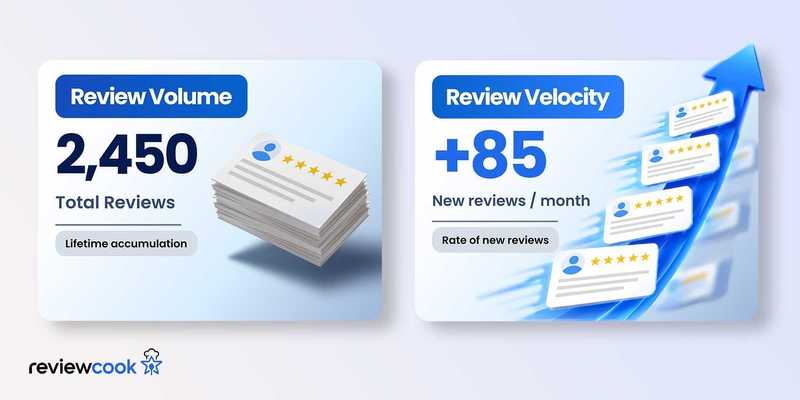
Review volume and review velocity do different jobs. Volume helps businesses build credibility and can support Google rankings because Google confirms review count as a local ranking factor.
Velocity keeps reviews recent, helping potential customers judge whether a business is still delivering a good experience.
For local businesses, volume matters more for rankings and establishing credibility, while velocity matters more for winning customers. The right strategy is to build a substantial review history while continuing to earn genuine feedback.
Quick Answer
- Google rankings: Google confirms that review count and positive ratings can help improve local search rankings.
- Review recency: BrightLocal’s 2026 survey found that 32% of customers look for reviews from the past two weeks.
- Customer trust: 47% of surveyed US consumers would not use a business with fewer than 20 reviews.
- What businesses should do: Ask customers for honest feedback at appropriate moments, make leaving reviews convenient, and compare monthly review counts with local competitors.
What is review velocity?
Review velocity measures how frequently a business receives new customer reviews over a specific period, such as a week or a month. It helps businesses understand whether customer feedback arrives consistently or in occasional bursts.
For example, two restaurants may each receive 20 new reviews in a month. One earns reviews steadily throughout the month, while the other receives most of them in a single burst, then goes three weeks without a new review.
Although their monthly review volume is the same, the second restaurant has less recent feedback for potential customers to consider.
The All-in-One Platform for Effective SEO
Behind every successful business is a strong SEO campaign. But with countless optimization tools and techniques out there to choose from, it can be hard to know where to start. Well, fear no more, cause I've got just the thing to help. Presenting the Ranktracker all-in-one platform for effective SEO
We have finally opened registration to Ranktracker absolutely free!
Create a free accountOr Sign in using your credentials
Velocity can change with customer demand, seasonal trends, and industry. A temporary decline in reviews does not necessarily indicate a problem, but prolonged inactivity may signal that the business needs to reassess its review request process.
What is review volume?
Review volume refers to the total number of customer reviews a business has accumulated on a platform such as Google. It gives potential customers a broader collection of feedback to examine when comparing businesses.
For example, a business with 250 Google reviews has a higher review volume than a competitor with only 60. However, a larger review count does not automatically mean better service or greater customer satisfaction.
Review volume can also help establish credibility. BrightLocal’s 2026 Local Consumer Review Survey found that 47% of consumers would not use a business with fewer than 20 reviews. While this is not a universal requirement, it shows why having a substantial review history can help build customer confidence.
Review velocity vs. review volume: what’s the difference?
The difference between review velocity and review volume comes down to timing versus quantity. Review velocity measures the pace of incoming feedback, while review volume measures how many reviews exist.
| Comparison | Review velocity | Review volume |
| Measurement | Rate of incoming reviews | Total accumulated reviews |
| Time frame | A defined period | Entire review history |
| Main question | How frequently are new reviews arriving? | How many reviews have been collected? |
| Example | 12 new reviews in one month | 240 total reviews |
| Confirmed Google ranking factor? | Not confirmed as a standalone factor | Review count can help improve local rankings |
| What it signals | Recent customer activity | Review count can help improve local rankings |
A business can have high review volume but low review velocity if most of its reviews were collected a year ago. Another business may receive new reviews consistently but still have a relatively small total.
These metrics provide different insights into a business’s online reputation. Review volume helps establish credibility, while review velocity helps businesses assess how recently customers have shared their experiences.
Which matters more for local SEO?
Google identifies review count and positive ratings as factors that can help improve local search visibility. Its local ranking guidance also identifies relevance, distance, and prominence as key factors.
Collecting more reviews alone does not guarantee a higher position in search results. Businesses can monitor review counts and compare their review activity with competitors to identify opportunities for improvement.
Review count is a confirmed local ranking factor, but Google does not identify review velocity as a standalone ranking factor.
How to calculate review velocity
Calculate review velocity by dividing the number of new reviews by the period measured.
The All-in-One Platform for Effective SEO
Behind every successful business is a strong SEO campaign. But with countless optimization tools and techniques out there to choose from, it can be hard to know where to start. Well, fear no more, cause I've got just the thing to help. Presenting the Ranktracker all-in-one platform for effective SEO
We have finally opened registration to Ranktracker absolutely free!
Create a free accountOr Sign in using your credentials
Review velocity = Number of new reviews ÷ Time period
For example, if a business receives 20 new reviews in four weeks, the review velocity is five reviews per week.
Businesses can also benchmark their performance against three local competitors. Count the new reviews each competitor received over the past 90 days, calculate the average monthly rate, and compare it with the business’s own monthly review count.
This comparison helps businesses assess whether their review activity is keeping pace with competitors. However, competitor review counts are a practical benchmark, not a guaranteed target for higher Google rankings.
ReviewCook helps you monitor incoming feedback and keep track of your review activity over time.
How to improve review velocity and build review volume

Businesses can improve their review collection process by asking at appropriate moments, making the process convenient, and monitoring incoming feedback.
Make review requests part of customer follow-up
Ask customers for honest feedback after a completed service or purchase. Send requests consistently without pressuring customers to leave positive reviews.
Never offer incentives in exchange for reviews or selectively ask only satisfied customers to post publicly. Both practices can violate Google’s review policies.
Make leaving reviews convenient
Provide direct Google review links through appropriate channels, such as emails and text messages. For in-person businesses, a Google Review QR code can give customers a convenient way to access the review page and share their experiences.
Track review activity regularly
Record new reviews each month and compare the results with previous months. Benchmark your monthly review count against the average monthly count for your three main local competitors, accounting for seasonal changes and customer volume.
Respond to customer feedback
Respond professionally to positive and negative reviews without disclosing private customer information. Timely, thoughtful responses show customers that their feedback is valued and that the business takes their concerns seriously.
How a review management platform can help local businesses
A review management platform helps businesses monitor customer feedback, track review activity, and organize review collection from one place.
Depending on its features, it can support these tasks in several ways:
- Centralized review monitoring: A dashboard lets businesses check incoming feedback without visiting each platform individually.
- Review activity tracking: Review reporting tools help businesses monitor review trends and assess whether new reviews are coming in consistently.
- AI-assisted replies: Draft personalized responses more efficiently, with staff reviewing them before sending.
The right platform depends on the business’s needs. Businesses should prioritize features that address their current review management challenges.
Build a stronger review history through consistency
Review volume helps establish credibility, while review velocity helps businesses keep customer feedback current. Both metrics offer useful insights, but they serve different purposes.
Businesses should build a review history that gives potential customers enough feedback to evaluate their options. They should then focus on asking every customer for honest feedback at the right moment, making the process convenient, and tracking monthly review counts against local competitors.
ReviewCook helps businesses monitor incoming feedback through its dashboard and makes Google Review pages easier to access with branded QR codes.
Consistent review collection helps businesses maintain a credible review history while keeping customer feedback current.
Frequently asked questions
Q: What matters more, review velocity or review volume?
A: Review volume helps establish credibility and supports local SEO, while review velocity helps businesses keep feedback recent for potential customers.
Q: Does review velocity affect Google rankings?
A: Google confirms that review count and positive ratings can help improve local rankings, but it does not identify review velocity as a standalone ranking factor. Read Google’s local ranking guidance.
Q: How do you calculate review velocity? A: Divide the number of new reviews by the period measured. The formula and an example appear in the review velocity calculation section above.
Q: Is review volume more important than star ratings?
A: Both matter. Review volume provides more customer feedback to evaluate, while star ratings offer a quick indication of customer satisfaction. BrightLocal’s 2026 survey found that 68% of US consumers only use businesses with four or more stars.
Q: How many Google reviews does a business need?
A: There is no universal minimum. BrightLocal’s 2026 survey found that 47% of surveyed US consumers would not use a business with fewer than 20 reviews.
The All-in-One Platform for Effective SEO
Behind every successful business is a strong SEO campaign. But with countless optimization tools and techniques out there to choose from, it can be hard to know where to start. Well, fear no more, cause I've got just the thing to help. Presenting the Ranktracker all-in-one platform for effective SEO
We have finally opened registration to Ranktracker absolutely free!
Create a free accountOr Sign in using your credentials
Q: Do old reviews still count?
A: Older reviews contribute to a business’s review history, but recent feedback can be more relevant to potential customers evaluating its current performance.
Q: Can getting too many reviews at once hurt your business?
A: A sudden spike that does not reflect normal customer activity may appear unnatural. Focus on asking customers consistently for honest, voluntary feedback instead of trying to generate reviews in artificial bursts.