Intro
TL;DR: Keyword research for SaaS companies means identifying the search terms your ideal customers use at each stage of their buying journey — from problem-aware queries to product comparisons. Unlike e-commerce, SaaS keyword research must account for long sales cycles, technical terminology, and multiple decision-makers. Prioritize intent and funnel stage over raw search volume.
Finding the right keywords is often treated as a numbers game — chase the highest search volume, write the content, and wait for traffic. For SaaS companies, this approach rarely works. Software buyers don't search the way retail shoppers do. They research problems before they research products, compare features across multiple tools, and often involve several stakeholders before a single sign-up happens.
That's why SaaS keyword research requires a different lens. It's less about volume and more about matching content to where a buyer actually is in their journey. Get this right, and you'll attract visitors who are genuinely evaluating solutions like yours. Get it wrong, and you'll rank for terms that bring traffic but never convert.
This guide breaks down how to approach keyword research specifically for SaaS businesses — covering the frameworks, tools, and decision criteria that separate traffic-focused SEO from pipeline-focused SEO.
Why Does SaaS Keyword Research Differ From Traditional SEO?
Traditional e-commerce SEO often optimizes for transactional intent — someone searching "buy running shoes" is close to purchasing. SaaS buying journeys are longer and more layered. A prospect might search "how to reduce customer churn" months before they ever type "best customer success software."
This means SaaS companies need to map keywords not just by topic, but by funnel stage: awareness, consideration, and decision. A keyword strategy that only targets bottom-of-funnel terms like "[competitor] alternative" will miss the much larger pool of prospects still defining their problem. A strategy that only targets top-of-funnel educational terms will generate traffic that never converts.
The strongest SaaS keyword strategies build content for all three stages, with each piece designed to move a reader one step closer to a decision.
How Do You Map Keywords To The Saas Buyer Journey?
Mapping keywords to the buyer journey starts with understanding what a prospect is trying to accomplish at each stage, not just what words they're typing.
The All-in-One Platform for Effective SEO
Behind every successful business is a strong SEO campaign. But with countless optimization tools and techniques out there to choose from, it can be hard to know where to start. Well, fear no more, cause I've got just the thing to help. Presenting the Ranktracker all-in-one platform for effective SEO
We have finally opened registration to Ranktracker absolutely free!
Create a free accountOr Sign in using your credentials
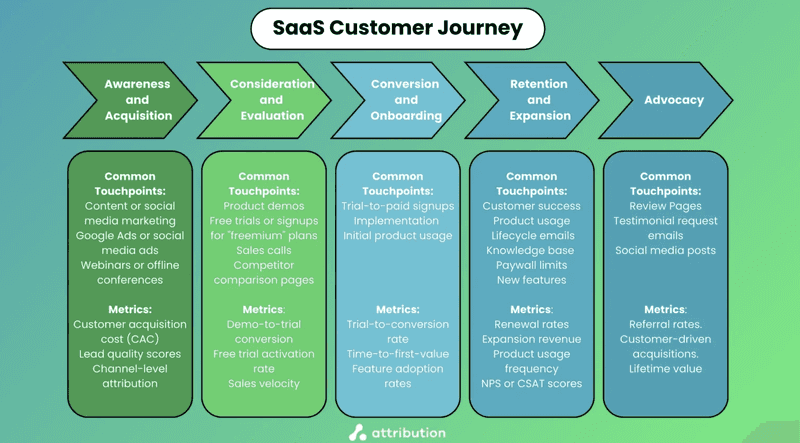
Awareness stage: problem-aware searches
At this stage, prospects know they have a challenge but haven't identified software as the solution. Searches look like:
- "why is customer churn increasing"
- "how to manage remote team projects"
- "signs you need better email deliverability"
Content here should educate, not pitch. A blog post targeting "how to reduce customer churn" can mention your product as one solution among several, but the primary goal is to establish expertise and capture the reader's attention early.
Consideration stage: solution-aware searches
Here, prospects know software can solve their problem and are researching categories or approaches. Examples include:
- "best project management tools for remote teams"
- "customer success platform vs spreadsheet"
- "how does email deliverability software work"
This is where comparison content, "best of" roundups, and category-defining guides perform well. These searches have higher commercial intent than awareness-stage queries but still leave room for multiple vendors.
Decision stage: product-aware searches
At this point, prospects are evaluating specific tools. Keywords include:
- "[your product] vs [competitor]"
- "[competitor] alternative"
- "[your product] pricing"
- "[your product] reviews"
These keywords have the lowest search volume but the highest conversion potential. A dedicated comparison page targeting "[Competitor] alternative" will almost always outperform a broad educational post in terms of lead quality, even if it ranks for far fewer total searches.
Choose awareness-stage content if your priority is building brand authority and top-of-funnel traffic. Choose decision-stage content if your priority is short-term pipeline and conversions. Most SaaS companies need a blend of both, weighted according to how mature their brand already is in the market.
What Tools Should Saas Companies Use For Keyword Research?
Several tools are commonly used for keyword discovery and analysis, each suited to different parts of the process:
RevPages
RevPages is an AI-powered keyword research tool built specifically for SaaS companies. It identifies commercial keywords, forecasts their potential revenue and prioritises the best opportunities.
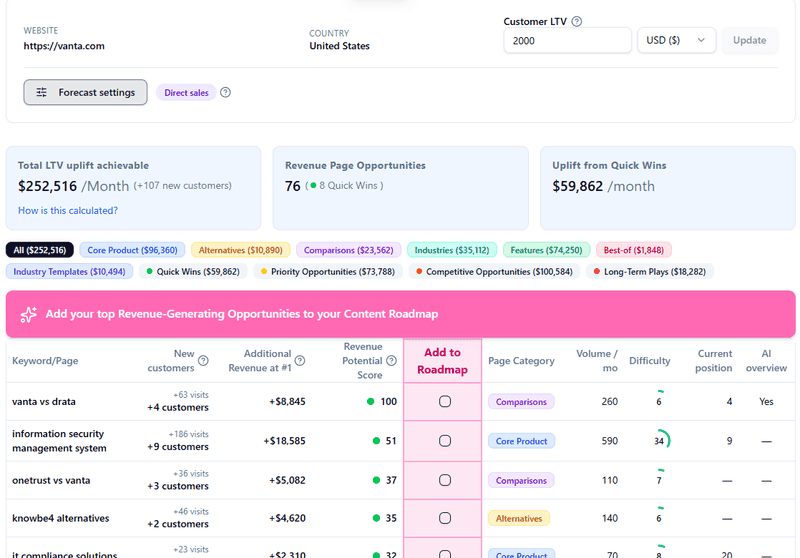
Simply enter your company’s website and average customer lifetime value, and RevPages:
- Identifies buying keywords: Analyses your website to find a focused list of commercial keywords across common bottom-of-funnel categories, including competitor alternatives, product features and industries served.
- Retrieves search data: Finds each keyword’s monthly search volume, ranking difficulty and your website’s current position.
- Forecasts customers and revenue: Estimates how many new customers and how much additional revenue your business could generate by achieving higher rankings for each keyword.
- Prioritises opportunities: Scores each keyword using its revenue potential and ranking difficulty, helping you focus on the opportunities most likely to generate meaningful sales sooner.
Other useful tools
- Ahrefs and Semrush: Useful for competitor keyword gap analysis — seeing which terms competitors rank for that you don't.
- Google Keyword Planner: Provides baseline search volume data, though SaaS-specific terms can be underreported due to lower overall search volume compared to consumer categories.
- AnswerThePublic or AlsoAsked: Surface question-based keywords, which are especially valuable for awareness-stage content and FAQ sections.
- Google Search Console: Reveals which queries your existing content already ranks for, often uncovering keyword opportunities you didn't intentionally target.
No single tool tells the whole story. Combining competitor analysis with your own Search Console data typically produces the most accurate picture of where your content gaps actually are.
How Do You Find Low-Competition, High-Intent Saas Keywords?
High-volume keywords are usually the most competitive, dominated by established companies with years of domain authority. For newer or mid-sized SaaS companies, the better strategy is identifying long-tail, high-intent keywords with lower competition.
A few tactics help surface these opportunities:
The All-in-One Platform for Effective SEO
Behind every successful business is a strong SEO campaign. But with countless optimization tools and techniques out there to choose from, it can be hard to know where to start. Well, fear no more, cause I've got just the thing to help. Presenting the Ranktracker all-in-one platform for effective SEO
We have finally opened registration to Ranktracker absolutely free!
Create a free accountOr Sign in using your credentials
Target feature-specific searches. Instead of competing for "project management software," a tool with a strong time-tracking feature might target "project management software with built-in time tracking" — a far more specific, less competitive query that still attracts relevant buyers.
Build comparison and alternative pages. Searches like "[Competitor] alternative" or "[Competitor] vs [Competitor]" tend to have lower search volume but extremely high purchase intent, since the searcher is already evaluating software options.
Target integration-based keywords. Terms like "[Your tool] Slack integration" or "best CRM for Shopify" combine lower competition with strong buyer intent, especially for companies with strategic partnerships.
Use question-based long-tail keywords. Questions like "how to automate invoice reminders" often have modest search volume individually but collectively represent a significant pool of engaged, problem-aware searchers.
How Should You Prioritize Keywords Once You've Found Them?
Not every relevant keyword deserves immediate content investment. Prioritization should weigh three factors together, not in isolation:
- Search intent alignment — Does the keyword reflect a problem or question your product actually solves?
- Competitive difficulty — Can you realistically rank for this term given your current domain authority?
- Business value — Would someone searching this term be a qualified lead, or just curious traffic?
A keyword with modest search volume but strong business value — like a competitor alternative page — often deserves priority over a high-volume, generic term that attracts unqualified visitors.
How Does Keyword Research Support Aeo And Geo For Saas Content?
As AI-generated answers and chat-based search tools become more common, keyword research needs to extend beyond traditional search engine results pages. Answer Engine Optimization (AEO) and Generative Engine Optimization (GEO) focus on how well content can be extracted and cited by AI systems like Google's AI Overviews or ChatGPT.
For SaaS companies, this means structuring content around the specific questions buyers ask — not just the keywords they type. Writing clear, self-contained answers to questions like "what is the best CRM for small businesses" increases the likelihood that an AI system will surface and cite your content directly.
Practically, this means pairing traditional keyword targets with conversational, question-based subheadings, and ensuring each section can stand alone as a direct, quotable answer.
Build A Keyword Strategy That Supports Your Entire Funnel
Effective SaaS keyword research isn't about chasing the biggest numbers — it's about understanding where your buyers are in their decision-making process and creating content that meets them there. A balanced strategy includes awareness-stage content to build authority, consideration-stage comparisons to guide evaluation, and decision-stage pages to close the gap between research and sign-up.
Start by auditing your existing content against the three funnel stages outlined above. Identify where your gaps are, then prioritize keywords that align with both searcher intent and real business value. Over time, this approach builds a content library that doesn't just drive traffic — it drives qualified pipeline.
Frequently Asked Questions
How is SaaS keyword research different from e-commerce keyword research? SaaS keyword research focuses more heavily on educational, problem-aware searches because buying cycles are longer and involve more research before purchase. E-commerce keyword research tends to prioritize transactional, purchase-ready terms since buying decisions happen faster.
The All-in-One Platform for Effective SEO
Behind every successful business is a strong SEO campaign. But with countless optimization tools and techniques out there to choose from, it can be hard to know where to start. Well, fear no more, cause I've got just the thing to help. Presenting the Ranktracker all-in-one platform for effective SEO
We have finally opened registration to Ranktracker absolutely free!
Create a free accountOr Sign in using your credentials
How much does keyword research cost for a SaaS company? Costs vary widely depending on tooling and team structure. Keyword research tools like Ahrefs or Semrush typically range from $99 to $400+ per month, while in-house or agency labor costs depend on the scope of ongoing content strategy work.
How long does it take to see results from SaaS keyword targeting? Organic content targeting competitive keywords can take three to six months to gain meaningful rankings, while long-tail, lower-competition keywords may rank faster — sometimes within four to eight weeks — depending on domain authority and content quality.
What are the risks of only targeting high-volume keywords? Focusing solely on high search volume keywords often means competing against established, high-authority competitors for terms that may not reflect strong buying intent, resulting in traffic that doesn't convert into qualified leads.
Are there alternatives to traditional keyword research tools? Yes. Google Search Console data, customer support transcripts, sales call recordings, and community forums like Reddit or industry-specific Slack groups can reveal the actual language prospects use, often surfacing keyword opportunities that standard tools miss.