
Intro
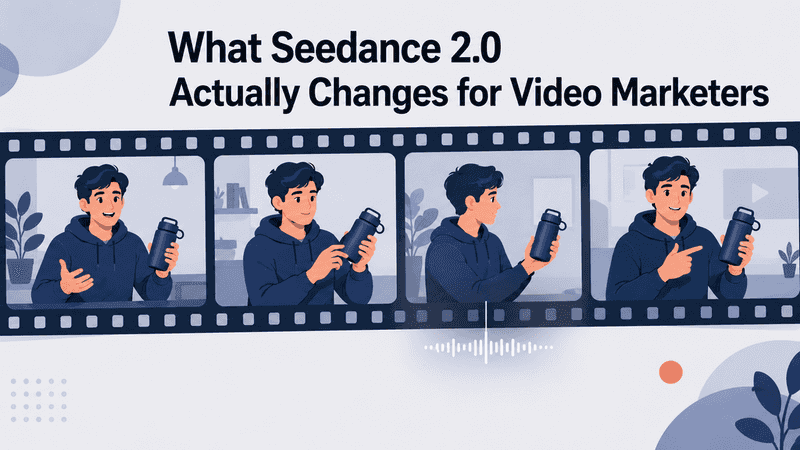
Every few months a new AI video model gets called the one that finally replaces the camera. Most of the time, the demo reel is gorgeous and the real workflow is a mess. You generate a clip, it looks great, you generate the next one, and your spokesperson has a different face. So when ByteDance shipped Seedance 2.0 in February 2026 and the clips started going viral, our first reaction was skepticism, not excitement.
We spent a week putting it through the kind of work an actual marketing team does: product shots, a talking-head explainer, a multi-scene ad cut. This is the field report. What changed, what didn't, where it fits in a content workflow, and the legal cloud you need to know about before you put any of this in a paid campaign.
The short version, for people who skim
Seedance 2.0 is ByteDance's text-to-video and image-to-video model, released in February 2026 as an upgrade to the original Seedance from June 2025. Its headline improvement over single-shot tools is consistency across multiple shots plus synchronized audio. The same character, product, and on-screen text can hold steady from one cut to the next, with lip-synced dialogue rather than a silent clip you score later.
That is the real story, not "type a sentence, get a movie." The shift is smaller and far more useful: the bottleneck moved from access to AI video toward directability. Can you reproduce the same shot twice and stitch it into something that looks intentional?
If you only remember one line: a demo you can't reproduce twice isn't ad creative. Seedance 2.0's progress is mostly about making the second take match the first.
Why "multi-shot consistency" is the part that matters
Single-shot generators are great for a hero clip and useless for a 30-second ad. An ad has cuts. Your product appears in shot one, your founder talks in shot three, your logo lands in shot five. If the model re-rolls the character's face, the lighting, or the packaging design between cuts, you don't have an ad. You have five unrelated clips.
Seedance 2.0's pitch is that it locks those elements. In our tests, character faces and product packaging stayed recognizably the same across a short sequence far more often than with the single-shot tools we'd used before. It wasn't perfect. Fine text on packaging still drifted, and hands still did hand things. But the failure rate dropped enough that a small team could plausibly use it for social-first creative without a VFX pass.
The All-in-One Platform for Effective SEO
Behind every successful business is a strong SEO campaign. But with countless optimization tools and techniques out there to choose from, it can be hard to know where to start. Well, fear no more, cause I've got just the thing to help. Presenting the Ranktracker all-in-one platform for effective SEO
We have finally opened registration to Ranktracker absolutely free!
Create a free accountOr Sign in using your credentials
The model is hosted in a few places. The third-party Seedance 2.0 AI video generator we tested exposes the core modes (text-to-video, image-to-video, and a multi-reference mode that takes a still as a first frame) through a browser, no install. Worth being precise here: that site is a third-party generator, not ByteDance's official property. The official model page lives at seed.bytedance.com. The capability is ByteDance's; the hosting and the pricing are not.
What it actually does (the feature list, de-hyped)
Here's what the model advertises, with our read on each after a week of use:
- Multi-reference input. Combine text, an image, and a reference clip in one generation. Genuinely useful for matching an existing brand look.
- Multi-shot output. One request, several continuous shots with locked characters and lighting. This is the headline, and it mostly delivers for short sequences.
- Synchronized audio. Joint video-plus-audio with lip-synced dialogue across languages. When it lands, it's a real time-saver. When it misses, the uncanny-valley lip-sync is worse than no audio.
- Style and character consistency. Stable faces, outfits, and products. Good on faces and outfits, shakier on small on-screen text.
- Camera and motion replication. Reproduce a reference clip's camera move. Handy for matching a house style.
- Edit and extend. Swap or extend a shot without regenerating the whole thing. Saves credits and time.
A note on specs, because the marketing and the live tool don't fully agree. The product pages talk up 1080p and "commercial use OK." The generator we actually loaded defaulted to a 480p path, 4–15 second clips (5s default), roughly one to two minutes per generation, a 30MB / 9-file upload cap, and a 20,000-character prompt limit. Treat the glossy numbers as the model's ceiling, not a guarantee of what your free session exposes. Verify the output resolution and rights on your own account before you trust either.
How it fits a real content workflow
This is where it gets interesting for a marketing team, and where it connects to everything else you're already doing.
AI video doesn't replace your funnel; it feeds it. The teams getting value aren't generating one viral clip. They're spinning up volume: a dozen variations of a product video to test hooks, thumbnails, and first frames. That only pays off if you're measuring which variants actually rank and convert. Generating creative without tracking the result is just a faster way to guess.
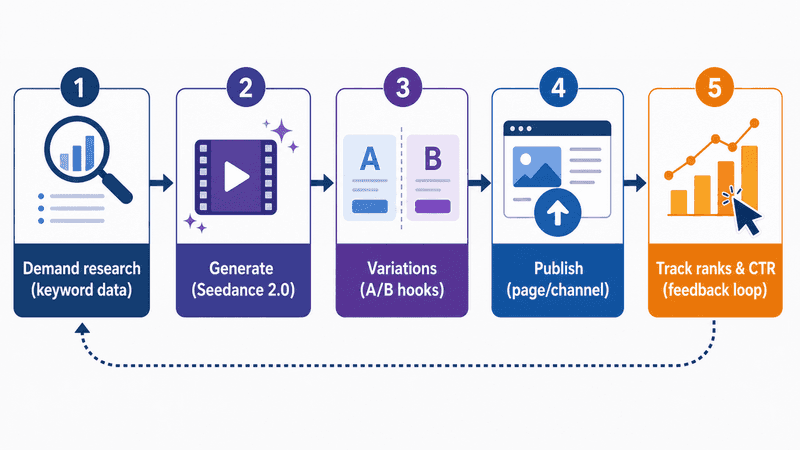
So the practical loop looks like this: research the demand, generate the creative, ship variations, and watch the data. If you're producing video around specific product or category terms, pull the search demand first with a keyword research tool so you're making clips for queries people actually type, not for a topic that feels important internally. Then, once the videos are live on a page or a channel, a rank tracking setup tells you whether the new video-rich pages are climbing or flat. The model makes the asset; your SEO stack tells you if the asset earned its place.
Demand research → Generate (Seedance 2.0) → Variations → Publish → Track ranks/CTR
keyword data the creative A/B hooks page/channel the feedback loop
The All-in-One Platform for Effective SEO
Behind every successful business is a strong SEO campaign. But with countless optimization tools and techniques out there to choose from, it can be hard to know where to start. Well, fear no more, cause I've got just the thing to help. Presenting the Ranktracker all-in-one platform for effective SEO
We have finally opened registration to Ranktracker absolutely free!
Create a free accountOr Sign in using your credentials
The mistake we keep seeing is treating generation as the finish line. It's the cheap step now. The expensive step is knowing which of the fifty clips you can suddenly afford to make is the one worth promoting.
When to use it, and when not to
Be honest about fit. Here's our split after a week.
Use it when:
- You need volume for testing: many hook and first-frame variations of the same concept.
- Your shots are short (under ~15 seconds) and social-first (Reels, Shorts, TikTok).
- You're matching an existing look via a reference image or clip.
- You have a product or character that needs to stay consistent across a short sequence.
For that last case in particular, the multi-reference mode is the draw. If you want to feed a product still plus a style reference and get a usable short sequence, this AI Video Generator is the path most teams will reach for first, because it runs in a browser and the free credits are enough to judge whether the consistency holds for your specific assets.
Don't use it when:
- You need long-form, narrative-precise video. It's a clip tool, not an editing suite.
- Fine on-screen text accuracy is non-negotiable (legal disclaimers, exact pricing).
- You need guaranteed, contract-grade commercial clearance today (see the next section).
And the honest caveat marketers learn the hard way: the free credits are an evaluation tier, not a production plan. They're there to let you test, and they run out fast once you're generating variations. Budget for the paid plan if it earns a place in your stack, and don't build a campaign timeline around free-tier throughput.
The part nobody in the demo reels mentions: the legal cloud
If you're generating video for paid advertising, you cannot skip this. Seedance 2.0 launched into an active copyright fight.
The Motion Picture Association denounced the model for what it called massive infringement. Disney sent ByteDance a cease-and-desist on February 13, 2026, alleging the model was trained on its works without permission. Paramount Skydance accused ByteDance of "blatant infringement" of properties including Star Trek and South Park. US Senators Marsha Blackburn and Peter Welch publicly urged ByteDance to shut Seedance down. ByteDance responded on February 16, 2026, saying it "respects intellectual property rights," had "heard the concerns," and would strengthen safeguards against IP violations. (Background and citations: the Seedance entry on Wikipedia and ByteDance's official model page.)
What does that mean for you, practically?
- Generic, original content is the safer lane. A clip of an abstract product render or a synthetic spokesperson reading your script is a very different risk profile than anything that reproduces a recognizable character, style, or franchise.
- Don't generate anything resembling protected IP for a campaign. "Make it look like [famous franchise]" is exactly the prompt that's drawing the lawsuits.
- Keep your provenance. Save prompts, references, and generation logs. If a "commercial use OK" claim is ever tested, you want a record of what you fed the model.
This isn't a reason to avoid the tool. It's a reason to use it like a professional: for original creative, with documentation, and without pretending the legal questions are settled. They aren't.
Seedance 2.0 vs. Veo and Kling
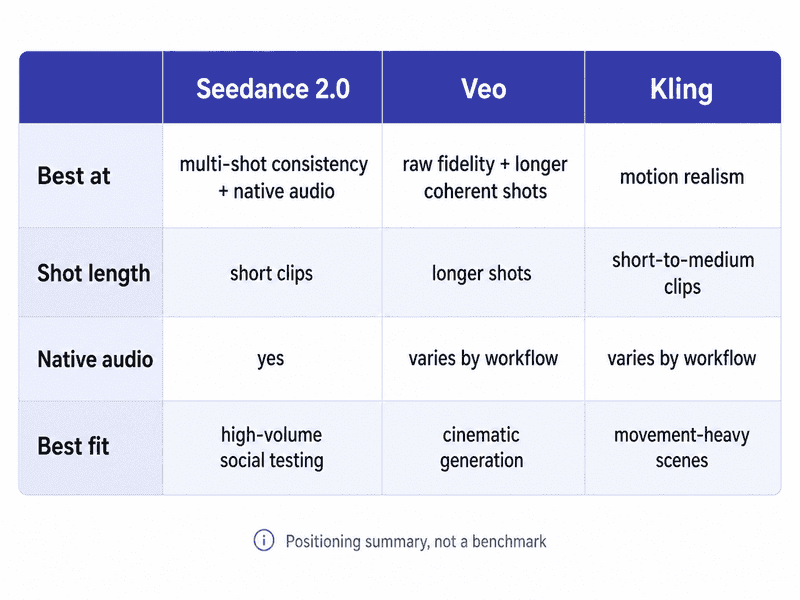
The honest comparison: there's no universal winner, and the answer depends on the shot.
The All-in-One Platform for Effective SEO
Behind every successful business is a strong SEO campaign. But with countless optimization tools and techniques out there to choose from, it can be hard to know where to start. Well, fear no more, cause I've got just the thing to help. Presenting the Ranktracker all-in-one platform for effective SEO
We have finally opened registration to Ranktracker absolutely free!
Create a free accountOr Sign in using your credentials
Google's Veo line tends to lead on raw fidelity and longer coherent shots. Kling has been strong on motion realism. Seedance 2.0's distinguishing bet is the multi-shot consistency plus native audio combination at fast generation speeds, which is exactly the bundle a high-volume social team values more than one perfect hero shot.
If your job is one cinematic flagship clip a month, fidelity-first tools may serve you better. If your job is shipping dozens of testable variations a week, the consistency-and-speed trade Seedance makes is the one that matches the workflow. Test both against your assets before committing budget, and track the output, because the model that produces your best-ranking video is the one that wins, regardless of which demo reel looked nicer.
The takeaway
Seedance 2.0 is a real step, but not the one the hype claims. It doesn't turn a sentence into a finished film. It makes the second shot match the first, gives you audio in the same pass, and drops the cost of producing testable video to near zero. That's genuinely useful, and it shifts the hard part of the job downstream, to judgment: which clip deserves promotion, which page it lives on, and whether it's actually climbing.
Generation got cheap. Knowing what to do with the output didn't. If you're going to lean on AI video, pair it with a real measurement habit: pull the demand before you create, and use a backlink and rank monitor plus rank tracking to confirm the new pages are earning visibility. The teams that win the next year won't be the ones generating the most video. They'll be the ones who can tell which video was worth making.
So here's the question we're still chewing on, and we'd genuinely like your answer: when anyone can generate a thousand clips a week, what becomes the scarce skill: taste, distribution, or trust?

