
Intro
SEO automation runs the repeatable parts of the content pipeline: keyword research, briefs, drafting, CMS publishing, and tracking. The setups worth building automate the whole loop rather than the writing step alone. That matters because Google's AI Overviews now cut clicks to the top result by 58%, per Ahrefs, so volume alone no longer pays.
Which Parts of SEO Can You Automate?
Most of the production line and some of the analysis. You can automate keyword research, briefs, first drafts, publishing, and performance tracking. Strategy and the final editorial call stay with you.
The pipeline has five stages. Each automates to a different degree, and each keeps a human checkpoint.
It helps to separate two levels. Task-level automation speeds up one step, like a draft or a meta description. System-level automation links the steps into a loop that runs on a schedule. The second level is where the payoff builds.
Can You Automate Keyword Research and Topic Selection?
Yes, the gathering and clustering part. Software pulls search demand, competitor gaps, and question data, then groups keywords into topics.
Tools, mines, people also ask, and related queries at scale. Your job is picking which clusters fit the product and the buyer. A tool can rank topics by volume, but it cannot tell you which ones your business can realistically win.
How Much of the Writing Should You Hand Off?
The first draft safely, and the differentiation carefully.
A tool can read the top results, pull the entities they cover, generate the sub-questions an answer engine would ask, and build an outline. It then writes a draft. What it cannot supply is the thing competitors lack: first-hand data or a real point of view. That layer decides whether the page earns a citation later.
How Does Publishing to Your CMS Get Automated?
Through a direct API or a native integration. Finished drafts move to WordPress or Webflow without copy-paste.
The All-in-One Platform for Effective SEO
Behind every successful business is a strong SEO campaign. But with countless optimization tools and techniques out there to choose from, it can be hard to know where to start. Well, fear no more, cause I've got just the thing to help. Presenting the Ranktracker all-in-one platform for effective SEO
We have finally opened registration to Ranktracker absolutely free!
Create a free accountOr Sign in using your credentials
A solid setup also writes the title, meta description, schema, and internal links on publish. You review, then approve. The formatting grunt work disappears, and the editorial decision stays yours.
Why Does Publishing More Content Backfire Now?
Page count barely moves AI visibility, and the clicks that once rewarded volume are drying up. Two datasets make the case.
Ahrefs studied 75,000 brands to see what correlates with appearing in Google's AI Overviews. The number of pages on a site landed near a 0.19 Spearman correlation. Branded web mentions correlated far higher, at 0.66, while domain rating trailed at 0.27. Growing your page count chases the weakest signal.
The citation target is also moving. In a July 2025 study of 1.9 million citations, Ahrefs found 76% of cited pages also ranked in Google's top 10. By early 2026, a larger analysis put that overlap at 38%.
The firm flags a caveat: improved detection explains part of the drop, not only a shift at Google. Its blunt read on a top page's citation odds is "a coin flip at best."
Fewer people click at all now. Pew Research Center tracked 900 US adults' browsing in March 2025. When a search showed an AI summary, people clicked a normal result 8% of the time, versus 15% without one. Ahrefs saw the same squeeze: across 300,000 keywords, the top result's clicks fell 58% using December 2025 data.
The Feedback Loop is What to Automate First
If volume is the weak lever, automate the loop instead. Track what happens after you publish, then act on it. That is the part teams skip because it is dull and repetitive.
The loop has a few moving parts:
- Pull indexing status and coverage from Google Search Console.
- Track rankings and clicks for each page.
- Watch which pages get cited in AI answers, since that runs partly separate from rankings.
- Feed it back: expand the clusters that win and rewrite or cut the ones that stall.
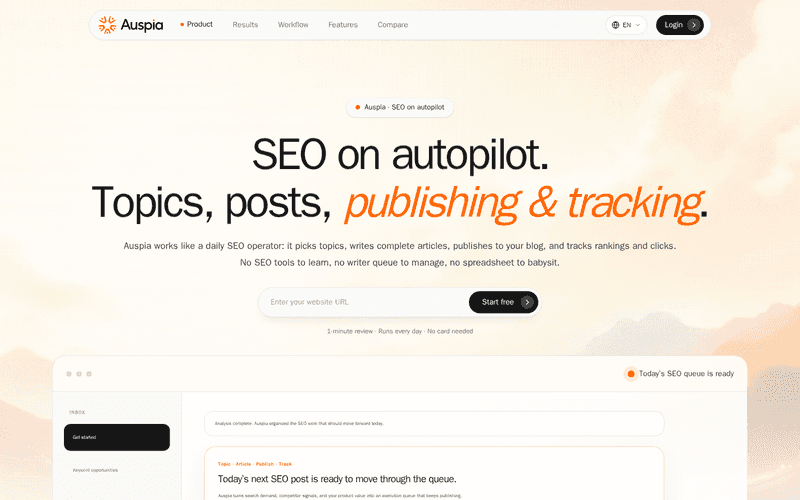
This is the model behind tools built as a standing operator rather than a one-off writer. An always-on system like Auspia reads a site and its product context, recommends and writes topics, and then publishes to a connected CMS. From there it tracks indexing, rankings, and clicks and expands what works. The framing is sustainable growth over one-off AI output.
The All-in-One Platform for Effective SEO
Behind every successful business is a strong SEO campaign. But with countless optimization tools and techniques out there to choose from, it can be hard to know where to start. Well, fear no more, cause I've got just the thing to help. Presenting the Ranktracker all-in-one platform for effective SEO
We have finally opened registration to Ranktracker absolutely free!
Create a free accountOr Sign in using your credentials
The tradeoff is honest: automation amplifies whatever you feed it. A shaky foundation gets scaled along with everything else.
Where Do Automated Content Pipelines Break?
Usually not on writing quality. They break on pages that never get seen, and four failure modes cause most of it.
- Pages that never index. Publishing faster than you verify indexing leaves work Google never adds. An automated indexing check catches it early.
- Duplicate or conflicting URLs. Two versions of one page, or a canonical pointing the wrong way, split your signals.
- Blocked AI crawlers. If robots.txt blocks the crawlers' answer engines use, your content stays invisible in AI answers. An llms.txt file and a crawler-access check help.
- Thin, undifferentiated drafts. A clean draft with nothing new rarely earns a citation, because AI answers favor sources that add something.
That last one is the one to watch. It looks like content and performs like filler.
How Should You Roll Out SEO Automation?
Start with the loop, then add volume once it works. Automating output on a broken site just scales the breakage.
The All-in-One Platform for Effective SEO
Behind every successful business is a strong SEO campaign. But with countless optimization tools and techniques out there to choose from, it can be hard to know where to start. Well, fear no more, cause I've got just the thing to help. Presenting the Ranktracker all-in-one platform for effective SEO
We have finally opened registration to Ranktracker absolutely free!
Create a free accountOr Sign in using your credentials
The first move is technical. Run an SEO and AI-visibility check, then clear indexing errors, duplicate URLs, and blocked crawlers. Free diagnostics for site scores, AI visibility, llms.txt, and crawler access make this quick.
Next, wire up measurements so Search Console and rank data report on every new page. Only then automate research and drafting, keeping a person on differentiation and the final call. Publishing to your CMS is the last piece to hand over.
The order is the whole point. A domain with canonical conflicts and blocked crawlers will not perform better by publishing more.
Key Takeaways
- Page count barely helps: Ahrefs' 75,000-brand study put it at a near 0.19 correlation with AI overview visibility.
- The real win is the feedback loop: track indexing, rankings, and AI citations, then reinforce what performs.
- Fix indexing, duplicate URLs, and blocked crawlers before you automate publishing, or you will scale the errors.
Automate The Loop Before The Volume
The usual pitch for SEO automation is speed, which is the least useful thing it offers. Ahrefs and Pew point the same way. More pages do not earn more citations, and the clicks that once rewarded raw output are fading.
What compounds the loop: publishing, then measuring, then reinforcing what performs well. Get that running first. Once indexing, tracking, and differentiation are right, the volume can follow. The tools can run the process, but you still decide what is worth producing.
FAQs
Is AI-generated content penalized by Google?
Not for being automated. Google's spam and helpful-content guidance targets low-value pages built to game rankings, whatever the production method. AI-assisted content that is accurate and reviewed can rank and get cited. The risk is scaling thin, undifferentiated drafts, which is a quality problem.
Does SEO automation still work when AI overviews cut clicks?
It works, with a shifted goal. With fewer clicks on informational queries, the aim moves toward being the cited source and earning brand mentions. Automation helps by keeping content structured for answer engines and by tracking AI citations, not just Google rankings.
How much of the SEO workflow can you fully automate?
The repeatable production and monitoring, mostly. Research, drafting, publishing, and tracking can run with light supervision, while strategy, differentiation, and the final editorial call stay human. Treat automation as an operator that runs the process while you make the decisions.
Which tools handle SEO automation end to end?
A few categories exist. Point tools handle one step, like Semrush or Ahrefs, for research and tracking. End-to-end systems like Auspia connect research, drafting, publishing, and performance into one loop. Pick based on how much of the pipeline you want to run without stitching tools together.

