
Intro
Ranking an interactive web application requires a completely different approach than ranking a standard blog or e-commerce store. When a company launches a virtual try-on website, they quickly realize that having a great technical tool doesn't automatically equal search visibility. Google still relies heavily on text, site structure, and traditional ranking signals to figure out where a page belongs in the search results. An SEO agency comes in to bridge the gap between a highly visual user experience and a search engine crawling for context.
Search behavior in this space is highly specific. Users rarely type in generic queries when they're trying to visualize something. They look for exact solutions. A user thinking about changing their style is going to search specifically for a preview short haircut tool to see immediate results. They want the application right in front of them. An agency helps identify these exact long-tail search queries and maps them to dedicated landing pages rather than dumping all traffic onto the homepage.
Tackling the Heavy Image Problem
The biggest hurdle for any virtual try-on platform is performance. These sites are inherently heavy. They rely on complex JavaScript, WebGL, or WebAssembly to process images or run camera feeds in the browser. If you leave this unoptimized, your site speed will tank. Search engines penalize pages that take too long to become interactive.
A good agency will immediately run an audit on your Core Web Vitals. They work with your developers to implement server side rendering or dynamic rendering. This ensures search engine bots get a fully formed HTML version of the page without having to execute heavy client side scripts. They will also look at how resources load. A visual processing app demands massive browser resources compared to a basic math script like an online BMI calculator which executes instantly. Agencies prioritize deferring non essential scripts and compressing interface assets so the initial page load stays fast enough to pass Google performance thresholds.
Creating Supporting Content Structures
You can't rank a blank page with a camera interface. The search engine needs text context to understand what the user is supposed to do. Since you don't want to clutter the actual try-on interface with thousands of words, an agency will structure the site to house supporting content nearby.
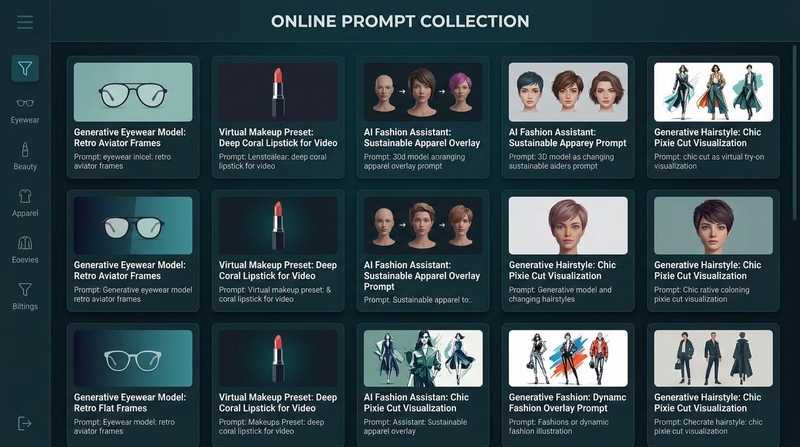
This usually involves building a silo of resource pages, style guides, or inspiration galleries. These pages capture informational search intent and then funnel users directly to the try-on application. For generative AI try-on tools, finding inspiration is a major part of the user journey. Just as AI image communities often host an online prompt collection to draw in organic traffic from creators, a try-on site might host a gallery of trending styles. These text-rich pages build topical authority. They give other websites something valuable to link to. People rarely link directly to a tool interface, but they will link to a well-researched guide on choosing frames for a round face.
Implementing Structured Data and Schema
An agency will implement specific schema markup to help search engines categorize the tool. SoftwareApplication schema is standard practice here. It tells Google that the page hosts an interactive application rather than a standard article. You can include details about the operating system requirements, browser compatibility, and user ratings directly in the code.
The All-in-One Platform for Effective SEO
Behind every successful business is a strong SEO campaign. But with countless optimization tools and techniques out there to choose from, it can be hard to know where to start. Well, fear no more, cause I've got just the thing to help. Presenting the Ranktracker all-in-one platform for effective SEO
We have finally opened registration to Ranktracker absolutely free!
Create a free accountOr Sign in using your credentials
For try-on sites tied to e-commerce, Product schema is equally important. If the user is trying on sunglasses, the underlying product needs to display price, availability, and review snippets in the search results. Proper structured data ensures your site takes up more real estate on the results page. Agencies write scripts to automate this markup so that every new product added to the try-on catalog automatically generates the correct schema without manual data entry.
Optimizing Crawlability for Dynamic Catalogs
Many try-on websites are built as Single Page Applications. The user clicks different categories, the image updates, and the layout changes, but the URL stays exactly the same. This is a nightmare for search engines. If the URL doesn't change, Google only sees one page. It will never find the hundreds of individual items you offer.
An SEO team will fix this by setting up a traditional URL structure that runs in parallel with the application logic. Every specific category needs its own indexable URL. If you sell virtual try-on glasses, you need distinct URLs for men, women, aviators, and blue light categories. The agency ensures the application pushes these unique URLs to the browser history and provides a clean XML sitemap so Googlebot can crawl the entire catalog.
Managing Index Bloat from Parameter URLs
Try-on applications often generate thousands of variations based on user filters. A user might select glasses, filter by blue frames, round shape, and polarized lenses. If the site generates a unique URL for every possible combination of filters, the search engine wastes its crawl budget on millions of useless pages.
An agency fixes this through canonical tags and proper parameter handling. They tell Google which core pages matter and which filter variations should be ignored. You want the search engine indexing the main category for blue glasses, but you do not want it indexing a specific URL generated when a user applies seven different sorting options at once. Keeping the index clean ensures your most important pages get crawled and updated frequently.
Acquiring Backlinks for Interactive Assets
Link building for software tools requires a specific strategy. Most standard outreach campaigns fail because webmasters ignore generic requests to link to commercial pages. Interactive tools are natural link magnets if positioned correctly.
An SEO agency will look at the mechanics of your virtual try-on and pitch it to publishers as an interactive asset. If your site lets users try on engagement rings, the agency will contact bridal blogs and wedding planning sites. They offer the tool as a resource that the publisher can embed or link to for their own readers.
Another tactic involves digital PR based on the data your tool generates. Try-on applications process thousands of user preferences daily. By aggregating this anonymized data, you can publish reports on current trends. You might reveal which frame styles are most popular in specific regions or how seasonal shifts affect color choices in apparel. Journalists and industry bloggers link to data they can't find anywhere else.
Refining Mobile Usability
Most searches happen on mobile devices. For a virtual try-on tool, mobile usability is non-negotiable. Google uses mobile first indexing, meaning they rank your site based on how it performs on a smartphone.
An agency will thoroughly test the mobile rendering of your application. The camera interface must scale correctly on smaller screens. Buttons need adequate touch targets. If the upload dialogue box gets cut off on a phone screen, users will bounce immediately. SEO professionals will work with UI designers to ensure the viewport settings are perfectly calibrated. They check that pop ups or instruction overlays do not trigger intrusive interstitial penalties. Everything must function seamlessly in a mobile browser environment without forcing the user to download a native application.
Tracking User Engagement as a Ranking Factor
Getting people to the site is only the first step. Google monitors how users behave once they land on your page. If they click your link, wait three seconds, and hit the back button, your rankings will drop. For virtual try-ons, poor engagement usually happens because the camera fails to load or the interface is confusing.
Agencies set up granular event tracking in Google Analytics. They track how many users successfully grant camera permissions, how many upload an image, and how many complete the try-on process. If they spot a high drop off rate at the camera permission step, they know the page needs better instructions or a fallback option like uploading a static photo. SEO is tied directly to the usability of the tool.

