Intro
Managing a handful of websites requires choosing the right SEO tools for them. There are a lot of SEO tools out there, making it difficult to choose the most suitable solution. Most answers to this question on the internet take the approach of comparing a selection of tools. This guide offers a process for making this decision. This is a more durable (and also a more useful) approach: SEO tool offerings and capabilities are changing all the time, and website owners are likely to manage a different set of websites than the author of such a guide. The process is as follows: start by doing an audit of the portfolio of sites in order to understand what is needed. Then match those needs to the categories of SEO tools that are available. Next, decide on a set of criteria that are important for an SEO tool in a multi-website context. Then use those criteria to compare a shortlist of candidate SEO tools. Finally, pilots test them on the websites and commit to the winners.
Start with an Audit of Your Own Portfolio
The “right” set of SEO tools for a portfolio of sites will depend on the number of sites, the platforms they’re built on, who executes the SEO (the website owner, the marketing team or an agency), the specific goals for each site and the available budget. These factors should be carefully considered before starting to look at SEO tools. The needs of someone with 2 websites will be significantly different from those of an SEO agency looking after 20 clients. Some SEO tools cost the same whether they are used on 2 or 200 websites (per-seat licensing), whereas others charge a fee per website. Choosing the right set of SEO tools for these needs is a process. One of the most common mistakes is buying a “flagship” all-in-one SEO tool without first establishing the requirements. Any functionality in these tools that nobody on the team uses is a waste of money.
Matching Tool Categories to the Jobs That Need to Be Done
When choosing SEO tools for multiple websites, it’s important to understand the different categories of tool and the role that each performs. Probably the first 3 categories that need to be understood are: 1. Technical Site Auditing Tools 2. Keyword Research and Rank Tracking Tools 3. Backlink Analysis Tools. There is no one single tool that can measure everything. Even carefully conducted academic research will employ a number of different SEO tools, and then generate multiple different rankings from the outputs of those tools.
1. Technical Site Auditing Tools
These tools crawl websites and identify technical and on-page SEO issues. Website owners will want to be able to run these tools across all their sites, so they should look for tools that let them set up multiple sites (ideally in bulk), and check what the per-site crawl limit is on each plan.
2. Keyword Research and Rank Tracking Tools
Keyword research tools help to identify which keywords to target for each site. Rank tracking tools monitor where websites currently rank for those keywords. Website owners will want to be able to set up a large number of sites in bulk and get consolidated reporting across all sites.
3. Backlink Analysis Tools
Backlink analysis tools show who is linking to websites. Again, the ability to set up multiple projects and get consolidated reporting is important. The remaining categories of SEO tools sit ‘downstream’ of the data generated by these tools. The other two categories of SEO tool are analytics and traffic measurement and (relatedly) reporting. These are the parts of the toolkit where website owners are most likely to feel the pain of any gaps in their coverage. Extensive indicators like bounce rates, visitor demographics, and traffic sources offer valuable insights into how well SEO campaigns are working. This is the crucial layer which takes all the data from various sites and consolidates it into one place in a format that website owners and/or their clients can actually make use of. Chances are most website owners already have at least one analytics product installed on their sites (they will probably have started with the free versions) before adding any paid tools on top.
Different categories of SEO tools also feed off one another. For instance, the output from SEO audit tools can be used to decide what to prioritize on each site, rank tracking data can measure the results of that work, and analytics data can show if those results have translated into more traffic. Gaps in coverage between tool categories are therefore often more important than which tool is chosen within each category. This brings the process to the next step – defining some criteria for scoring tools (both within and between categories) based on the realities of a multi-site portfolio.
Criteria That Matter When One Tool Must Cover Many Sites
Once there is a clear picture of what jobs a portfolio of websites needs done, the task of selecting the best tools becomes a matter of scoring options against specific needs and constraints. Research into how practitioners choose their e-commerce software platforms has found that security and functionality are among the most critical factors, followed by maintenance costs and scalability. Other types of software selection decisions similarly elevate cost and scalability to be as important or more important than features.
For businesses managing multiple websites, the reliability of the underlying IT infrastructure and access to technical assistance can also influence operational efficiency. Depending on their internal capabilities, some organizations may rely on managed IT services to maintain their systems. In the case of SEO tools, website owners may be comparing subscription pricing models (per user vs per project vs lump sum), the maximum number of websites that can be added to a single rank tracking or analytics subscription or crawled by an audit tool, or whether a single consolidated dashboard or spreadsheet can be generated for all sites or users need to log into a dozen different accounts. Based on the inventory created in the previous step, website owners should have a good idea of which of these (or other) criteria should get a heavy or light weighting for their decision.
Turn the Criteria List Into a Simple Weighted Scorecard
Doing this will ensure that the resulting shortlist of tools is based on specific priorities and not just whichever tool has the most prominent (or loudest) marketing. The purpose of this process is to select the software that best fits the criteria after determining which criteria should be considered. There is no need to get too hung up on the intricacies of decision science and how to build the ‘perfect’ weighted scorecard. Select 6-8 criteria that are considered important (based on the list above). Assign a relative importance weighting to each criterion that totals 100 (using the insights gathered during the ‘portfolio audit’ stage). Then simply score each tool (from the shortlist) 1 – 5 on each criterion. Tally it all up and it will be easy to identify the top 2 or 3 tools that should move on to the next stage.
The benefit of this process is that decision-makers are forced to explicitly decide on the relative importance of each criterion and will have a documented rationale for the choice they eventually make. This can be referred back to next time they are faced with the decision of whether to renew the subscription.
Piloting the Shortlist on Existing Sites
Before spending another penny on annual subscriptions, the top-scoring tools should be selected and put through a rigorous 2-4 week trial on 2 or 3 existing websites. At the end of the trial, the tools should not be judged by what the demo data says they can do but by what they can actually do. Studies have demonstrated the use of multiple independent audit tools on real websites to identify potential SEO issues.
A good pilot will show whether the issues the tool is reporting on are issues that website owners are already aware of on their websites. How long does it take to onboard? Is multi-site set up as painless as the sales page makes it sound? What happens when things break – is support available?
Running several tools over the same real site is a perfectly legitimate test methodology. If a tool can help fix issues and website owners can verify that the fixes have been implemented, that is proof that it deserves a place in the stack. But finally, it is important to ask how the selected tools fit together into one reporting and workflow system.
Data, Automation and Avoiding Tool Sprawl
The final step in the process is considering how the selected tools will work together. Which tools share (or export) data with one another? Which have API access, in case reporting needs to be automated? The aim should be to consolidate reporting into one place (instead of paying for 5 overlapping subscriptions). Since SEO is dynamic, making informed decisions requires a data-driven strategy, which makes analytics an essential component. Therefore, website owners should avoid paying for a collection of overlapping tools with data locked into each one.
The All-in-One Platform for Effective SEO
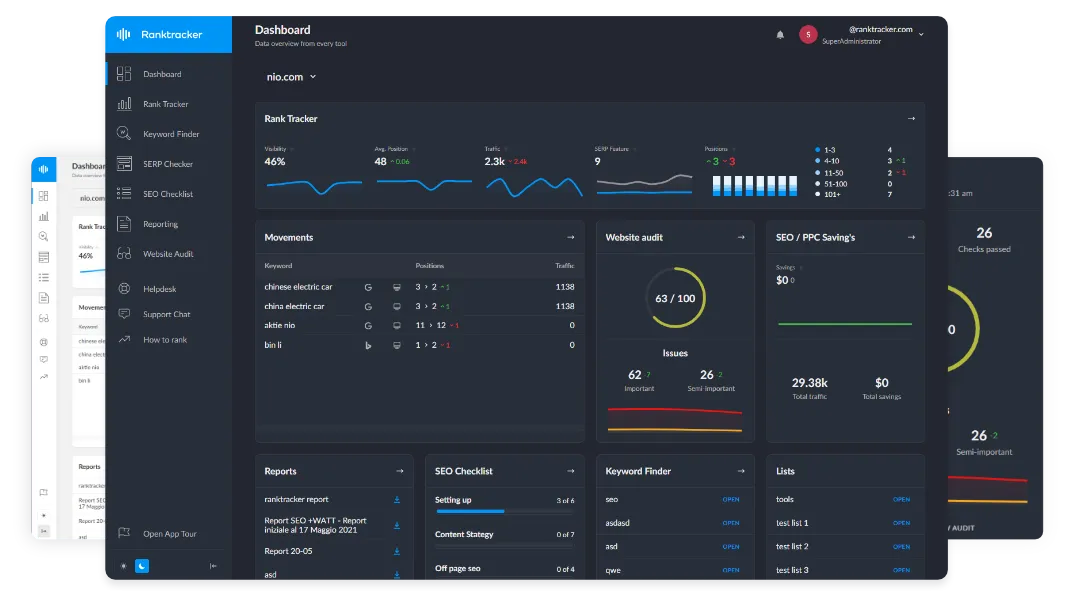
Behind every successful business is a strong SEO campaign. But with countless optimization tools and techniques out there to choose from, it can be hard to know where to start. Well, fear no more, cause I've got just the thing to help. Presenting the Ranktracker all-in-one platform for effective SEO
We have finally opened registration to Ranktracker absolutely free!
Create a free accountOr Sign in using your credentials
When managing multiple websites, the ideal setup will include an SEO audit tool, a rank tracker, an analytics platform, and one reporting tool that can pull the data together. Automating the reporting process between tools (either via API access or built-in integrations) is particularly important when managing more than 5 or 6 sites, since manual reporting doesn’t scale. Tools that incorporate Python code and data science techniques can also help generate data-driven recommendations and automate the SEO workload. In short, the aim should be a small, consolidated stack of tools that can be used to implement the whole process outlined here.
Conclusion
Zooming back out from this discussion of consolidation to the original question addressed at the start of this article, how should website owners decide which SEO tools to use when managing multiple websites? The right answer will be a set of tools (not just one!) that cover all the ‘jobs’ that need to be done, at a total cost that can be justified to management. The end result of the outlined process should be the identification of that set of tools and a defensible choice. Website owners will also be in a good position to revisit that decision (and make changes) in the future when their sites change, or the SEO tool market changes.