
Intro
Search interest in media mix modeling jumped over 200% in mid-2025, and the brands behind that spike aren't who you'd expect.
Fortune 500s already had MMM. The new wave is everyone smaller: DTC apparel, regional retail, SaaS shops running $50K to $500K a month in ads, finally getting the kind of channel-by-channel clarity that used to cost six figures, mostly because Google made the tool free.
This is the guide I wish someone had handed me when our team first tried to set this up: what MMM actually does for a brand at that size, 6 ways to turn it into smarter spend, and a 30-day plan that won't waste your marketing budget.
What Media Mix Modeling Means For A Small Brand In 2026
Here's the simplest way to think about it. Media mix modeling lines up your channel spend against your sales over time, then figures out which channels actually drove the lift.
It accounts for elements you don't control (seasons, price changes, what competitors did), so it can separate what your ads moved from what would have happened anyway.
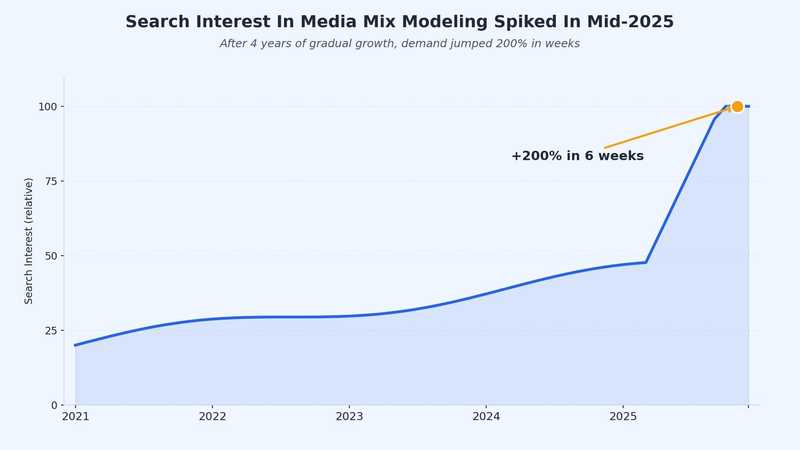
53.5% of US marketers already use MMM, and another 60% of advertisers are in the active or considering bucket.
The All-in-One Platform for Effective SEO
Behind every successful business is a strong SEO campaign. But with countless optimization tools and techniques out there to choose from, it can be hard to know where to start. Well, fear no more, cause I've got just the thing to help. Presenting the Ranktracker all-in-one platform for effective SEO
We have finally opened registration to Ranktracker absolutely free!
Create a free accountOr Sign in using your credentials
Until 2024, this was mostly a CPG and big-brand game. Then Google opened Meridian, Meta's Robyn matured, hosted tools dropped to $1K a month, and the floor caved in. Cheaper tools helped, but what really pushed small brands in is that the alternatives stopped working.
5 Reasons Media Mix Modeling Now Beats Attribution-Only Stacks For Small Brands
Tracking is broken, and the platforms aren't going to fix it. iOS opt-outs hollowed out half of MTA's data, and Chrome's cookie deprecation is finishing the job. MMM doesn't care because it works on totals.
You also can't see what's happening if you only watch the channels you can track. 32% of marketers measure digital and traditional spend in the same view. Two-thirds are flying blind, so MMM is the cheapest way to fix it.
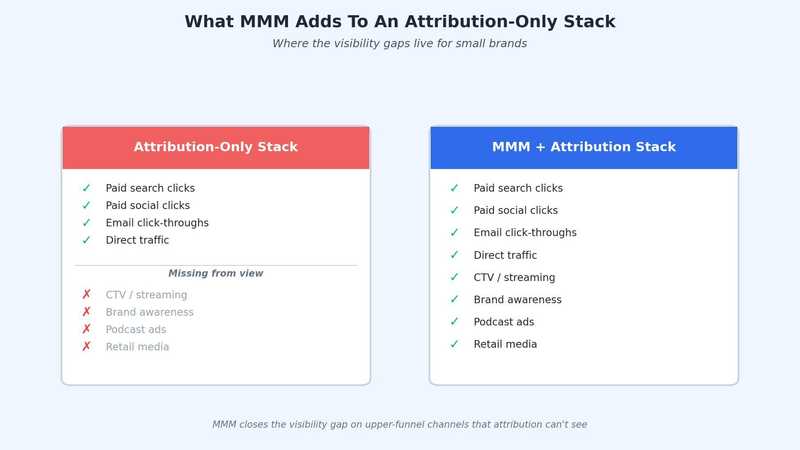
The cost of building a model collapsed. Google's Meridian, Meta's Robyn, and other open-source tools are free. A junior analyst with 18 months of clean data ships the first version in 4-6 weeks. The same project used to mean writing a $40K check.
Finance is paying attention too. 61% of CMOs are now treated as profit centers, up from 53% the year before. The way to keep that label is showing where the money actually works, and MMM is the measurement most CFOs trust.
The proof's in the outcomes. Deloitte found leaders who prioritized MMM were over 2x more likely to beat revenue goals by 10% or more.
The All-in-One Platform for Effective SEO
Behind every successful business is a strong SEO campaign. But with countless optimization tools and techniques out there to choose from, it can be hard to know where to start. Well, fear no more, cause I've got just the thing to help. Presenting the Ranktracker all-in-one platform for effective SEO
We have finally opened registration to Ranktracker absolutely free!
Create a free accountOr Sign in using your credentials
📊 By the Numbers
34% of advertisers prioritize MMM over every other measurement option, ahead of conversion lift testing at 26% (Kantar, May 2025). Three years ago, that ranking would have been reversed.
6 Media Mix Modeling Tactics That Sharpen Small Brand Spend
These tactics build on each other. Skip the data work in tactic 1, and the cleanest model in the world tells you nothing useful.
1. Build A Clean History Of Spend And Sales Before You Touch A Model
This is the boring part that decides whether your model works. Pull 78-104 weeks of weekly history into one spreadsheet: spend per channel, sales or conversions, and anything else that affects sales (promos, price drops, weather if your category is seasonal).
A year and a half of weekly data is the minimum. Less than that, the model can't see how channels behave through different seasons or at different spend levels. Teams that try for 9 months and watch the recommendations fall apart by Q2.
What kills MMMs at this stage is data that's inconsistent rather than data that's missing. A channel renamed mid-year, an attribution window someone changed in Meta settings 6 months ago, and two holiday promos logged differently. Spend a few days reconciling the columns before you touch anything else. Tedious work, but the model lives or dies on it.
2. Pick A Tool That Fits Whoever's Going To Run It
The pick depends on your team. R-comfortable team picks Meta's Robyn. Python-comfortable team picks Google's Meridian or LightweightMMM. No data scientist on staff, you go hosted: Recast, Prescient, or AdBeacon, where the heavy lifting is built in.
| Approach | Software cost | Time per refresh |
| DIY open-source | $0 | 2-4 weeks of analyst time |
| Hosted small-brand tools | $500-$3,000/month | 1-2 days |
| Agency-built MMM | $15K-$50K per build | Mostly outsourced |
Spending 60%+ with Google? Default to Meridian. It plugs straight into Google's own search and YouTube data, which makes it sharper for that profile than most paid tools. Heavy on Meta and TikTok? Robyn or a hosted tool gives cleaner numbers.
💡 Pro Tip
Don't pick a framework before you understand your team. I've watched brands spin up Meridian on a Friday and quietly abandon it by Wednesday because nobody could read the output. The hosted tool would have shipped a working model in week 2.
3. Add The Variables That Aren't Ads (Most Brands Forget This)
A model that only knows about ad spend is going to tell you ad spend caused sales. The variables that move the needle most often live outside your ad accounts: price drops, sitewide promos, weather (if you sell something weather-sensitive), how often people search your category on Google, and what your competitors did.
This is where I see most small-brand MMMs fall apart. Teams build a beautiful model with 8 channels and zero context, then wonder why the recommendations feel off.
A DTC apparel brand using AdBeacon plus Meridian figured out that their prospecting ads were quietly bringing in their highest-LTV customers. Last-click had been crediting retargeting for years. They added prospecting impressions as a separate variable, and the LTV story popped out.
Same logic when you start segmenting paid social audiences inside the model. Splitting Meta into prospecting versus retargeting often shows where one part of the channel is overpriced, and the other is starved.
4. Pressure-Test Your Model With Real Experiments Before You Trust It
Without experiments to check it against, your model will lie to you. Sometimes by 50% or more. The fix is running 2-3 simple tests a year on your biggest channels: turn off ads in one region for a few weeks, leave them on everywhere else, and see how much sales drop in the test region. Feed those results back so the model learns what reality looked like.
The Advertising Research Foundation now treats this as the standard fix for models that drift, and Meridian has it built in.
In practice, when you compare the model's answer for a channel against what the experiment showed, the gap should be under 30%. Wider than that, and trust the experiment.
Most brands run their models and their experiments in parallel and never wire the results together. The model says one thing, the experiment says another, leadership picks whichever number flatters the most expensive channel, and the program collapses by Q3. I've watched this play out more than once.
5. Translate Model Output Into Channel-Level Budget Moves Within 2 Weeks
What you actually get out of an MMM is two charts per channel. One shows how much that channel contributed to sales, the other shows the curve where extra dollars stop helping. Turning those into budget moves is the part that takes work.
A simple rule that holds up for most small brands:
Any channel spending past the inflection point on its curve gets cut by 10 to 15%. Any channel that's underfunded gets a 15 to 25% test bump. Leave everything else alone for a quarter and check again.
Most brands stall here, and it's not a modeling problem. The model's done. The hard part is rewriting the media plan every month based on what it says, then catching the early signal when a shift isn't working before bad spend compounds. The shops that combine MMM with active media buying run both as one workflow instead of two separate vendors.
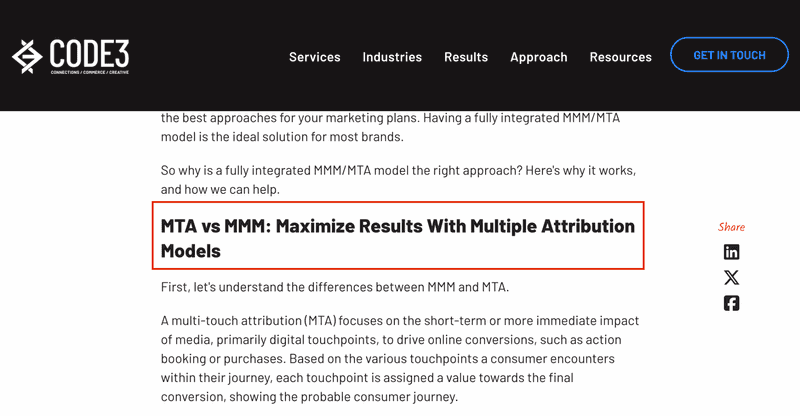
Code3 has written a lot about why doing MMM and multi-touch attribution as one integrated solution beats running them as separate projects with separate reports. The pattern most brands learn the hard way: MMM tells you to shift 15% of your budget from paid social into CTV, then MTA tells you which CTV partners and creatives pick up the slack inside that new budget.
6. Treat Media Mix Modeling Like A Quarterly Habit
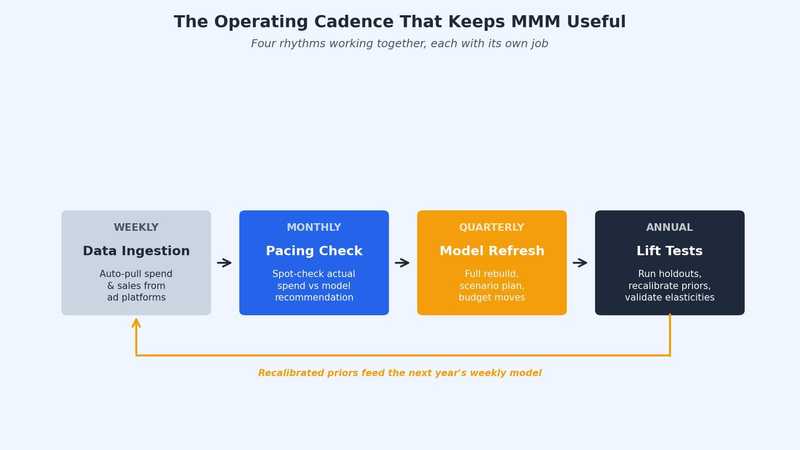
Models go stale fast. More than half of MMM-using marketers refresh quarterly or faster, and the brands that ship on cadence pull away from the ones treating MMM as a one-off audit.
Here's what "recurring program" actually looks like in practice: one owner, a quarterly calendar, a single home for the data, and clear handoffs between marketing, finance, and analytics.
Most small teams skip the workflow piece, and by month 4, the model lives on someone's laptop, the data is buried in a Drive folder, and the next steps are stuck in a Slack thread nobody can find. Run MMM like any recurring project that touches multiple teams: someone owns it, the work is tracked, and the data lives in one place.
A reliable AI-powered suite like Easy8 Private WorkOps is one of the few platforms designed for exactly this kind of recurring program work. It bundles project management, resource allocation, and an AI assistant that handles the repetitive workflow tasks (status updates pulled from meeting notes, surfacing what's behind schedule, drafting weekly summaries for leadership) on one surface.
Just as important, it runs on your own server or private cloud with ISO 27001 and 27017 compliance, which matters once the workflow holds revenue forecasts and finance-side ROI numbers next to ad spend tables. In regulated categories, someone in legal will eventually ask where that data lives, and self-hosted deployment means you control the answer.
Media Mix Modeling vs Multi-Touch Attribution For Small Brands
Brands that fight over which one is "right" usually run neither well.
MMM tells you the big picture: how to split next quarter's budget across Meta, TikTok, Google, and CTV. MTA tells you the small picture: which Meta campaigns and which TikTok creators to scale inside the budget MMM gave that channel.
MTA also holds up better for brands with deep first-party signal. Nootropics Depot collects user-level intent through a goal-based product quiz, a five-tier rewards program, and an affiliate dashboard, which gives the team enough touchpoints to keep MTA meaningful inside whatever channel-level budget MMM allocates.

| Question | MMM | MTA |
| Data | Aggregated channel-level | User-level paths |
| Best for | Quarterly budget allocation | Daily campaign optimization |
| Privacy-safe? | Yes | Increasingly compromised |
| Refresh cadence | Monthly to quarterly | Daily to weekly |
| Cost for a small brand | Free to $3K/mo | $200-$1,500/mo |
| Owner | Analytics or finance lead | Performance marketer |
Skipping MMM means you're optimizing inside the wrong budget split. A perfectly tuned Meta retargeting campaign can still pull from a pool of money that should mostly sit somewhere else. MTA without MMM is a fast car going the wrong way.
Your 30-Day Media Mix Modeling Sprint For Small Brands
You don't need a year. A focused 30-day sprint will get you a working model, 2 or 3 specific budget moves, and the cadence for ongoing refreshes.
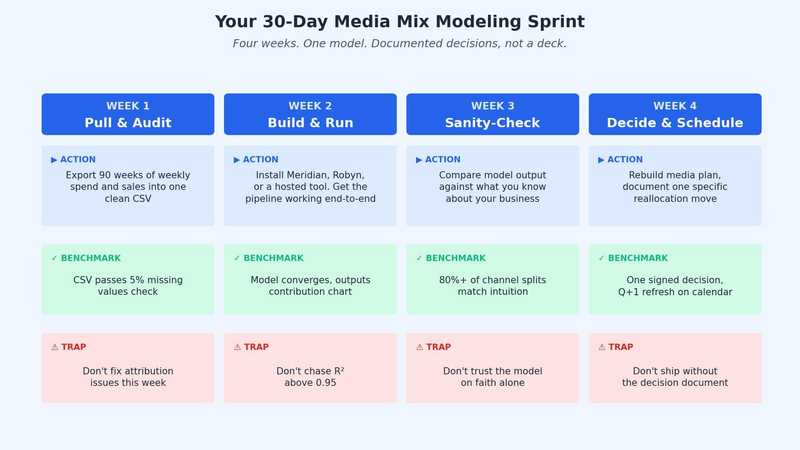
Week 1: Pull And Audit The Data
Pull 90 weeks of weekly data into one spreadsheet:
- Spend by channel
- Sales or conversions
- Promo calendar
- Anything else that affects sales (price changes, weather, etc.)
Make sure each channel is named the same way every week. Add a notes column for anything weird you remember.
Benchmark: every column has data for at least 95% of the weeks.
Trap: trying to fix attribution problems this week. Don't. MMM works on totals. Save the attribution cleanup for later.
Week 2: Build And Run The First Model
Install Meridian, Robyn, or your hosted tool. Run their sample notebook with your data instead of theirs. The first run will look messy, and that's fine. Week 2 is about getting the pipeline running from input to output.
Benchmark: the model finishes running and gives you a contribution chart by channel.
Trap: chasing a "perfect" fit. If your model matches your past data 99% perfectly, that's almost always a sign it's memorized your past instead of learning what drives sales. Aim for stable, reasonable results.
Week 3: Sanity-Check Against Reality
Compare the model's results against what you already know. If it says paid search drives 5% of sales, but you ran a $200K push that clearly fueled your Q4, the model is missing something. Usually,y it's a variable you didn't include yet, like the timing of the push or a competing promo.
Benchmark: 80% or more of the channel results look right to you and your team.
Trap: trusting the model just because it took 3 weeks to build. It can still be wrong. If it disagrees with an experiment you've already run, the model is what's wrong.
Week 4: Translate To Spend Decisions And Set The Cadence
Rebuild next month's media plan based on the model. Write down one specific budget move in plain language and get marketing and finance to sign off in writing. Put the next quarterly refresh on the calendar with names attached.
Benchmark: one written decision document, one signed reallocation, one scheduled refresh.
Trap: shipping the model without the decision document. Models without decisions become zombie projects that quietly disappear by month 3.
5 Metrics That Show Your Media Mix Modeling Is Working
These are the 5 I track. Skip them, and you'll never know if the model is helping or quietly turning into wallpaper.
1. Return on the next dollar. Track how much sales lift you'd get from one more dollar on each channel, quarter over quarter. Rising after a budget increase means the channel still has room to scale. Rising after a cut means you trimmed the right one.
2. Gap between the model and your real experiments. When you run a holdout test, compare its result to the model's estimate. A gap wider than 30% means the model needs adjusting. Make it shrink every quarter.
The All-in-One Platform for Effective SEO
Behind every successful business is a strong SEO campaign. But with countless optimization tools and techniques out there to choose from, it can be hard to know where to start. Well, fear no more, cause I've got just the thing to help. Presenting the Ranktracker all-in-one platform for effective SEO
We have finally opened registration to Ranktracker absolutely free!
Create a free accountOr Sign in using your credentials
3. Blended customer acquisition cost. If your MMM-driven shifts are working, blended CAC drops 10 to 20% within 2 quarters. Flat after 2 quarters, and you're either missing variables or moving too slowly.
4. Whether you actually refresh on time. Count what % of the last 4 quarters you got the refresh done. Below 75% and the program is slipping.
5. Real decisions per refresh. 3 to 5 budget moves per quarter are healthy. 1 or fewer means nobody trusts it. More than 7 and you're chasing noise.
Media Mix Modeling Turns Spend Into Strategy For Small Brands
Media mix modeling stopped being a Fortune 500 luxury the day Google Meridian went free. The brands that started measuring properly in 2025 are already pulling away from the ones still running last-click GA4 dashboards, because data-driven marketing decisions compound when the data is honest.
Pull 18 months of channel data this week, pick a tool that fits your team, and ship the first model before Q1 lands.

