
Intro
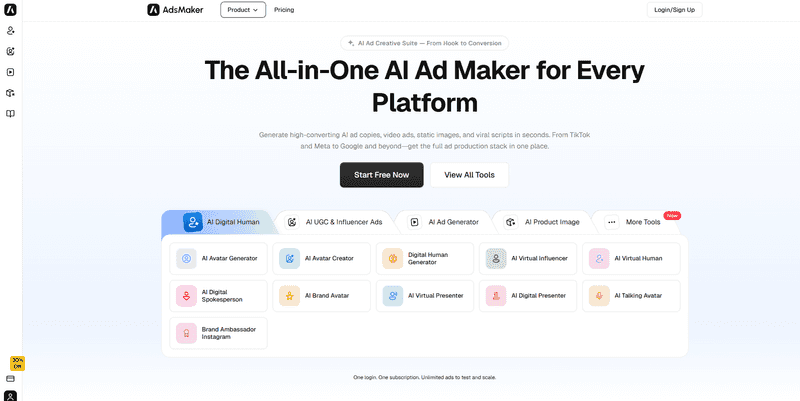
I've spent the better part of six years in SaaS marketing, and creative has always been the bottleneck. Not strategy. Not budget. Creative.
You can have the smartest targeting in the world, but if your ad set has the same three images running for five weeks straight, performance tanks and nobody on the team can explain why fast enough to fix it. That's the problem I kept running into, and it's why I finally sat down and actually used Adsmaker.ai for a real campaign instead of just bookmarking it.
What follows isn't a feature tour. It's what actually shifted in my week once an AI Ad Generator took over the parts of the job that used to eat my Tuesdays.
Your Creative Turnaround Drops From Days to Minutes
This is the obvious one, so let's get it out of the way fast.
A single product ad used to mean a Slack thread with our designer, two rounds of revisions, and a 48-hour wait if she was buried in other requests. With Adsmaker.ai, I uploaded product shots and had five ad-ready variations back in under three minutes.
Multiply that across twelve SKUs and you're looking at roughly 20 hours saved in a single week — hours I used to burn just waiting, not even working. That's not a minor efficiency gain. That's a full extra workday recovered from thin air.
Testing Ten Variations Stops Feeling Like a Luxury
Here's where it gets interesting, and honestly a little uncomfortable at first.
The All-in-One Platform for Effective SEO
Behind every successful business is a strong SEO campaign. But with countless optimization tools and techniques out there to choose from, it can be hard to know where to start. Well, fear no more, cause I've got just the thing to help. Presenting the Ranktracker all-in-one platform for effective SEO
We have finally opened registration to Ranktracker absolutely free!
Create a free accountOr Sign in using your credentials
Most teams test two or three ad variants because that's all the design budget allows. It's not a strategic choice — it's a resource constraint dressed up as strategy. Once an ai ad maker removes the cost of producing variation number eight, you start testing things you never would have bothered with before: a different background, a different headline angle, a different crop.
I ran ten variants on one product last month instead of my usual three. Two of the "weird" ones I almost didn't bother generating ended up outperforming my safe picks by a wide margin. Turns out my taste and the algorithm's taste don't always agree, and I only found that out because testing ten no longer cost anything extra.
Designers Become Editors, Not Producers
This is the shift nobody warns you about, and it's a little uncomfortable to admit out loud.
Our designer's job didn't disappear. It changed shape. Instead of producing every single ad from a blank canvas, she now reviews AI-generated output, flags what's off-brand, and fixes the 20% that needs a human eye — things like awkward text placement or a background that clashes with a product's color palette.
HubSpot's marketing research has consistently pointed to volume as one of the top pressures marketing teams face, with a large share of marketers naming "producing enough content" as a persistent challenge rather than a one-off problem. That tracks with what I saw internally: the constraint was never creativity, it was throughput. Once throughput stopped being the bottleneck, our designer's actual expertise — taste, brand judgment, editing — became the highest-value part of her job instead of the most time-consuming part.
Bad Targeting Gets Exposed Faster, Not Fixed
Now for the one that might not belong on a "wins" list at all, and I want to be upfront about that.
An ai ad generator will happily produce twenty polished variations of an ad aimed at the wrong audience. It's fast, not psychic. When one of my campaigns kept underperforming despite fresh creative every few days, the problem wasn't the ads — it was that I'd been targeting a segment that never wanted this product in the first place.
Faster creative production has a strange side effect: it removes "we didn't have time to test enough" as an excuse. If your numbers are still bad after ten well-made variants, the honest answer is usually targeting, offer, or pricing — not creative fatigue. That's a harder conversation to have with a client or a boss, but it's a more useful one. I'll also say, out of curiosity, that Adsmaker.ai's avatar tools function almost like an ai avatar generator for testimonial-style ads — useful, but again, no substitute for knowing who you're actually trying to reach.
The Part Nobody Puts in the Case Study
None of this made me a better strategist. It made me a faster one, which is a different thing entirely, and I think that distinction is the whole point worth remembering here.

