
Intro
A TikTok can look successful at first glance and disappointing five seconds later.
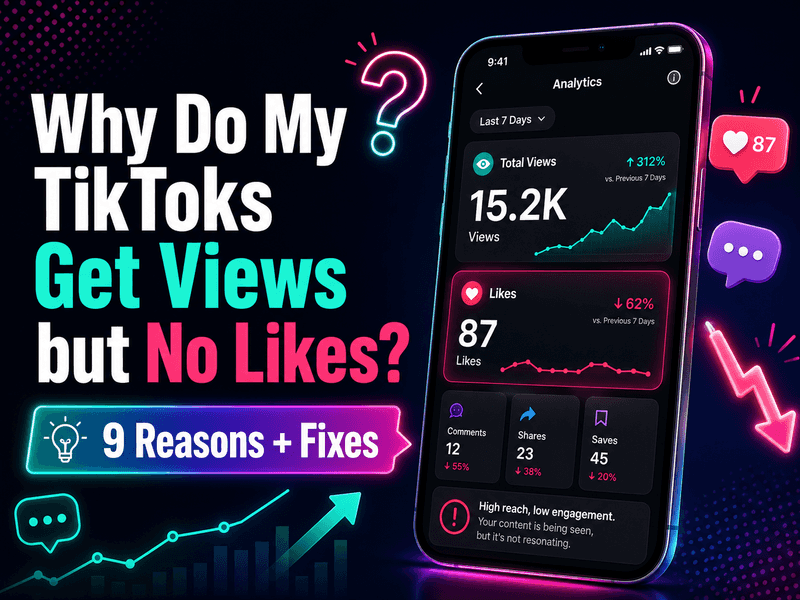
You open Analytics and see 10,000 views. That feels promising. Then you notice that the same video has 120 likes, barely any comments, and almost no shares. Another post has even more reach, yet the engagement looks just as weak.
That creates an obvious question: if people are watching, why are they not reacting?
The answer usually has less to do with TikTok “hating” your account and more to do with the difference between attention and response.
A view tells you that your video entered someone’s feed and held their attention for at least a moment. A like tells you that the content did something beyond that. Maybe it surprised them, helped them, made them laugh, challenged an assumption, reflected their experience, or gave them something worth remembering.
The All-in-One Platform for Effective SEO
Behind every successful business is a strong SEO campaign. But with countless optimization tools and techniques out there to choose from, it can be hard to know where to start. Well, fear no more, cause I've got just the thing to help. Presenting the Ranktracker all-in-one platform for effective SEO
We have finally opened registration to Ranktracker absolutely free!
Create a free accountOr Sign in using your credentials
Those are very different outcomes.
So when TikToks get views but no likes, the useful question is not simply how to get more engagement. It is figuring out where the interest disappears between the first impression and the final reaction.
That is what your analytics are really pointing toward.
Getting Seen Is Only the First Layer
Creators often treat views as a form of approval, but that is not exactly what they represent.
Think about your own scrolling habits.
You probably watch videos every day without liking them. Maybe the opening caught your attention but the rest was average. Maybe you watched because you wanted a quick answer. Sometimes you finish a video simply because it was easy enough to consume, not because you felt strongly about it.
Your viewers do the same.
The All-in-One Platform for Effective SEO
Behind every successful business is a strong SEO campaign. But with countless optimization tools and techniques out there to choose from, it can be hard to know where to start. Well, fear no more, cause I've got just the thing to help. Presenting the Ranktracker all-in-one platform for effective SEO
We have finally opened registration to Ranktracker absolutely free!
Create a free accountOr Sign in using your credentials
TikTok evaluates several interaction signals when distributing content, including watch behavior, skips, likes, comments, and shares. That means a video can accumulate views even when the deeper engagement signals remain weak.
In practical terms, a view can mean: “I was curious enough to watch.”
A like is closer to: “This was worth reacting to.”
If your account regularly gets the first response without the second, the content may already be good at generating curiosity. The next step is making that curiosity worthwhile.
10 Reasons Why You Get Views but Not Likes and its Simple Fixes
1. The Opening May Be Better Than Everything That Comes After It
Start by looking at your hook.
Suppose you open with: “This one mistake is ruining your TikTok growth.”
That creates tension immediately. People want to know what the mistake is, so they stop scrolling.
Now imagine the answer is something broad like: “You need to post more consistently.”
The problem is not that consistency is bad advice. The problem is that the viewer expected something more specific because the opening created a bigger promise.
This creates an interesting performance pattern. The hook may be strong enough to attract views, but the payoff is too ordinary to generate engagement.
A good test is to compare the emotional weight of your first sentence with the actual value delivered later.
- If the hook sounds dramatic, the answer needs to justify that drama.
- If you promise an experiment, show the numbers.
- If you tease a mistake, explain exactly why it matters.
- If you tell viewers that “nobody talks about this,” make sure the point is not something they have already heard ten times that week.
Creators spend so much time improving hooks that they sometimes forget the hook is not the content. It is only an invitation. The video still has to earn the reaction.
2. A Low Like Count Can Weaken Social Proof
Likes do more than measure engagement; they also influence how a video looks to new viewers. When a TikTok has thousands of views but very few likes, some people may assume the content did not connect strongly with others.
That is where social proof comes in. Viewers often use visible engagement, including likes and comments, as a quick signal of popularity or credibility before deciding how much attention to give a post.
For creators trying to strengthen that first impression, some choose to buy real TikTok likes on selected videos while continuing to build organic engagement.
The key is balance. Social proof can support strong content, but it should never replace useful videos, relevant targeting, and genuine audience interaction.
3. You Could Be Getting Plenty of Reach From People Who Do Not Care Enough
Here is where things become more analytical. TikTok’s recommendation system is designed to predict what users may want to watch based on their past behavior, interactions, and the information available about each piece of content.
That matching system can generate reach without producing perfect audience alignment.
Imagine you create advanced photography content and publish a video that begins with an incredible sunset over a city.
The shot itself has broad appeal. A photographer, a traveler, a casual viewer, someone interested in video editing might stop. All of them contribute to the view count.
But once you start explaining aperture settings or exposure compensation, only part of that audience has a strong reason to care.
The casual viewer may simply enjoy the visual and continue scrolling. A photographer dealing with the same problem may like the post, save it, follow your account, or ask a technical question.
This is why raw reach can be deceptive. Ten thousand highly relevant viewers may be more valuable than fifty thousand viewers who only had passing curiosity.
That can support the appearance of engagement, but it does not replace relevance. If the content consistently reaches the wrong people, the bigger strategic issue remains unchanged.
4. Your Video May Be Informative but Emotionally Empty
This problem is especially common with educational creators. The video is useful, the information is accurate and the explanation is clear. And yet the viewer feels almost nothing.
That matters because people rarely engage with content purely because it contains facts.
Compare these two introductions: “Here are three ways to improve your TikTok videos.”
And: “Creators keep blaming their editing when their real TikTok problem often starts before the video is even recorded.”
The first version tells the viewer what they are going to learn. The second creates curiosity because it challenges an assumption. Neither approach is automatically better in every situation, but the second gives the audience something to react to.
Engagement often starts with an internal response such as:
“That is exactly what I have been doing.”
“I never thought about it that way.”
“This explains why my videos keep failing.”
You do not need exaggerated controversy to create those moments. A specific observation can do the same job. Use real examples. Show what changed when you tested something. Explain why common advice does not always work.
Include details that make the viewer feel like the video came from experience rather than from a generic checklist. Useful content tells people something. Memorable content makes them feel involved in what they just learned.
5. Sometimes the Content Solves the Problem Too Fast
Short-form content rewards efficiency, but there is a difference between being concise and eliminating the entire viewing experience.
Imagine posting: “Best TikTok posting time: 7 PM.”
The viewer receives the answer immediately, but there is no context, no uncertainty, and no reason to continue exploring the idea.
Now change the framing: “Everyone says to post at 7 PM, but that advice can be completely wrong for your account.”
The subject has barely changed, but the second version opens a question.
- Why might 7 PM be wrong?
- What should the viewer check instead?
- How do they find their own best time?
The goal is not to hide the answer for twenty seconds. Viewers dislike obvious padding. The better approach is to create progression. Introduce the assumption, explain the problem with it, and then give the viewer the useful alternative. Good pacing does not make people wait for value. It makes the value unfold.
6. Your Content May Be Too Familiar to Trigger a Reaction
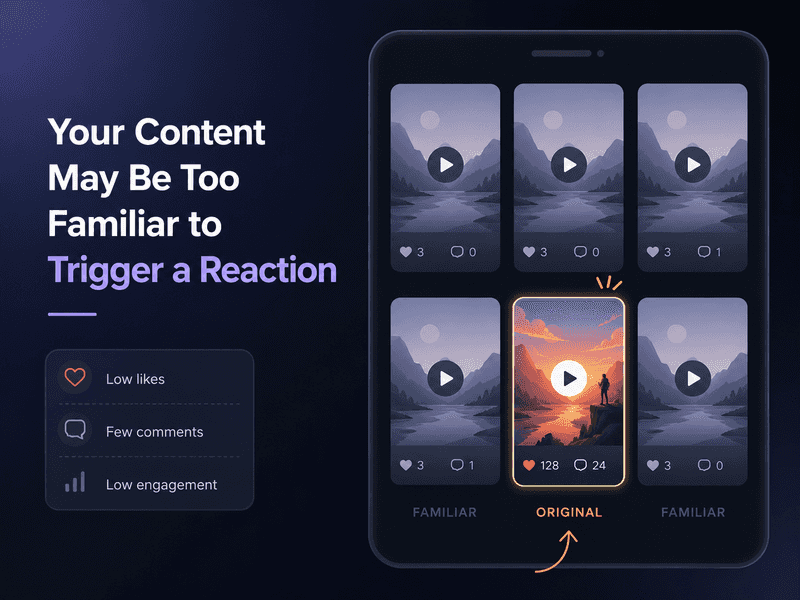
There is a quieter problem that does not show up neatly in Analytics. Some TikToks are polished but anonymous. The lighting is good, the captions are clean, the editing is fast, the creator follows a proven format. Everything works, yet nothing feels distinctive. Repeated exposure to similar formats can also lead to habituation, where people gradually respond less strongly to the same type of stimulus.
TikTok users have already seen thousands of videos beginning with variations of:
“Three things you need to know…”
“Things I wish I knew before…”
“POV: You finally…”
There is nothing inherently wrong with those structures. Familiarity can actually help viewers understand what they are about to watch. The problem appears when the content inside the structure also feels interchangeable. If another creator could deliver your exact script and nobody would notice the difference, the video probably needs more identity.
That identity does not need to be loud. Use unusually specific examples. Build recurring themes. Talk about your own tests. Develop a recognizable way of explaining difficult ideas. Say what you actually think instead of neutralizing every opinion.
Good production helps someone watch a video. A recognizable point of view gives them a reason to remember who made it.
7. Likes Are Only One Part of the Story
Suppose your latest post gets 20,000 views and 300 likes. That sounds weak if you judge the video only through the like count. But what if it also generates 800 profile visits, 150 followers, and dozens of saves? The interpretation changes immediately.
This is why TikTok Analytics should be read as a collection of behaviors rather than a scoreboard with one winning number. At the same time, strategic social media likes can contribute to social proof and shape how viewers perceive a post’s popularity and engagement.
Check:
- Average watch time
- Completion behavior
- Shares
- Comments
- Profile visits
- Followers gained
- Search traffic
- Traffic sources
A search-driven tutorial may receive lower visible engagement because viewers arrive looking for one specific answer. A relatable entertainment video may generate more likes because its main job is to create an emotional reaction. Both videos can be useful. They simply perform different jobs.
8. Specificity Usually Beats Trying to Appeal to Everyone
Consider these two topics:
“Three TikTok mistakes creators make.”
“Three mistakes small creators make after their first video reaches 10K views.”
The second idea reaches a narrower group, but the right viewer immediately sees themselves in it. That recognition is powerful. Creating content for a specific audience can also increase relevance because the message is shaped around a narrower set of interests and needs. Forbes has similarly highlighted the engagement advantages of focusing on micro-niche audiences.
Specific content can create stronger comments, saves, follows, and shares because the audience feels understood. You do not need everybody to care. You need the right people to care more.
9. Use Your Own Videos as the Benchmark
There is no single like-to-view ratio that explains every TikTok account. Different content formats create different behavior, so comparing your tutorial with someone else’s comedy clip rarely tells you much.
Instead, look at your last twenty posts.
Compare:
Views → Likes → Comments → Shares → Profile Visits → Followers
Then isolate the strongest five. What changed? Maybe those posts were more personal. Maybe the topics were narrower. Perhaps you showed the result sooner. Maybe your audience responds better when you challenge common advice instead of listing tips.
Those patterns are far more useful than chasing a universal percentage.
And when you test improvements, change one important variable at a time. If you rewrite the hook, switch the posting time, change the editing style, add trending audio, shorten the video, and use a new CTA all at once, you will never know what actually helped.
The All-in-One Platform for Effective SEO
Behind every successful business is a strong SEO campaign. But with countless optimization tools and techniques out there to choose from, it can be hard to know where to start. Well, fear no more, cause I've got just the thing to help. Presenting the Ranktracker all-in-one platform for effective SEO
We have finally opened registration to Ranktracker absolutely free!
Create a free accountOr Sign in using your credentials
Small experiments produce clearer answers.
Views Without Likes Are Still Telling You Something Valuable
If TikTok keeps giving your content reach, the platform is already finding people willing to stop and watch. That means something is working. The topic may be interesting, the opening may create curiosity, your video may match search demand or fit the behavior of your current audience.
The next task is understanding why the reaction stops there. Maybe the payoff is weaker than the hook. Perhaps the audience is too broad. The content might be informative but emotionally flat, or polished enough that it blends into everything else on the feed.
Study the posts that turn viewers into commenters, followers, sharers, and profile visitors. Those videos reveal what your audience genuinely cares about. For creators who also use trusted services such as Media Mister to strengthen visible engagement on selected posts, those likes are most useful when they support content that already gives viewers a reason to react.
Once you can see that difference, improving engagement becomes less about hoping people tap the heart and more about understanding what makes them want to respond in the first place.

