Intro
Paid social has become a creative-first channel. Targeting still matters. Bidding, of course, is at play. And landing pages are also important. But your ad creative is perhaps the most important variable because it essentially determines ad quality, cost, and conversion.
If there’s one style of ad that has won social media, it’s user-generated content (UGC). Across social platforms like Facebook, Instagram, and TikTok, UGC-style ad creatives have become super popular because they are more engaging and appear more authentic than branded ads.
And a good UGC creative can even earn a better quality score (like on Meta), which ultimately favors your ad.
In this article, we’ll cover exactly how UGC-based ads improve paid social performance and how your brand can use them in your next campaign.
What is UGC-style creative?
UGC-style creative refers to ad content that mimics the look, tone, and structure of organic user-generated content. It may feature real customers, influencers, paid UGC creators, employees, founders, or actors.
As for content format, UGC-style ads typically feature_ creator testimonials, product demos, unboxings, casual reviews, before-and-after clips,_ and quick problem-solution videos
What makes it “UGC-style” is not always who made it, but how it feels.
The All-in-One Platform for Effective SEO
Behind every successful business is a strong SEO campaign. But with countless optimization tools and techniques out there to choose from, it can be hard to know where to start. Well, fear no more, cause I've got just the thing to help. Presenting the Ranktracker all-in-one platform for effective SEO
We have finally opened registration to Ranktracker absolutely free!
Create a free accountOr Sign in using your credentials
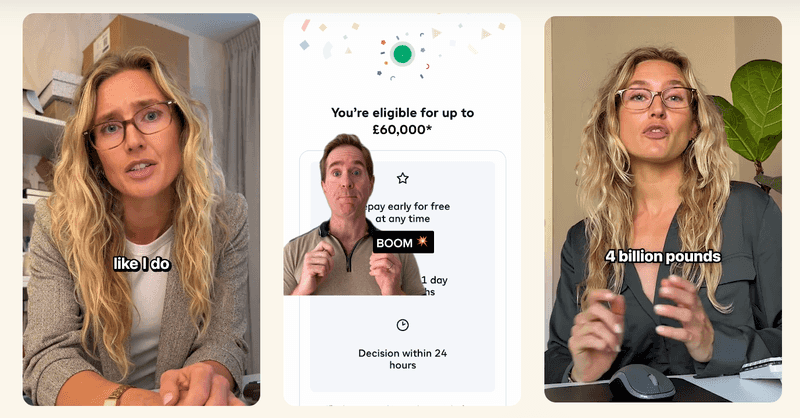
For social media marketing, UGC-style ad creatives can be used in a variety of ways. A brand can license a creator video and use it as an asset for TikTok in-feed, Reels, or Stories ads. But there are other ways, too, like creator whitelisting, where the ad appears to come from the actual creator. This can be done on Meta and TikTok (Spark Ads), with creator permission.
UGC-style ads basically combine the look and feel of organic content with the targeting, control, and budget of paid social. That hybrid quality is what makes the format powerful.
Because they involve actual users and creators, brands turn to UGC specialist agencies like Creative Milkshake for creative production and paid advertising.
Source: Creative Milkshake
What is Quality Score in paid social advertising?
Quality Score is associated with Google Ads. It’s basically a rank given to an ad based on factors like ad relevance, landing page experience, and expected click-through rate (CTR).
Although there’s no standardized ‘Quality Score’ for ads on mainstream social media platforms, there are other ways paid social algorithms measure an ad's creative quality.
The All-in-One Platform for Effective SEO
Behind every successful business is a strong SEO campaign. But with countless optimization tools and techniques out there to choose from, it can be hard to know where to start. Well, fear no more, cause I've got just the thing to help. Presenting the Ranktracker all-in-one platform for effective SEO
We have finally opened registration to Ranktracker absolutely free!
Create a free accountOr Sign in using your credentials
For instance, Meta offers something called ‘ad relevance diagnostics’ where a quality ranking is used. It looks at perceived quality based on similar ads targeting the same audience. It also looks at engagement and conversion rate rankings. The better your content engages and gets clicks, the more relevant it’s considered.
TikTok doesn’t have a quality score either, but its algorithm still responds to performance indicators such as engagement, watch behavior, click behavior, and conversion outcomes.
So, even though there’s no quality score per se, the quality of your ad creative still matters a lot for the algorithm and the audience.
How UGC-style creatives improve paid social performance
If it’s high-performance paid social you’re after, UGC should form a core part of your creative strategy. UGC ads, when done right, deliver strong performance in several ways. Here’s how:
1. Improving ad relevance
Relevance is one of the strongest connections between UGC-style creative and ad quality and performance. People respond better when an ad feels like it understands their problem, their language, and their context.
Besides, UGC is 2.4 times more likely to be perceived as authentic by the audience than branded content, according to Influee.
A UGC-style ad can improve relevance by showing:
- A person who resembles the target customer
- A real-world product use case
- A specific pain point
- A relatable objection
- A believable result
- A natural product explanation
If the ad features a real person using or talking about a product or service, it comes off as more authentic than a brand saying the same with flashy edits and product shots.
2. Increasing click-through rate
Click-through rate (CTR) is one of the clearest signs that your creative is matching audience intent. A higher CTR usually means the ad is doing two things well: stopping the scroll and giving people a reason to take the next step.
UGC-style creative performs well here because it starts with a human hook rather than a brand statement. In fact, UGC ads have 4x higher CTR than typical brand ads.
And CTR matters for ad quality because platforms use click and engagement behavior to understand whether users find an ad useful.
Although CTR is not the whole story for paid social, it’s still an important creative signal.
3. Strengthening engagement signals
Engagement signals are especially important in social feeds because platforms are built to keep people watching, reacting, and interacting. Likes, comments, shares, saves, watch time, video completion, and dwell time all help indicate whether the content is resonating with the people. That’s why marketers prefer UGC for social media (it can even be good for SEO).
UGC-style creative can strengthen engagement because it feels conversational. Instead of “Buy now,” the ad might say “Here is what happened when I tried this.” That shift makes the ad easier to comment on, save, share, or watch to the end.
This is one reason creator content works well in formats like TikTok Spark Ads and Meta Partnership Ads. TikTok’s Spark Ads use organic TikTok posts and allow views, comments, shares, likes, and follows gained during promotion to be attributed to the original organic posts. That means the engagement can compound on the post itself rather than disappearing after a standard ad flight.
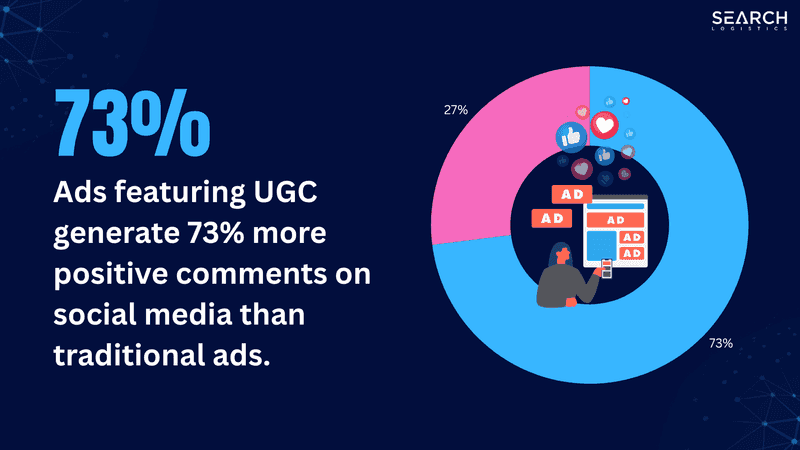
For brands, comments can also become a source of social proof. A UGC-style product demo with real questions, replies, and customer reactions looks more credible than a clean brand ad with no visible interaction.
Source: Search Logistics
4. Lowering CPMs and CPCs
UGC-style creative can even be cost-effective for your campaign budget. You want more impressions, clicks, and conversions, but at a lower cost. That’s what these ads make possible.
There is evidence that UGC-based ads can reduce costs. Influee reports that ads featuring UGC have seen a 50% reduction in CPC compared with ads without UGC.
Meta Partnership Ads, which let brands run creator content through paid placements, have also been reported to deliver 19% lower CPAs and 13% higher CTRs on average compared with standard formats, according to Meta data reported by EMARKETER.
TikTok’s Spark Ads provide another example. TikTok describes Spark Ads as a native ad format that lets brands use their own organic TikTok posts or creator posts with authorization. In one TikTok for Business example, Isle of Paradise repurposed creator testimonials and UGC for Spark Ads, generating 500% ROI, 45 million video views, and a 68% increase in weekly revenue.
Pro Tip: UGC isn’t a magic formula. Performance still depends on the product, offer, audience, landing page, pricing, creative quality, and optimization setup. But brands should definitely test UGC ads against brand ads to see what works better.
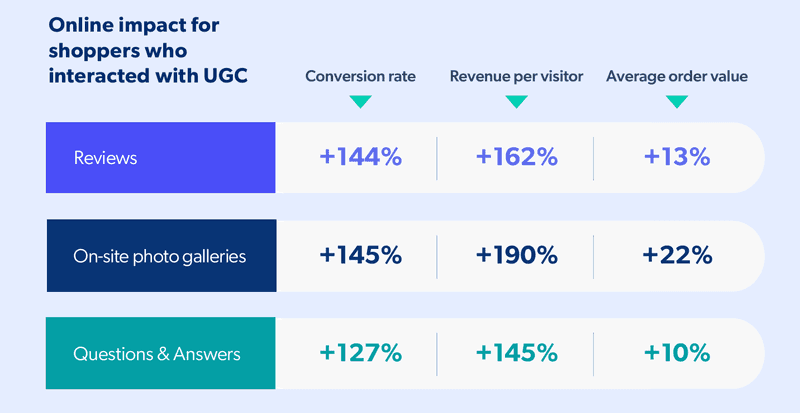
5. Supporting conversion rate
The ultimate goal of the ad is conversion, and that’s another area where UGC-style creatives are better positioned. Again, it all comes down to relatability and information.
Most buyers don’t just need to know what a product is. They need to know whether it will work for someone like them. A UGC asset from a micro-creator or even a customer or employee can answer that question better than many traditional ads.
A good UGC-style conversion ad usually includes:
- A clear problem
- A specific use case
- A visible product demonstration
- A relatable creator or customer
- Proof of outcome
- Objection handling
- A direct CTA
For example, a polished ad for a meal delivery service might show beautiful food shots and a discount. A UGC-style ad might show a busy parent opening the box, cooking the meal in real time, explaining how long it took, showing the final plate, and saying who it is best for. The second ad answers practical questions that affect conversion: Is it easy? Is there enough food? Does it look like the photo? Is it worth the price?
That is why UGC-style creative works especially well for products that need trust or education, such as beauty, wellness, food, home products, software, apps, courses, financial tools, and B2B services.
Source: Bazaarvoice
UGC-style creative vs. polished brand creative
UGC can be better than those polished, branded creatives, but that doesn’t mean the latter don’t have a place in your strategy. The best paid social accounts usually use both. The difference is in the role each format plays.
| Factor | UGC-style creative | Polished brand creative |
| Feed fit | Feels native and organic | May feel more like an ad |
| Trust | Relatable and personal | Brand-led credibility |
| Production speed | Faster to produce and test | Slower and more expensive |
| Scalability | Easier to create variations | Harder to refresh often |
| Message style | Conversational and specific | Controlled and polished |
| Best use case | Testing hooks, objections, demos, testimonials | Brand campaigns, premium positioning, launches |
When UGC-style creative works best
UGC-style creative should be used when the audience needs proof, relatability, or education before taking action.
It tends to work well for:
- Direct-response campaigns
- Product launches
- Retargeting campaigns
- Ecommerce ads
- App install campaigns
- Problem-aware audiences
- Products with visible demonstrations
- Brands with strong customer stories
- B2B products that need a practical explanation
Also, UGC can be great for a brand that needs more creative volume. A polished brand shoot might produce a few hero assets. A UGC-style production sprint can produce dozens of hooks, creator types, angles, and edits.
When UGC-style creative may not improve performance
UGC-style creative can underperform when it’s treated as a shortcut. Low-quality UGC-style ads fail because they are too scripted, too vague, poorly targeted, or have a weak hook or CTA.
Keep in mind, a strong UGC-style ad still needs a strategy. It needs a hook, a narrative, proof, pacing, captions, product clarity, and a next step. It should look native, not careless.
Creative testing tips for UGC ads
It’s incredibly important to test ad creatives, especially when you’re working with a variety of creators and also using regular brand ads.
Here are practical tips for creative testing for paid social:
- Test multiple hooks: The first three to six seconds determine whether the user keeps watching. Test several hook types, testing ideas like pain point, curiosity, comparison, proof, unpopular opinion, or surprise.
- Test different creator types: Not all UGC is the same, and creator persona and style matter a lot. A product may perform differently depending on who explains it. You might want to test different personas, depending on the product or service and its intended audience.
- Test angles, not just edits: Changing background music or captions is useful, but it’s not enough. Strong testing requires different angles, for example,_ problem-solution, before-and-after, tutorial, myth-busting, comparison, unboxing, social proof, and honest review_.
- Test video length: Shorter is not always better. A 15-second ad may work for a simple impulse product. But you might need something longer to cover the angle and provide enough information for conversion.
- Match the landing page to the ad: UGC-style ads sometimes create a personal, specific promise. The landing page needs to continue that promise. So, make the page an extension of the ad, reinforcing the offer with a similar angle.
- Read comments as creative research: Comments on UGC ads can have powerful insight (especially when using formats like partnership ads on Meta or Spark Ads on TikTok). They can tell what’s missing, if the creator is a good fit, and if the ad is making a difference.
Metrics to track for UGC ad creative performance
To measure UGC creative properly, separate creative-level metrics from funnel-level metrics.
Creative-level metrics show whether the ad is getting attention and engagement. Funnel-level metrics show whether that attention is turning into business outcomes.
The All-in-One Platform for Effective SEO
Behind every successful business is a strong SEO campaign. But with countless optimization tools and techniques out there to choose from, it can be hard to know where to start. Well, fear no more, cause I've got just the thing to help. Presenting the Ranktracker all-in-one platform for effective SEO
We have finally opened registration to Ranktracker absolutely free!
Create a free accountOr Sign in using your credentials
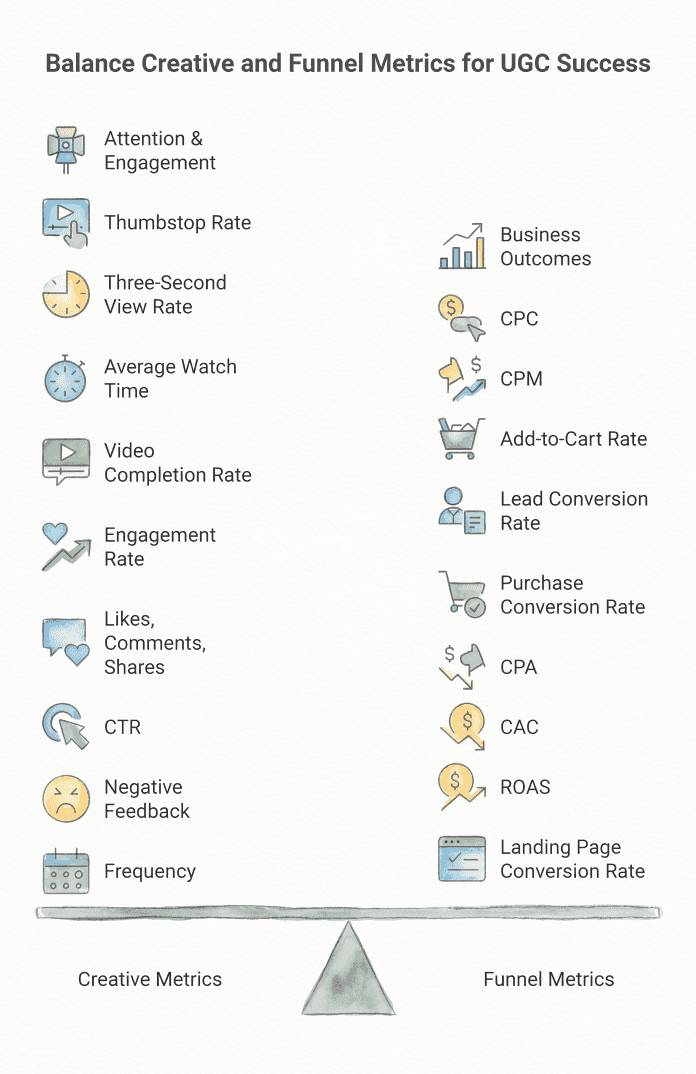
Pro Tip: A common mistake is judging UGC-style creative only by engagement. An ad can get comments because it is entertaining, controversial, or visually unusual, but still drive poor conversion quality. Another ad may have average engagement but strong CPA because it attracts high-intent buyers. So, look at the creative and funnel metrics relative to each other.
How to improve UGC-style creative for better quality signals
To improve quality signals, brands should focus on clarity,** relevance**, and trust. Follow these 10 recommendations to achieve that.
- Start with a real audience pain point. Weak UGC ads are too product-centric. Strong ones begin with the buyer’s problem. Instead of “This is our new productivity app,” try “I was losing two hours a week just tracking project updates.”
- Use a strong first-three-second hook. The opening line should make the right viewer feel seen. Avoid generic hooks like “You need this.” Use hooks that identify a specific problem, situation, or transformation.
- Show the product quickly. Don’t hide the product until the end. Show the product early enough that people understand what the ad is about.
- Make the message native to the platform. TikTok content should feel different from LinkedIn content. Reels should feel different from YouTube Shorts. Adapt pacing, captions, framing, and tone to the placement.
- Use natural language. The creator should sound like a person, not a brand guideline document. Replace corporate claims with simple, specific explanations.
- Address objections directly. Price, quality, ease of use, shipping, durability, setup time, and trust are common conversion blockers. UGC-style ads are ideal for answering these in a human voice and creating trust.
- Add captions. Many users watch without sound. Captions also make the hook and proof points easier to follow, and the ad more accessible.
- Test creator diversity. Different audiences respond to different people. Test age, style, expertise, background, and use case.
- Use a strong CTA: Make sure the CTA is clearly stated and displayed within the ad. The audience should be told what they need to do next (like click a link, sign up for a free trial, or fill out a form).
- Refresh creative before fatigue sets in. When frequency increases, and CTR decreases, performance often declines. Keep a pipeline of new UGC-style assets ready.
Final thoughts: UGC ads for the win
UGC-style creative can be high-quality and positively impact paid social performance by improving the signals that platforms and people care about most: relevance, attention, engagement, click intent, trust, and_ conversion behavior_.
UGC videos make ads feel more native, specific, and believable. This type of content helps people understand how a product fits into real life. It gives platforms better engagement and conversion signals. It gives marketers more creative variation to test. And when executed well, it can reduce costs and improve performance.
That said, it’s not a magic spell. Brands do need to put in the effort for strategy, targeting, testing, and measurement. Not every UGC ad may perform well, but with continuous testing and monitoring, you may just arrive at that winning creative that results in actual revenue growth.