
Intro
Your dashboard says the campaign is healthy. Impressions are up, CTR sits in range, spend is pacing as planned. None of that tells you whether a real person in Munich actually saw the ad you built for the German market. Platforms report what their servers logged, not what rendered on a screen, and the gap between those two things is expensive. Lunio's 2026 Global Invalid Traffic Report puts the cost at $63 billion in wasted spend during 2025, roughly 1 in 12 paid clicks going to traffic that was never going to convert. Ad verification closes that gap. You load your own campaigns the way your audience does, from their locations and devices, then compare what you see against what the platform claims. This guide covers what to check, how to build a test setup that holds up, and what to do when the numbers refuse to match.
What your own IP hides from you
Checking your ads from the office feels natural, and it's the least reliable check available. Your IP, cookies, and logged-in accounts mark you as the advertiser, so what serves to you reflects your profile, not your audience's. Google built its Ad Preview tool because searching for your own ads distorts impression data, but preview tools only simulate the auction. They won't show a competitor outbidding you at 8 pm, a banner rendering cropped on a specific placement, or the localized version serving abroad.
Personalization makes it worse: delivery adapts to browsing history, language, and device, so your desk check is a sample size of one.
The three failures worth catching
Trying to check everything kills verification programs. Most wasted budget traces to three failure types.
Ads serving outside the target geo
Location targeting misfires more often than platforms admit. A campaign set to Germany can serve to users abroad if your settings use "presence or interest" instead of physical presence. If you only operate in one country, every one of those impressions buys nothing.
Creative that renders broken
An ad that technically served but loaded cropped, unclickable, or buried under a cookie banner still counts as a paid impression. So does a landing page that takes nine seconds on mobile in the target region. Page experience cuts both ways here: the same speed and usability signals that show up in Google ranking factors also feed your Quality Score, so a slow regional page raises your CPC while it kills conversions.
Invalid traffic draining spend
Bots and fraudulent placements absorb budget at a scale most managers underestimate, and exposure varies wildly by channel. Lunio measured 24.2% invalid traffic on TikTok against 5.21% on Google Search in the same 2026 report. Your platform mix decides how much verification effort each channel deserves.
Why one location gives a false picture
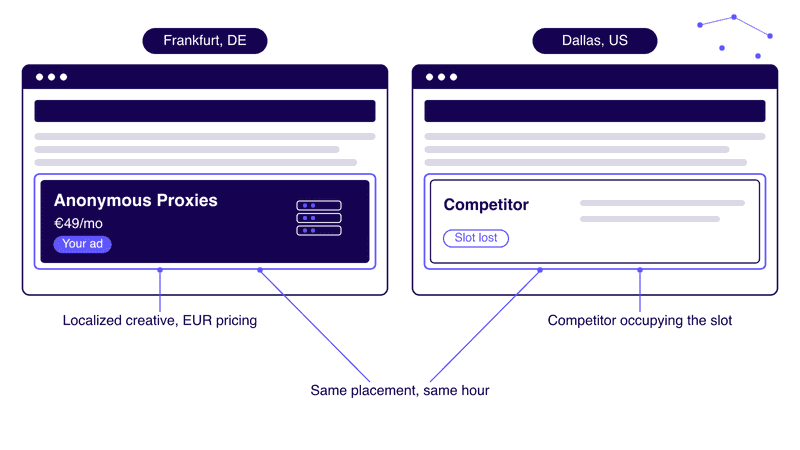
Say your campaign targets six countries. Checking from headquarters shows one version: your currency, your language, your inventory. It proves nothing about whether the French creative serves in France or the promo price renders in zloty for Polish users. To check ad placement by location, you have to appear in that location at the network level; the IP is what the ad server acts on.
SEO teams accepted this long ago. A tool like Ranktracker's Rank Tracker reports keyword positions per country and city because rankings move with the searcher's location. Paid delivery moves at least as much; auctions, inventory, and competitor pressure all differ across markets. Checking six markets from one IP is guesswork with screenshots attached.
Building a stable test identity
The tempting shortcut is a consumer VPN, and it fails twice. VPN exit nodes are shared by thousands of users, so ad platforms either flag them or serve a sanitized version of the auction. City-level accuracy is also poor: an endpoint labeled "Frankfurt" can resolve to a datacenter in another country.
You want a small set of stable identities, one per target market, that look like ordinary households and stay identical between checks. Static ISP proxies that keep the same IP fit this job: the addresses come from real consumer ISP ranges but run on stable infrastructure, so your Tuesday check in Madrid arrives from the same "resident" as the one two weeks earlier. Give each IP its own browser profile with matching timezone and language, and never log into your ad account from it. A test identity that jumps cities mid-audit produces data you can't trust and behavior that looks like the bots you're hunting.
A weekly verification workflow
One fixed hour a week covers a mid-size account.
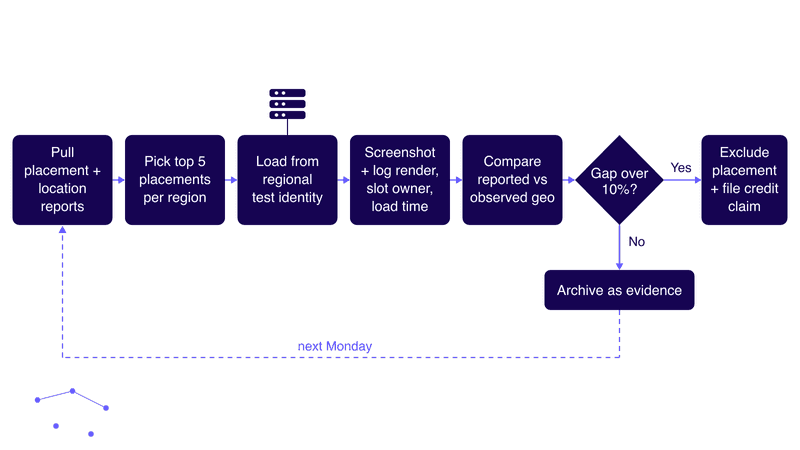
Pull placement and location reports from each platform on Monday. Sort by spend and pick the top five placements per region; they carry most of the risk. Load each one from the matching regional identity, screenshot the slot, and log whether your ad rendered correctly, who else held the slot, and how fast the landing page loaded. Then compare the platform's reported geo distribution with what your checks and analytics show.
The All-in-One Platform for Effective SEO
Behind every successful business is a strong SEO campaign. But with countless optimization tools and techniques out there to choose from, it can be hard to know where to start. Well, fear no more, cause I've got just the thing to help. Presenting the Ranktracker all-in-one platform for effective SEO
We have finally opened registration to Ranktracker absolutely free!
Create a free accountOr Sign in using your credentials
Two additions sharpen the loop. Cross-reference your screenshots with one of the ad intelligence platforms to surface competitor placements you'd never find by hand. And treat verifying how ads render by region as a standing calendar block rather than a reaction to bad numbers, because geo misfires are cheapest to fix in the week they start. The archive doubles as evidence when you file for credits.
Reading discrepancies
Small gaps are noise. Reporting lag, cached impressions, and attribution windows create a few percent of variance. Repeated gaps tied to specific placements or regions are not.
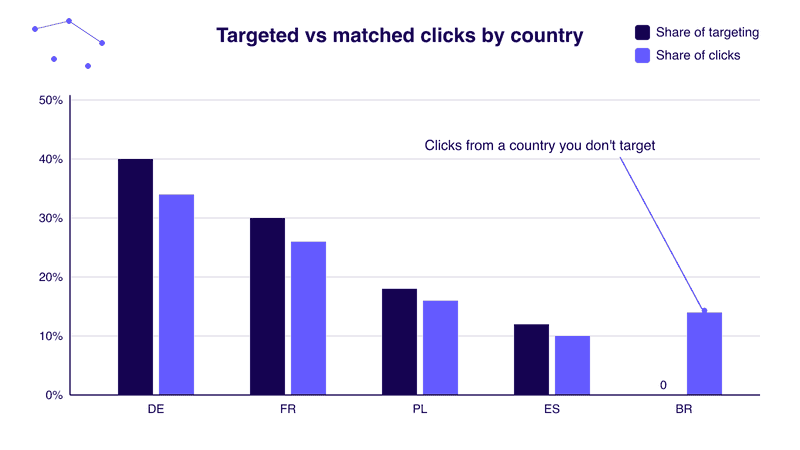
A placement pulling 40% of clicks from a country you barely target points at loose location settings. High CTR and zero conversions on a single placement is a classic bot signature. To detect invalid ad traffic, watch session duration (bot visits often die inside two seconds), click spikes at 3 am local time, and clusters of outdated browser versions.
IP filters alone won't save you. Imperva's 2025 Bad Bot Report put automated traffic at 51% of all web traffic and found that 21% of bot attacks now route through residential or ISP proxies, the same address ranges real users occupy. Behavior separates bots from humans better than blocklists do. Juniper Research, cited by Search Engine Land, projects ad fraud losses climbing toward $172 billion by 2028. Platforms filter part of that before billing; the rest is yours to find.
Staying compliant
Ad verification is a recognized practice with published IAB and MRC standards, and platforms expect advertisers to audit their own delivery. What burns accounts is sloppy execution. Don't click your own ads during checks: render checks cost nothing, self-clicks waste money and register as invalid activity on your account. Don't interact with competitor ads to drain their budget; that's click fraud, with legal exposure in most jurisdictions. Keep test volume tiny, a handful of loads per placement per week, so checks disappear inside real traffic. And timestamp everything, because refund claims get approved on evidence, not frustration.
Start with one market
You don't need the full setup on day one. Pick the region carrying the most spend, set up one test identity there, and run the workflow once this week. A single pass usually surfaces something, a placement worth excluding or a landing page slower than you thought. Expand to the next market once the habit sticks.
FAQ
How often should I run ad verification?
Weekly for steady campaigns, daily during launches or spend spikes, because that's when a misfire costs the most.
Can I check ad placement by location with a free VPN?
You can, but the data is close to worthless. Shared, flagged exit nodes see a filtered auction or none at all, and their city-level geolocation is often wrong.
What discrepancy between platform reports and my checks is normal?
Variance under roughly 5 to 10% per placement is usually reporting noise. Sustained gaps above that, concentrated on specific placements or regions, justify exclusions and a credit request.
Do platforms refund invalid traffic automatically?
Partly. General invalid traffic gets filtered before billing; sophisticated bot activity often slips through. Recovering it means filing with evidence, which is what your screenshot log is for.

