Intro
AI video has reached the point where a single demo proves almost nothing. Any of these systems can produce ten seconds of footage that looks finished on a phone screen. The separation begins the moment a person walks across the frame, a camera starts to travel, two objects collide, or a prompt asks for more than one thing to happen at once. That is where quality stops being a still frame and starts being a behaviour.
Seedance 2.5, MiniMax H3, and Wan 3 are treated here as video-generation engines under load, not as marketing products. Three quick signals frame the fight before the rounds begin. MiniMax H3 currently owns the strongest verifiable quality position, because it is the only one of the three with a live public benchmark placement and downloadable weights.
Seedance 2.5 carries the strongest motion and storytelling pedigree, inherited from a Seedance line that has topped public video rankings. Wan 3 offers the most contested picture of all: a live commercial endpoint and a headline duration, wrapped in a fog of specifications that its own maker has never published.
The champion is not revealed yet. The rounds decide it, and the evidence is uneven enough that one of the three cannot be scored on quality at all.
Seedance 2.5, ByteDance
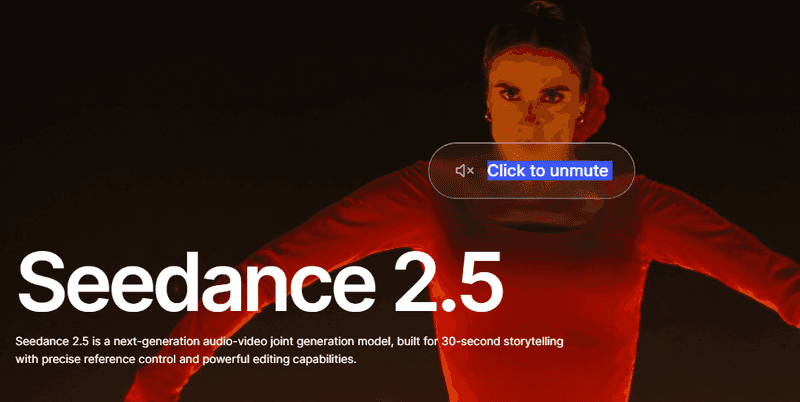
ByteDance released Seedance 2.5 on 31 July 2026, rolling it out through Jimeng (Dreamina) and the Pro tier of Doubao after a preview at the Volcano Engine FORCE conference on 23 June. The headline capability is native 30-second single-pass audio-video generation, with multi-turn extension for longer sequences, and an input ceiling of up to 50 multimodal references (30 images, 10 video clips, 10 audio clips), the widest reference budget in the category. Weights are closed. At the time of writing the public API had not gone live: ByteDance pointed developers to BytePlus ModelArk with access expected to open in early August. Independent benchmarks for 2.5 do not yet exist, though its predecessor Seedance 2.0 sits near the top of public rankings.
MiniMax H3, also called Hailuo 3.0
MiniMax released H3 to the public on 31 July 2026, the same day as Seedance 2.5, after a WAIC preview on 17 July. The official model name is MiniMax H3; Hailuo 3.0 is the app name most creators use. It generates 4 to 15 second clips at up to native 2K (2560 by 1440), 24 fps, with 32 kHz stereo audio produced in the same pass, and an omni-reference system taking up to 9 images, 3 video clips, and 3 audio clips. On the Artificial Analysis leaderboards it ranks second in text-to-video, third in image-to-video, and first in video editing. On 3 August 2026 MiniMax published open weights (a 33B transformer) to Hugging Face, with one important caveat covered later: the community licence carves out several major jurisdictions from local deployment.
Wan 3, Alibaba
The All-in-One Platform for Effective SEO
Behind every successful business is a strong SEO campaign. But with countless optimization tools and techniques out there to choose from, it can be hard to know where to start. Well, fear no more, cause I've got just the thing to help. Presenting the Ranktracker all-in-one platform for effective SEO
We have finally opened registration to Ranktracker absolutely free!
Create a free accountOr Sign in using your credentials
Wan 3 is the most over-described model in AI video right now. What is verifiable:
Alibaba lists it on its own Qwen Cloud platform as wan3.0-video, with a live DashScope endpoint, published per-second pricing, and a 30-second maximum duration across text, image, audio, and video inputs. What is not true, despite dominating the first page of search results: it is not 4K (the price sheet has only 480p, 720p, and 1080p tiers), it is not open-weight (the last Wan flagship released under Apache 2.0 was Wan 2.2, over a year ago), and it has no independent benchmark placement anywhere.
A cluster of lookalike domains publishes confident specification tables (native 4K, a 27B or 60B mixture-of-experts architecture, an April 2026 open release) that trace back to no first-party source and contradict each other. A model that had shipped 4K would carry a 4K price. The absence of that tier is stronger evidence than any marketing claim. For this showdown, Wan 3 competes as a callable product with a real duration ceiling and an unknown quality.
The scoreboard
Seven dimensions carry the whole comparison. Every dimension is scored on a 100-point scale, and the numbers are not calculated mechanically from specifications. They represent the strength of the available evidence, which is why ranges appear instead of single figures, and why they widen sharply for Wan 3. Close scores are not laboratory measurements. Their only job is to make comparative differences legible at a glance.
| Judging dimension | Seedance 2.5 | MiniMax H3 | Wan 3 (provisional) |
| Picture quality | 86 to 91 | 89 to 93 | 77 to 88 |
| Movement | 85 to 90 | 84 to 89 | 76 to 86 |
| Scene stability | 85 to 90 | 85 to 90 | 79 to 88 |
| Prompt execution | 85 to 90 | 87 to 92 | 77 to 87 |
| Camera behavior | 85 to 90 | 84 to 89 | 77 to 86 |
| Human consistency | 86 to 91 | 86 to 91 | 77 to 87 |
| Creative range | 84 to 89 | 87 to 92 | 78 to 88 |
Table 1. Opening scoreboard. Ranges reflect evidence confidence, not measurement precision.
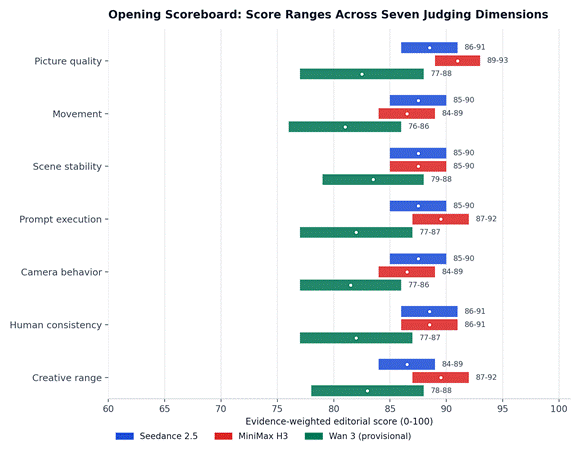
Figure 2. The same scoreboard as horizontal ranges. The dot marks each range midpoint. Wan 3 bars run wide because so little of its quality is confirmed.
The All-in-One Platform for Effective SEO
Behind every successful business is a strong SEO campaign. But with countless optimization tools and techniques out there to choose from, it can be hard to know where to start. Well, fear no more, cause I've got just the thing to help. Presenting the Ranktracker all-in-one platform for effective SEO
We have finally opened registration to Ranktracker absolutely free!
Create a free accountOr Sign in using your credentials
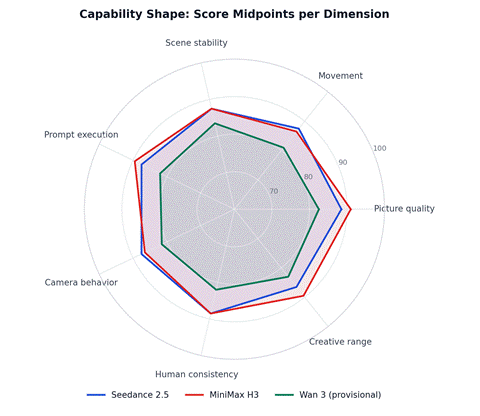
Figure 3. Capability shape using range midpoints. Seedance 2.5 leans toward movement and camera work; MiniMax H3 leans toward picture, prompt, and range; Wan 3 trails on every axis for lack of evidence, not for proven weakness.
Round 1: the single-shot beauty test
The challenge is the easy one on purpose: a person in cinematic light, a landscape, a luxury interior, a slow close-up. The point is which model produces the most convincing first frame and then holds that quality for the length of the shot. Sharpness is not realism. Over-processed skin, plastic micro-detail, and unstable textures can all read as impressive on a thumbnail and fall apart in motion.
MiniMax H3 has the cleanest evidence here. Native 2K output is a documented specification rather than a claim, and its second-place text-to-video ranking is built partly on how finished single shots look. Seedance 2.5 clearly targets premium imagery too, and its lineage suggests strong results, but ByteDance did not publish a matching 2K resolution figure for 2.5 at launch, so its top-end sharpness is inferred rather than confirmed. Wan 3 tops out at a documented 1080p, a rung below.
**Round winner: MiniMax H3. **Closest challenger: Seedance 2.5. The reason is narrow and honest: H3 wins on a resolution figure that is written down, not on a demonstrably prettier frame.
Round 2: people actually moving
Difficulty rises. Walking, turning, running, dancing, sitting, standing, picking things up, passing an object between two hands. This round rewards temporal quality, not pretty frames. The failure signatures are joint instability, feet that slide or plant wrong, sudden limb deformation, and weight that never transfers.
A published side-by-side fight test is the most useful single piece of evidence in this round. In it, Seedance 2.5 stayed easier to follow through the fastest movement, and a subject in a white outfit with red hair remained readable while the camera swept. H3 reached for more aggressive shot variety and sharper cutting, which looks energetic but is a different strength. Neither result solved choreography: guard positions drifted and some reactions lacked a visible cause. On the narrow question of whether movement feels intentional rather than merely animated, Seedance edged it.
**Round winner: Seedance 2.5. **Motion legibility under speed is the Seedance line's inheritance, and the one direct comparison available supports it.
Round 3: the camera starts moving
Tracking, push-ins, pull-outs, orbits, pans, tilts, low-angle travel, following a moving subject. The test is whether the scene stays structurally stable as the viewpoint changes, and whether the camera move is the one the prompt asked for rather than random cinematic drift that happens to look filmic.
Seedance 2.5 carries explicit AI camera control forward from its predecessor and adds viewpoint and camera edits as first-class controls. The same fight-test footage showed a subject holding identity through sweeping motion, which is exactly the background-reconstruction problem this round targets. H3 handles motion well and markets film-cadence movement, but its controls are described in more general terms. Requested-versus-incidental camera behaviour favours the model that exposes camera direction explicitly.
**Round winner: Seedance 2.5. **Documented camera controls beat a general promise of cinematic movement.
Round 4: too much happening at once
This round tries to break things. Three or more people, crowds, busy streets, restaurants, factories, festivals, markets, traffic. The measures are scene organisation, subject persistence, background coherence, object count, and whether the model keeps several simultaneous instructions alive. A gorgeous clip that quietly drops half the requested scene should not score.
Here the evidence turns candid. ByteDance itself notes that complex physical motion and scenes with very many interacting subjects still have room for improvement, which is a rare and useful admission about Seedance. H3 has no crowd-specific benchmark to lean on, and its strengths are demonstrated on tighter shots. Nothing in the record separates the two on dense scenes with any confidence, and both visibly strain.
**Round result: drawn. **Crowd handling is an open problem for both, and pretending otherwise would be the exact demo-flattery this article exists to avoid.
Round 5: hands, objects, and contact
One of the hardest sections. Pouring a drink, opening a box, holding a phone, using a tool, cooking, writing, passing an object, touching another person, handling a small product. The moment to watch is physical interaction: finger mutation, object fusion, items that vanish or change shape, impossible contact, grips that break. This is the round that decides whether advertising and product footage is usable without heavy cleanup.
No credible source demonstrates reliable hand-object contact from any of the three across varied prompts. A single successful clip proves nothing, because contact is where variance is highest and cherry-picking is easiest. H3 testers report clean results on specific shots; Seedance 2.5's region-level editing offers a repair path when contact fails, which is a workflow advantage rather than a generation advantage. Neither earns a confident win.
**Round result: drawn, cautiously. **Success in one clip is not reliability across a campaign.
Round 6: physics under pressure
Water splashing, smoke, fire, fabric, blowing hair, falling objects, turning cars, bouncing balls, pouring liquid, breaking materials, wind. Generative video routinely produces motion that looks plausible without modelling physics at all, so the judgement is perceived physical credibility: momentum, gravity, collision behaviour, fluid continuity, how materials actually behave.
This is analysis, not promotion, and the honest reading is that none of the three has a published physics evaluation. Seedance's motion pedigree hints at an edge on momentum and fluidity, and ByteDance's own caveat about complex physical motion tempers that hint at the same time. H3's physics behaviour is undemonstrated at scale. Wan 3 is unmeasured entirely.
**Round result: drawn. **Physical credibility remains the softest ground in the whole category, and no contender has earned a claim on it.
Round 7: character identity
Does a person stay recognisable through a clip, and harder still, across separate generations? Face structure, hair, clothing, accessories, apparent age, proportions, skin. This is where short-form drama lives or dies, because a jaw that shifts half a centimetre on the fourth shot loses the viewer.
Both models attack this with reference systems, and this is where the evidence quietly favours H3. A hands-on tester running a real project through H3's omni-reference, with images, a video clip, and audio, reported character consistency noticeably better than expected and clean on-screen text, and H3 holds the top spot in video editing, which is adjacent to identity retention. Seedance 2.5 counters with a far larger reference budget, up to 50 assets, and production-grade consistency positioning, but for version 2.5 that remains a vendor claim rather than an attested result. Bigger reference capacity is promising; a tester's confirmed outcome is stronger.
**Round winner: MiniMax H3. **Attested consistency outranks a larger but unverified reference ceiling. Reference-image control changes results for both, and neither should be assumed to hold identity without it.
Round 8: prompt obedience
Different prompt shapes reward different models: a simple visual line, a narrative, a camera-heavy brief, an action-heavy brief, a dense cinematic description, and a prompt with several sequential actions. The judgement covers instruction retention, subject and action accuracy, environment, style, camera compliance, and temporal order. A stunning video that ignores the brief is a failure, not a triumph.
H3 has two concrete advantages. Its second-place text-to-video ranking is itself a proxy for instruction following, and its API documents a 7,000-character prompt budget, which is room for genuinely layered direction. Seedance 2.5 follows instructions well and adds strong multi-language support, and its timestamp control is excellent for the specific sub-case of sequential actions that must land at defined moments. For general obedience across prompt shapes, the measured model leads; for time-coded action sequences specifically, Seedance is the sharper tool.
**Round winner: MiniMax H3. **A measured prompt-following position plus a very large prompt budget, with Seedance the pick when actions must be timed to the beat.
Round 9: cinematic instinct
The unmeasurable qualities: shot composition, lighting choices, atmosphere, sense of scale, camera rhythm, colour relationships, drama, visual storytelling. A real question sits underneath this round. Some models quietly beautify a plain prompt; others follow instructions literally. Automatic enhancement is a gift when a brief is thin and a liability when a brief is precise and the model overrides it.
Seedance's lineage is steeped in cinematic output, and its explicit camera and viewpoint tools let a creator direct rhythm rather than accept whatever the model prefers. H3 produces handsome, film-cadence results and leans toward automatic polish, which flatters casual prompts and can fight a demanding one. For creators who want the camera to obey a plan, directability tips this toward Seedance.
**Round winner: Seedance 2.5. **Cinematic control, not just cinematic looks.
Round 10: stylised content
Photorealism is not the only test. Anime, illustration, fantasy, surreal scenes, claymation, 3D animation, comic-book visuals, painterly video. The real question is whether motion stays coherent when the visual rules are deliberately unrealistic, and which model reaches furthest beyond realistic footage.
H3 is built as a general-purpose, omni-modal generation model rather than a realism-first video engine, and that framing is exactly what broad stylistic range demands. Seedance 2.5 is positioned as a production system aimed at commercial and narrative realism, which is a strength elsewhere and a slight narrowing here. For range across non-realistic styles, the generalist has the wider envelope.
**Round winner: MiniMax H3. **A general-purpose design covers more stylistic ground than a production-tuned one.
Round 11: commercial video
Judged from a paid creative's chair. Perfume ad, sneaker commercial, food promotion, automotive, fashion campaign, tech product launch, travel spot. The measures are product integrity, controlled movement, luxury aesthetic, reusability, and how much post-production the output demands. Text is the honest sticking point: none of these models can be trusted to preserve typography or a logo reliably, so any on-screen branding should be composited in later rather than generated.
Seedance 2.5 is engineered for this. Region-level editing redraws part of a frame while leaving performance and lighting intact, green-screen editing swaps backgrounds while the subject holds, and white-model control blocks a shot with untextured geometry before lighting. That is a commercial control suite, not a single generator. H3 answers with native 2K, clean text in tester reports, and instruction-based edits that avoid a full re-roll, which is real, but Seedance's toolset maps more directly onto how ad shots are actually built and revised.
**Round winner: Seedance 2.5. **Region editing, green-screen, and white-model blocking are production controls advertising teams already think in.
Round 12: short-form social
Usefulness for TikTok, Reels, Shorts, vertical ads, creator B-roll. The measures are speed, visual hook, vertical framing, fast motion, ease of spinning up many variations, and consistency across a batch. This round can crown a different winner from the cinematic one, which is welcome rather than a contradiction.
H3's shape fits short-form almost exactly: 4 to 15 second clips are the native length of the format, 2K gives room to crop into vertical, audio arrives in the same pass, and instruction-based edits let a creator iterate variations without regenerating from scratch. Seedance 2.5's 30-second single take is more than most short-form needs, and its power is aimed at longer, more directed work. For volume vertical output, H3 is the more natural fit.
**Round winner: MiniMax H3. **Native short-clip length, 2K crop headroom, one-pass audio, and fast variation.
The round tally, and why it does not settle everything
Twelve rounds produced a narrow split. MiniMax H3 took five, Seedance 2.5 took four, three were drawn on genuinely open problems, and Wan 3 took none. Wan 3's blank column is not a verdict that it is weak. It is a verdict that its quality is unproven: no round could be awarded to a model with no verifiable quality evidence, and inventing wins for balance would betray the method.
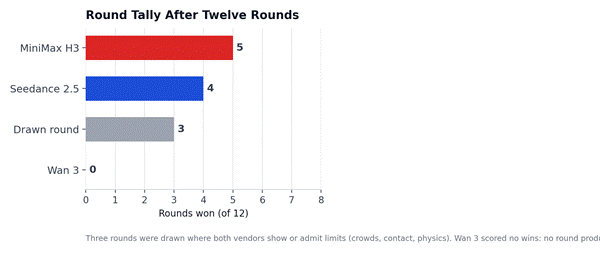
Figure 4. Round tally. H3's wins cluster on verifiable strengths (resolution, attested consistency, measured prompt-following, range, short-form); Seedance's wins cluster on motion craft and commercial control tooling.
There is a real tension worth naming. On several of the hardest craft rounds, motion and camera and commercial control, Seedance 2.5 looks like the stronger pure video engine. Yet the overall title, decided later on evidence weight, does not simply follow the round count. The rounds measure where each vendor's evidence and positioning is strongest. The championship measures which quality is actually verified and which access is actually real.
Where each model still falls apart
Every generative video model breaks in patterns. These are the failure signatures most consistent with the available evidence, not weaknesses invented to force a tidy balance.
Seedance 2.5
The two most credible weak points come from ByteDance's own framing and from the wider record: dense scenes with many interacting subjects, and complex physical motion, both of which the maker concedes have room to improve. Hand-object contact remains unreliable across varied prompts, as it does for the field. And a practical failure that is not about pixels at all: at the time of writing the public API had not shipped, so integration into an automated pipeline was blocked regardless of output quality.
MiniMax H3
The headline risk is a licensing failure rather than a rendering one. The open weights exclude the United States, European Union, United Kingdom, and Korea from local deployment, and the smallest working local setup runs natively at 768 pixels on the short edge, with true 2K arriving only through a hosted regeneration pass that did not ship in the downloadable release. On output itself, crowds and physics are undemonstrated, contact is unreliable, and clip length caps at 15 seconds natively, short for narrative work.
Wan 3
The defining weakness is epistemic. No independent benchmark, no technical report, no model card, and no leaderboard placement means every quality claim about Wan 3 is unverified. Around it sits a layer of fabricated specifications (4K, open weights, exotic parameter counts) that a careful reader must actively discount. The one hard commercial fact is unfavourable: at 1080p its price works out higher than every measured model above Alibaba's own Wan 2.7 on the public rankings.
Specifications, kept in their place
Only after the quality analysis do the numbers belong on the page, and several of them are marked uncertain because their makers left them unstated. Specifications describe potential, not performance.
| Attribute | Seedance 2.5 | MiniMax H3 | Wan 3 |
| Max resolution | Not published for 2.5 | 2K (2560 x 1440) | 1080p (per price sheet) |
| Max duration | 30s single-pass | 4 to 15s (extendable) | 30s |
| Native audio | Yes | Yes, 32 kHz stereo | Yes |
| Image references | Up to 30 | Up to 9 | Omni-modal, unstated |
| Video / audio refs | 10 video, 10 audio | 3 video, 3 audio | Supported, unstated |
| First / last frame | Supported | Yes (both frames) | Supported |
| Video extension | Multi-turn extend | Extendable to ~30s | Editing / driving modes |
| API availability | Pending (ModelArk) | Live | Live (Qwen Cloud) |
| Open weights | No | Yes, with carve-outs | No |
| Independent benchmark | None (2.0 ranks high) | #2 T2V, #1 editing | None |
Table 2. Technical reference. Fields left unstated by the vendor are labelled as such rather than filled with plausible guesses.
Getting hold of the models
Availability separates these three as sharply as any quality metric. MiniMax H3 is the easiest to reach and the easiest to automate: a live API, a public app, and downloadable weights for teams outside the excluded jurisdictions, with the important footnote that local generation is 768-pixel native and true 2K stays hosted. Wan 3 has a live commercial endpoint on Alibaba's Qwen Cloud with published pricing and modest concurrency limits (two concurrent requests, a 50-task async queue, 30 requests per minute), so it can be built on today, quality risk accepted. Seedance 2.5 is the friction case: reachable through Jimeng and Doubao for manual creation, but with no public API at the time of writing, which stops any developer workflow at the door until ByteDance opens ModelArk access.
The blunt question for a production team is whether a model can be dropped into a regular pipeline. Two of the three answer yes today. Seedance 2.5 answers not yet, however strong its output proves to be.
The real cost is per clip that works
Subscription and per-second prices are the wrong comparison. The number that matters is cost per usable result. A cheaper model becomes expensive fast if a creator burns ten generations to land one acceptable clip, and a pricier model with a high usable-shot rate can be the cheaper choice in practice. No honest per-successful-clip figure can be published for any of these models, because the usable-shot rates are not measured, so the principle has to be applied qualitatively.
The All-in-One Platform for Effective SEO
Behind every successful business is a strong SEO campaign. But with countless optimization tools and techniques out there to choose from, it can be hard to know where to start. Well, fear no more, cause I've got just the thing to help. Presenting the Ranktracker all-in-one platform for effective SEO
We have finally opened registration to Ranktracker absolutely free!
Create a free accountOr Sign in using your credentials
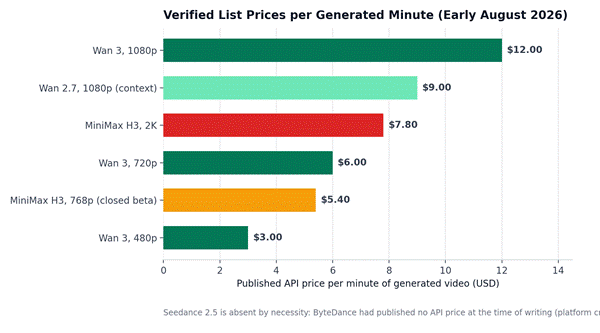
Figure 5. Verified list prices per generated minute. Seedance 2.5 is absent because ByteDance had published no API price at the time of writing; only platform credits existed.
On published list prices, MiniMax H3 is the cheapest of the measured options at 7.80 dollars per minute for 2K. Wan 3 sits at 12.00 dollars per minute at 1080p, roughly a third more than Alibaba's own Wan 2.7 and more expensive than every model ranked above Wan 2.7 on the public leaderboard, while offering no benchmark of its own. That combination, priced above the measured field with quality unknown, is the sharpest commercial caution in this comparison. Seedance 2.5 cannot be placed on the axis yet, because only platform credits existed at the time of writing. Applied qualitatively, H3's low price paired with an attested quality position gives it the strongest cost-per-usable-clip case, and Wan 3's premium-for-the-unproven gives it the weakest.
Quick calls by job
For film-like shots
Seedance 2.5, with MiniMax H3 as the alternative. Directable camera and viewpoint controls plus a cinematic lineage suit shot-by-shot craft. H3 is the fallback when a verified 2K frame and a live API matter more than fine camera direction.
For fast-moving scenes
Seedance 2.5, with MiniMax H3 as the alternative. The one direct motion comparison favoured Seedance for legibility under speed. H3's sharper cutting is a stylistic edge rather than a motion-stability edge.
For advertising
Seedance 2.5, with MiniMax H3 as the alternative, once its API lands. Region editing, green-screen, and white-model blocking match how spots are built and revised. H3's cleaner on-screen text and instant availability make it the pragmatic choice while Seedance's API is pending.
For human characters
MiniMax H3, with Seedance 2.5 as the alternative. A tester's confirmed omni-reference consistency and a top editing ranking outweigh Seedance's larger but unverified reference budget. Seedance takes over when continuity across a long, multi-shot sequence is the priority.
For experimental visuals
MiniMax H3, with Wan 3 as a distant alternative. A general-purpose omni-modal design covers stylised and surreal work more comfortably than a realism-tuned production system.
For developers
MiniMax H3, with Wan 3 as the alternative. H3 offers a live API, documented parameters, and weights within permitted regions. Wan 3 is callable today for teams that need a 30-second single take and can accept unmeasured quality; Seedance 2.5 is out until its API opens.
For local control
MiniMax H3 where the licence permits, otherwise Wan 2.2 remains the honest open-weight answer for self-hosting. Neither Seedance 2.5 nor Wan 3 ships weights, so on-premise deployment of either is not an option.
The final scoreboard
Back to the seven dimensions, now as totals. Because the scoreboard measures evidence strength rather than vendor ambition, MiniMax H3's verified position lifts its total narrowly clear of Seedance 2.5, whose 2.5-specific evidence is thinner. The ranges overlap, which is the honest signal that on craft the top two are within touching distance. Wan 3 sits well back with the widest range and the lowest confidence.
| Model | Total (of 700) | Confidence | Best / weakest category |
| MiniMax H3 | 602 to 636 | Medium-high | Best: picture, range / Weakest: camera |
| Seedance 2.5 | 596 to 631 | Medium | Best: movement, camera / Weakest: crowds |
| Wan 3 | 541 to 610 | Low | Best: duration / Weakest: unverified quality |
Table 3. Final scoreboard. Totals are the sum of the seven evidence-weighted dimension ranges.
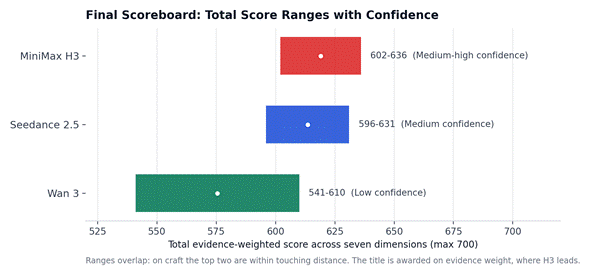
Figure 6. Total score ranges with confidence. The overlap between the top two is the point: the title turns on evidence weight, not a runaway lead.
Champion, runner-up, and specialist pick
Overall champion: MiniMax H3
H3 wins because it is the only contender whose quality is verified rather than promised. It holds a live, high public benchmark placement, ships downloadable weights, runs on a working API today, and has the cleanest cost position of the measured field. It also produced attested character consistency and clean on-screen text in real hands-on use. It does not win every round, and it is not obviously the prettier or the more cinematic engine. It wins the showdown's own test: when the beautiful demos are set aside, it is the model whose repeatable performance can actually be confirmed.
Runner-up: Seedance 2.5
Seedance 2.5 has the higher ceiling and the strongest craft case: better motion legibility in the one direct comparison, explicit camera control, the deepest commercial editing suite, and the largest reference budget in the category, backed by a lineage that has topped public video rankings. It loses the title on two counts that the method cannot ignore: its 2.5-specific quality is not yet independently measured, and its public API had not shipped at the time of writing. The moment that API opens and independent benchmarks land, this ordering could invert.
Specialist pick: Wan 3
Wan 3 earns a specialist nod for one concrete, verifiable advantage: a live API today that generates a full 30-second take in a single pass, which suits a team that needs an entire spot in one seamless generation and cannot wait for Seedance's endpoint. That advantage is about availability of a specific capability, not demonstrated quality, and it should be chosen with eyes open, above Alibaba's own measured model on price and unproven on the leaderboard. It is a tool for a narrow job, not a general recommendation.
Verdict
If all three can produce a beautiful demo, the one that keeps performing when the scene turns difficult is the one whose difficulty performance is actually verified. On today's evidence that is MiniMax H3: measured, downloadable, callable, and affordable, even though it is not the flashiest engine in the room. Seedance 2.5 is the more exciting video model on craft and may take the crown once its API and benchmarks arrive, which makes it the one to watch rather than the one to build on this week. Wan 3 is a real, callable product buried under fabricated specifications, worth using only for its 30-second single-take availability and worth approaching with active skepticism everywhere else. The recommendation changes with the job: reach for Seedance when directable cinematic craft and commercial editing lead, reach for H3 when verified quality, character work, short-form volume, or a live pipeline lead, and reach for Wan 3 only when a single long take, callable today, is the specific requirement. Above all, do not pay for 4K on Wan 3. It is not on the menu.