
Intro
Modern SEO is no longer limited to manual spreadsheets and occasional ranking checks. Today, most decisions are based on large volumes of data: competitor rankings, SERP structure, content updates, pricing changes, indexing status, catalog monitoring, and much more.
When a project operates with thousands of keywords or pages, collecting data manually becomes impossible. This is why SEO teams rely on web scraping - automated collection of information from websites and search engines.
These systems help monitor rankings, analyze competitors, collect ecommerce data, verify regional search results, and detect technical issues across websites.
However, as the number of requests grows, another challenge appears - infrastructure. Even a well-built scraper becomes unstable if traffic routing, request distribution, connection speed, and regional targeting are not properly managed.
For this reason, large-scale SEO projects usually treat web scraping as a full infrastructure system rather than simply a set of scripts.
How MangoProxy Is Used in Scraping Tasks
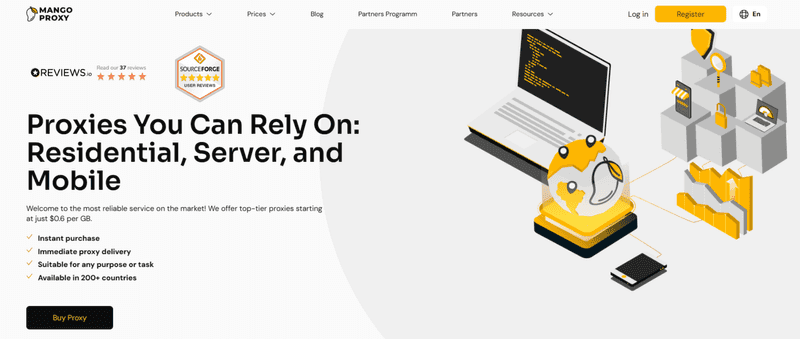
MangoProxy is a proxy infrastructure service designed for tasks related to automation, data collection, monitoring, and scalable traffic management.
The All-in-One Platform for Effective SEO
Behind every successful business is a strong SEO campaign. But with countless optimization tools and techniques out there to choose from, it can be hard to know where to start. Well, fear no more, cause I've got just the thing to help. Presenting the Ranktracker all-in-one platform for effective SEO
We have finally opened registration to Ranktracker absolutely free!
Create a free accountOr Sign in using your credentials
The platform provides residential, ISP, mobile, and datacenter proxies with support for both HTTP and SOCKS5 protocols. Management is available through a dashboard and API access, allowing teams to integrate proxies directly into scraping systems and automated workflows.
Rotating proxies are typically used for dynamic tasks, while dedicated IPs are more suitable for long sessions and persistent connections.
The service supports proxy locations across more than 200 countries for rotating connections and more than 40 countries for static infrastructure.
Proxy Types and Their Use Cases
Different scraping tasks require different infrastructure approaches. There is rarely a universal setup - the choice depends on request type, traffic volume, geography, and session duration.
Residential Proxies
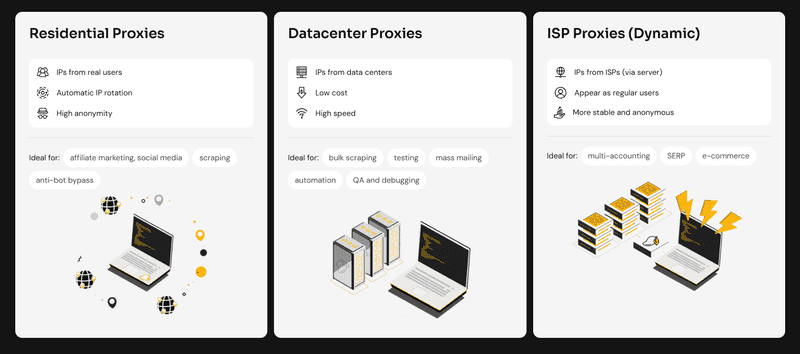
Residential proxies operate through IP addresses associated with household internet providers. This type of connection is commonly used for collecting search engine results, monitoring ecommerce platforms, and analyzing localized content.
Many SEO teams use residential proxies for collecting SERP data from multiple regions simultaneously.
ISP Dynamic Proxies
ISP dynamic proxies combine server infrastructure with ISP routing. They are often used in systems where speed, stability, and regular request rotation are important.
This format works well for monitoring, automation, and scalable crawling systems.
ISP Static Proxies
ISP static proxies provide dedicated IP addresses with long-term session stability. They are typically used in workflows where persistent connectivity and predictable infrastructure behavior are required.
Examples include dashboard systems, automated accounts, and ongoing SEO operations.
The All-in-One Platform for Effective SEO
Behind every successful business is a strong SEO campaign. But with countless optimization tools and techniques out there to choose from, it can be hard to know where to start. Well, fear no more, cause I've got just the thing to help. Presenting the Ranktracker all-in-one platform for effective SEO
We have finally opened registration to Ranktracker absolutely free!
Create a free accountOr Sign in using your credentials
The promo code RANKTRACKER provides an 8% discount on MangoProxy static ISP proxies.
Datacenter Dynamic Proxies
Datacenter dynamic proxies are commonly used in high-volume tasks where scalability and speed are the main priorities.
They are often integrated into parsers, technical monitoring systems, and internal SEO tools.
Datacenter Static Proxies
Static datacenter proxies are suitable for integrations, API-related tasks, and infrastructure systems requiring dedicated long-term connections.
Mobile Proxies
Mobile proxies operate through mobile carrier networks. They can be used for mobile SERP verification, app monitoring, and mobile-first analysis scenarios.
Simple Explanation of Common Terms
Rotating Proxies
Rotating proxies automatically change IP addresses during operation. This helps distribute requests evenly across multiple connections.
For scraping infrastructure, this becomes especially important when handling large request volumes.
Dedicated Proxies
Dedicated proxies use a single fixed IP address assigned to one user. They are commonly chosen for long sessions and stable connections.
Request Distribution
Request distribution refers to sending traffic through different IP addresses, regions, and sessions. This helps avoid excessive load concentration on individual connections.
Session Stability
Some workflows require a stable IP address over an extended period. Session stability means maintaining the same session instead of rotating constantly.
API Integration
Many proxy providers offer APIs for automated connection management, proxy rotation, and infrastructure configuration.
Pricing and Payment Models
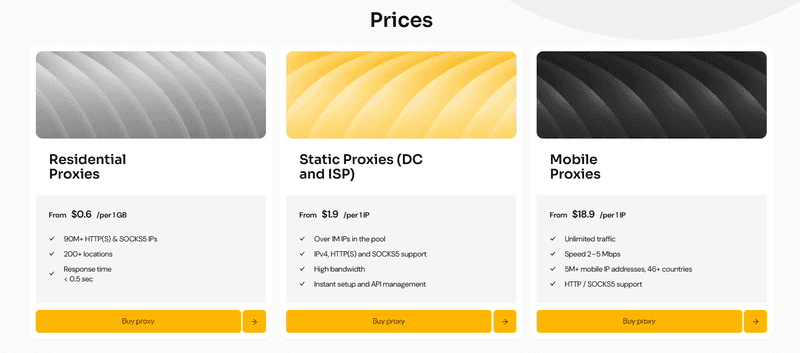
Proxy infrastructure is usually billed either by traffic volume or by the number of IP addresses.
MangoProxy supports both pricing models.
Traffic-based plans:
- Residential - from $2.00 per GB
- ISP Dynamic - from $0.80 per GB
- Datacenter Dynamic - from $0.60 per GB
IP-based plans:
- ISP Static - from $2.18 per IP
- Datacenter Static - from $1.43 per IP
- Mobile proxies - from $18.9 per IP
Pricing depends on the connection type, request volume, and infrastructure stability requirements.
Practical Use Cases
Regional SERP Monitoring
Search results can vary depending on country, city, and even device type. SEO teams collect localized SERP data to compare rankings, featured snippets, and advertising placements across regions.
Residential proxies are commonly used for these tasks.
Competitor Monitoring
Companies automatically track competitor websites for new pages, pricing updates, metadata changes, and catalog modifications.
Such systems usually operate continuously and require stable proxy infrastructure.
Ecommerce Data Collection
Online stores and analytics platforms collect data about products, categories, stock availability, and price dynamics.
These workflows typically rely on rotating proxies and distributed request infrastructure.
Technical SEO Monitoring
Some teams build custom crawlers to identify broken links, redirect chains, duplicate pages, and indexing issues.
As these systems scale, proper request distribution becomes increasingly important.
Rank Tracking Systems
Large rank tracking platforms collect data simultaneously from multiple search environments and regions. Without distributed infrastructure, these systems quickly become unstable.
Common Mistakes When Scaling Scraping Systems
One of the most common mistakes is focusing only on scraper logic while ignoring infrastructure quality.
Even a well-built parser becomes unreliable if requests are sent through a limited number of connections.
Another issue is using the same proxy type for every task. In practice, different workflows require different infrastructure architectures.
Many teams also underestimate the importance of geography. Search results, content, and ecommerce pages may differ significantly depending on the user’s region.
Practical Limitations
Even large-scale scraping infrastructure requires careful traffic management and realistic load planning.
The All-in-One Platform for Effective SEO
Behind every successful business is a strong SEO campaign. But with countless optimization tools and techniques out there to choose from, it can be hard to know where to start. Well, fear no more, cause I've got just the thing to help. Presenting the Ranktracker all-in-one platform for effective SEO
We have finally opened registration to Ranktracker absolutely free!
Create a free accountOr Sign in using your credentials
A higher volume of traffic does not always produce better data. In many cases, stability comes from proper request distribution and session management.
Different websites also respond differently to automated traffic, so infrastructure is usually adapted according to specific use cases.
Mini FAQ
Why are residential proxies used in SEO?
Residential proxies are commonly used for collecting localized search results, monitoring competitors, and distributing requests.
Why do scraping systems use rotating proxies?
Rotating proxies distribute requests across multiple IP addresses and help maintain infrastructure stability.
Are static proxies suitable for SEO tools?
Yes. Static proxies are often used for persistent connections, dashboard systems, and API integrations.
What is the difference between ISP and datacenter proxies?
ISP proxies use ISP-based routing, while datacenter proxies operate entirely on server infrastructure.
Why is geography important for scraping?
Search results, pricing, and content may vary depending on the user’s location.
Conclusion
Web scraping has become an important part of modern SEO infrastructure. SERP monitoring, competitor analysis, technical audits, and large-scale data collection now depend heavily on infrastructure quality rather than scraper logic alone.
Proxy networks, request distribution, regional routing, and automation directly affect the stability and scalability of these systems.
As SEO projects continue to grow, infrastructure decisions are becoming an increasingly important part of data collection and analysis workflows.

