Intro
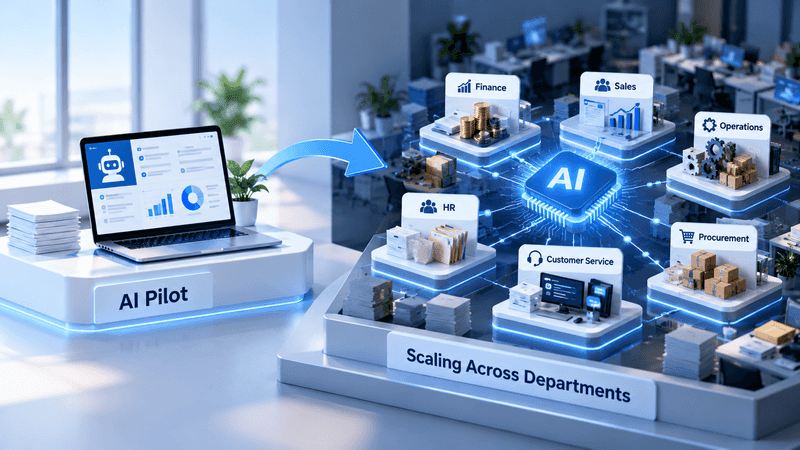
An AI project can look successful during testing and still run into serious problems when a company starts using it across everyday operations.
A small pilot might process invoices accurately, answer customer questions, or help employees complete tasks faster. The results look promising, and management decides to introduce the system across the business.
But once more people begin using it, problems start appearing.
The AI struggles with unexpected requests. Some business systems fail to exchange information correctly. Employees find that the tool needs more manual support than expected. Operating costs also begin to rise.
This does not always mean the original AI project was poorly built.
The All-in-One Platform for Effective SEO
Behind every successful business is a strong SEO campaign. But with countless optimization tools and techniques out there to choose from, it can be hard to know where to start. Well, fear no more, cause I've got just the thing to help. Presenting the Ranktracker all-in-one platform for effective SEO
We have finally opened registration to Ranktracker absolutely free!
Create a free accountOr Sign in using your credentials
The problem is that a successful pilot and a reliable production system are two different things.
Moving AI into production requires more than good test results. Businesses need to prepare for real data, larger workloads, system failures, security concerns, and ongoing support.
Understanding these challenges before rollout can prevent a promising AI project from becoming an expensive operational problem.
1. A Successful Pilot Does Not Guarantee Production Readiness
AI pilots are usually developed within a controlled environment.
The development team knows which problem the system needs to solve. Test data is often prepared in advance, and only a small group of employees uses the application.
These conditions make it easier to demonstrate what the technology can achieve.
However, everyday business operations are rarely this predictable.
The All-in-One Platform for Effective SEO
Behind every successful business is a strong SEO campaign. But with countless optimization tools and techniques out there to choose from, it can be hard to know where to start. Well, fear no more, cause I've got just the thing to help. Presenting the Ranktracker all-in-one platform for effective SEO
We have finally opened registration to Ranktracker absolutely free!
Create a free accountOr Sign in using your credentials
Consider a company testing AI for invoice processing.
During the pilot, the team provides 100 invoices with readable formats and complete supplier information. The system extracts the required details accurately and produces useful results.
After deployment, it receives invoices from hundreds of suppliers.
Some documents are scanned poorly. Others contain different currencies, missing purchase order numbers, or unfamiliar layouts.
The AI may now require more manual correction than expected.
The original test showed that the technology could perform a particular task. It did not prove that the system could handle every situation the business would encounter.
Before scaling, companies should identify the conditions that helped the pilot succeed and examine whether those conditions will remain the same in production.
2. Real Business Data Creates Unexpected Problems
Data quality is one of the most common reasons AI systems struggle after deployment.
During testing, teams often work with selected information that is accurate, organised, and easy to process.
Production systems must work with information collected through everyday business activities.
That data may contain duplicate records, outdated details, missing fields, and inconsistent formats.
For example, an AI customer service assistant might perform well when answering questions from an approved knowledge base.
However, the company may later connect it to product records, customer accounts, and support documents.
If these sources contain conflicting information, the assistant could provide incorrect answers.
A product might appear available in one system while another system shows that it is out of stock.
The AI cannot reliably resolve every disagreement without clear business rules.
Companies should therefore test AI using realistic information before deployment.
They also need people responsible for maintaining data quality and correcting problems as they appear.
Good results from carefully prepared data are useful, but they are not enough to prove that a system is ready for everyday use.
3. Existing Business Systems May Not Work Together Smoothly
Many AI pilots operate independently from the software a company uses every day.
Developers may upload sample files manually or connect the AI to a temporary database.
This is acceptable during early testing because the main goal is to understand whether the idea works.
Production requires something more dependable.
The AI may need to exchange information with CRM software, ERP platforms, finance applications, customer support tools, and internal databases.
These connections introduce new challenges.
An AI sales assistant might identify a promising lead but fail when trying to update the CRM.
An invoice processing tool might extract the correct amount but send information in a format the accounting system cannot accept.
In both cases, the AI performs its assigned task, but the wider business process remains incomplete.
Before deployment, teams should test the complete workflow, including what happens when another system becomes unavailable.
A useful resource is this guide on how to move AI pilots into production, which explains how businesses can review data readiness, system reliability, security, and operational requirements before expanding AI.
The goal should be to make AI work reliably within existing business processes, not simply connect another application.
4. Production Testing Must Cover More Than Accuracy
A pilot often focuses on whether the AI produces the correct answer or completes the expected task.
Accuracy matters, but it is only one part of production testing.
Businesses must also understand how the system performs when several users access it at the same time, when information is missing, or when an unexpected request appears.
Suppose an AI assistant handles 20 customer conversations during testing.
It may respond quickly and accurately.
But what happens when 500 customers try to use it during a busy period?
Response times might increase. Some requests may fail, and the cost of processing each conversation could rise.
A production testing plan should examine several areas:
- Real-world accuracy: Can the system handle incomplete, unusual, or poorly formatted information?
- Performance: Does it respond reliably when usage increases?
- Integration: Can it exchange information correctly with connected business applications?
- Security: Does it protect sensitive information and follow access restrictions?
- Failure handling: What happens when the AI model or another service becomes unavailable?
- Human review: Can employees correct mistakes and take over complicated cases?
These tests should reflect how the business will actually use the system.
A company should also agree on acceptable performance before launch.
For example, management might set targets for successful task completion, processing time, and the number of cases requiring manual review.
Without agreed targets, teams may struggle to decide whether the system is ready.
5. Security Risks Increase When More People Use AI
A small AI pilot may only be accessible to a few employees using limited information.
Once deployed across a company, the same system could handle customer records, financial documents, employee details, and confidential business information.
That creates additional security responsibilities.
Businesses need to understand which employees can access the AI application and what information it can retrieve.
A customer support employee, for example, should not automatically receive access to confidential financial records simply because both departments use the same AI platform.
Companies should also review how information moves between systems and whether external providers process or retain business data.
Permission controls, activity records, secure connections, and clear data handling rules should be established before wider deployment.
Security reviews should also continue after launch, particularly when new departments or data sources are connected.
Scaling AI without reviewing these controls can expose information that was never intended to be shared.
6. Unclear Ownership Makes Production Problems Harder to Resolve
During a pilot, developers often monitor the system closely.
If something fails, the project team can investigate and correct the issue.
This arrangement becomes difficult when AI starts supporting everyday business operations.
Who will respond if the system stops working outside office hours?
Who decides whether an incorrect recommendation is serious enough to pause automation?
Who updates business information when company policies change?
These questions need answers before deployment.
A production AI system should have clear responsibilities across technical and business teams.
Developers may handle software problems, while department managers review whether the AI is producing useful business results.
Operations teams may monitor system availability, and employees may handle cases that require human judgement.
Without this structure, problems can remain unresolved while teams disagree about who should take responsibility.
Clear ownership makes it easier to maintain performance and respond quickly when something goes wrong.
7. Costs Can Rise Quickly After Deployment
AI pilots usually involve limited usage, which makes costs easier to control.
Production systems can be different.
More users may mean additional model requests, higher cloud expenses, increased data storage, and greater monitoring requirements.
Some AI workflows may also require employees to review or correct outputs regularly.
For example, an automated document processing system might reduce data entry time but still require finance staff to review many exceptions.
If the company only measures processing speed, it may overlook the cost of that additional work.
Businesses should estimate the full operating cost before scaling.
This includes infrastructure, software usage, integration maintenance, technical support, and employee involvement.
They should also compare these costs with the value the system delivers.
A lower-cost AI model is not necessarily the better option if employees spend significantly more time correcting its mistakes.
The real measure of success is not how cheaply AI produces an output, but how efficiently it helps the business complete a useful task.
8. A Gradual Rollout Reduces Production Risk
One of the biggest mistakes companies can make is introducing AI to every department immediately after a successful pilot.
A full rollout can make problems harder to identify because many users and systems begin depending on the technology at the same time.
A gradual approach provides more control.
Businesses can begin by running the AI alongside the existing process without allowing it to make live changes.
This lets employees compare AI results with normal business decisions and identify mistakes.
The next step could involve introducing the system to one department or a small group of users.
During this stage, the company should monitor response times, accuracy, system failures, employee feedback, and operating costs.
Once performance is stable, the business can expand usage.
For example, a company introducing AI-powered invoice processing might begin with one supplier group.
After confirming that document extraction, approval rules, and ERP connections work correctly, it can introduce additional suppliers.
If problems appear, the company can correct them before the system affects a much larger volume of transactions.
Every rollout plan should also explain how to return to the previous process if something goes wrong.
Employees need a reliable alternative when an automated system becomes unavailable.
This prevents a technical failure from bringing an important business operation to a complete stop.
9. AI Needs Monitoring After Launch
Launching an AI system does not mean development and testing are finished.
Business information changes. Customers ask new questions, employees follow updated procedures, and connected software receives updates.
These changes can affect AI performance.
A system that works well today may produce less reliable results after several months.
Companies should regularly review accuracy, response times, failed requests, employee corrections, and operating costs.
They should also collect feedback from people using the system.
If employees repeatedly correct the same type of mistake, the company needs to understand why.
The problem might involve outdated information, an incorrect business rule, or an integration that is no longer working properly.
Regular monitoring helps teams identify these issues early.
It also provides evidence for deciding when the system needs improvement or whether it is ready to support additional departments.
Final Thoughts
Successful AI pilots are an important first step, but they do not guarantee success in everyday business operations.
The challenges often appear when AI must handle real information, connect with existing systems, support more users, and operate without constant developer assistance.
The All-in-One Platform for Effective SEO
Behind every successful business is a strong SEO campaign. But with countless optimization tools and techniques out there to choose from, it can be hard to know where to start. Well, fear no more, cause I've got just the thing to help. Presenting the Ranktracker all-in-one platform for effective SEO
We have finally opened registration to Ranktracker absolutely free!
Create a free accountOr Sign in using your credentials
Businesses can reduce these problems by testing realistic situations, reviewing security, assigning clear responsibilities, and planning production costs before deployment.
A gradual rollout also gives teams time to identify problems and improve performance before expanding further.
AI projects should not be judged only by how well they perform during a demonstration.
The real test begins when the technology becomes part of everyday business operations and must deliver reliable results without creating additional problems.