
Intro
A shopper in Berlin pays 89 euros for the exact product a shopper in Austin picked up for 59 dollars an hour earlier. Same SKU, same brand. If you've ever searched "why do prices change by country", you've probably noticed the answers stop at "taxes and shipping". That explanation is true and badly incomplete: a big slice of every gap is strategy, and strategy is something you can respond to.
For sellers, the gap matters more than the reason. Every market you operate in has a real price level, set by local rivals and local buying power, and your dashboard shows you none of it. You see your price sheet. Shoppers see something else.
This guide covers what drives those differences, how to see each market the way a local customer does, and how to turn the spread into decisions you can defend in a planning meeting.
What geographical pricing actually is
Geographical pricing means the price of a product depends on where the buyer is. Sometimes that's a deliberate call: a brand decides German customers will bear a premium while Polish customers get a lower entry point. Sometimes it's structural: taxes, duties, and freight land differently in every market.
Both layers sit on the same product page. A 30 percent gap between two countries might be 12 points of tax, 8 points of freight, and 10 points of pure pricing decision. Only that last slice is a choice a competitor made, and separating the layers is the whole job.
Location based pricing vs dynamic pricing
Dynamic pricing moves with time and demand: the same visitor sees a different number on Friday than on Monday. Location based pricing in ecommerce moves with geography: two visitors see different numbers at the same moment. Big retailers run both at once, which is why one check from your desk tells you so little.
Why the same SKU shows different prices by country
Pull a cross-border gap apart and you'll usually find some mix of these drivers:
- Taxes and duties. A 119 euro price in Germany already includes 19 percent VAT. A 119 dollar price in Texas includes no tax yet, and import duties can add double digits on top.
- Local competition. If three strong domestic rivals sell a comparable product in France, the French market price sits lower, whatever your global sheet says.
- Purchasing power. Brands price against what households in each market will actually pay, so software subscriptions often cost less in India or Brazil.
- Currency rounding. After conversion, prices get pushed to local charm numbers, 49.99 in one currency, 45 in another.
Much of this is deliberate. In the European Commission's e-commerce sector inquiry, 38 percent of consumer goods retailers said they geo-block shoppers in other EU countries. Sellers who work that hard to control who can buy have clearly thought about what each country should pay.
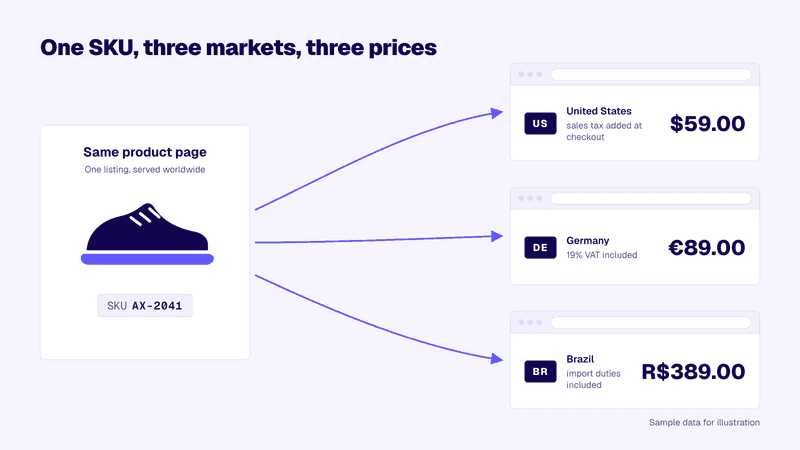
What marketers miss when they only see their home price
Your home price is one data point, and whole media plans get built on it like it's a dataset. Campaign math breaks first: run Shopping ads in five countries with ROAS targets based on home margin, and if the real selling price in two of them lands 15 percent lower, those "profitable" campaigns are quietly underwater. Positioning breaks too: calling yourself the affordable option where a domestic rival undercuts you by 20 percent makes every landing page ring false. Content leans on price assumptions as well, since a topical ecommerce SEO plan built around value-for-money angles has to survive contact with each market's actual shelf.
The All-in-One Platform for Effective SEO
Behind every successful business is a strong SEO campaign. But with countless optimization tools and techniques out there to choose from, it can be hard to know where to start. Well, fear no more, cause I've got just the thing to help. Presenting the Ranktracker all-in-one platform for effective SEO
We have finally opened registration to Ranktracker absolutely free!
Create a free accountOr Sign in using your credentials
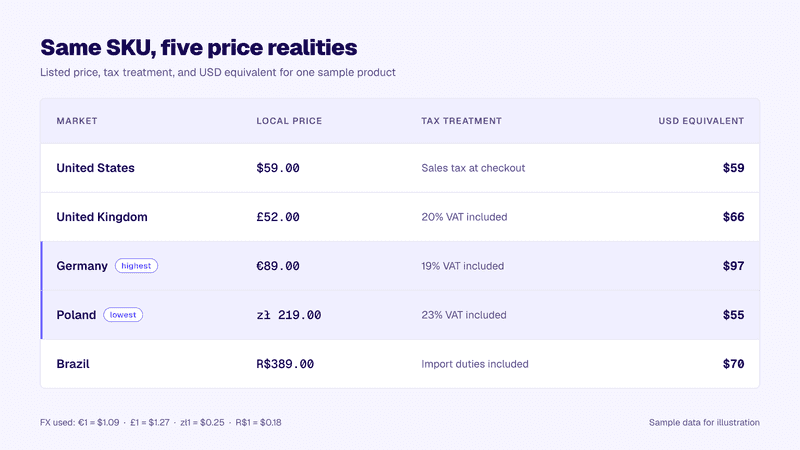
Read across a real version of that table and you can usually tell which markets a competitor is defending and which they're milking for margin.
How to view each market's price as a local shopper
You can't run this research from your own browser. Stores read your IP address and quietly localize the currency, the price, sometimes the whole catalog. Your home IP always returns one price: yours. Clearing cookies or flipping the footer country selector often changes the display language and nothing else.
So the workflow starts with the connection:
- Pick markets and rivals. Three to five priority countries, top three competitors in each. Small enough to maintain, big enough to matter.
- Load product pages the way a local would. This is where checking each market's prices from a local shopper's connection earns its spot: when the request comes from a residential connection inside the market, the store serves what a real customer there gets instead of an export fallback page.
- Walk each cart to checkout. Sticker price is half the story, so capture shipping, tax treatment, and duty estimates and compare landed costs.
- Log the currency and the date so later comparisons stay honest.
- Repeat on a schedule. Monthly as a baseline, weekly around launches and Q4.
Turning geo price data into positioning decisions
Collection is the easy half. The first real decision is a per-market posture: premium, parity, or undercut. That posture only exists relative to what rivals charge locally, never relative to your internal sheet. If Germany runs 18 percent above your home price across competitors, you have headroom to enter high and protect margin. If Poland's market price sits below your landed cost, that country needs a cheaper tier or it doesn't need you.
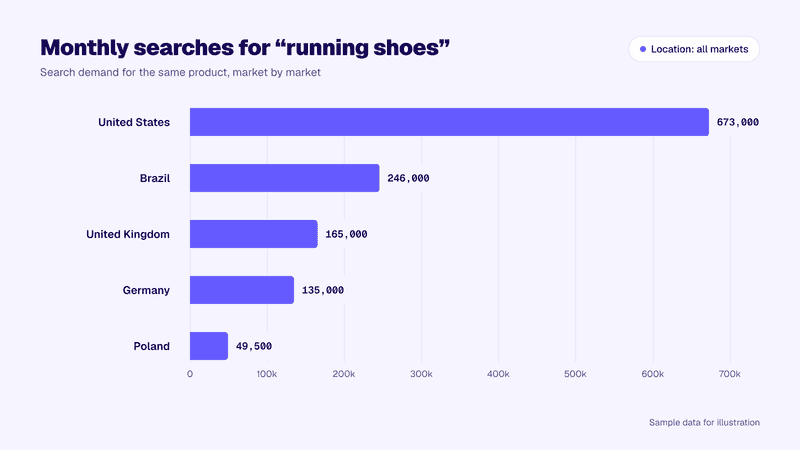
Then match the posture to demand. Ranktracker's Keyword Finder filters search volumes by country, so you can see whether a market searches "cheap running shoes" or brand names before you commit to a price story.
A geo pricing strategy set once goes stale within a quarter, so build a loop instead of a snapshot. Ongoing benchmarking competitor prices across markets shows you when a rival repositions, runs a long promo, or exits a country, and each move is a window to adjust before your traffic data catches up.
Common mistakes when reading cross-border prices
- Comparing tax-in prices to tax-out prices. Strip taxes from both sides before you conclude anything.
- Treating one snapshot as truth. You may have landed mid-promo. One check is an anecdote; a series is evidence.
- Reading currency noise as strategy. If a "price drop" in the UK matches the pound's move that week, nobody repositioned anything.
- Checking everything from one address. Stores can serve cached or personalized numbers to a repeat visitor, and one IP loading twenty product pages a day stops behaving like a shopper. Providers like Anonymous Proxies rotate requests through many local IPs so no single address gets a distorted price.
- Trusting your own store's foreign view. Geo-redirects and currency logic on your side can hide what locals actually see, and that's worth auditing alongside the technical SEO of your store.
FAQ
Is charging different prices by country legal?
Broadly, yes. The EU's geo-blocking regulation stops a seller from blocking a customer in another member state from buying at the local price, but different prices on different national sites stay legal. Check consumer rules market by market before launch.
Can a VPN handle the price checks?
For a one-off look, sometimes. Plenty of retail sites recognize datacenter IP ranges and fall back to a default version, which defeats the point. A residential connection inside the market mirrors what a genuine shopper sees.
How often should each market be rechecked?
Monthly for a stable catalog. Weekly during launches, seasonal peaks, or right after a competitor moves in one of your markets.
Taking your pricing research global
Prices split by country for reasons that are part structure and part strategy, and only the strategy part deserves a reaction. Your home screen shows one market's reality, so an expansion plan resting on it alone is guesswork. Check each country the way its shoppers experience it, all the way to checkout, on a repeating schedule. Then let the gaps set your posture and your messaging instead of sitting in a spreadsheet. Sellers who read markets locally price on purpose; everyone else prices by accident.

