Intro
A pre-launch Google Trends case study, as of October 23, 2026
Key findings (within this Google Trends sample):
- "wow forever" went from 0 on all 51 days before September 12 to a sustained topic.
- In a US side-by-side comparison since September 12, it averaged 55.7 against 14.4 for "wow classic" (about 3.9×).
- By October 17–23, each market's average was 55–64% below its own peak day.
- Class-and-build terms are the largest intent cluster among the top-25 related queries in all four markets: 38–47% of summed related-query scores, not of searches.
- The selected commercial phrases ("gold", "boost") registered low relative interest before launch. That says nothing about absolute demand for paid services.
This case study uses Google Trends data collected on October 23, 2026, twelve days before the November 4 launch. Methods, limitations and a reproduction guide are included, and the full data package (raw values, cluster assignments, scripts and charts) is published with the article; see "Data availability".
Methodology and date window
| Parameter | Value |
| Source | Google Trends, Web Search, All categories; search terms (not Topics) |
| Collected | October 23, 2026, 12:58 UTC, single session |
| Daily window | "Past 90 days" preset. The Explore preset returned 93 daily timestamps (July 23–October 23, inclusive) in the archived export collected on October 23, 2026. We report the actual timestamps rather than assuming the preset spans exactly 90 calendar dates. |
| Weekly window | "Past 12 months": weeks starting Sunday; the latest week (Oct 18–24) was partial at collection |
| 7-day window | "Past 7 days" (related queries, US only) |
| Markets | US, UK, Canada, Australia |
| Seed term | "wow forever" |
Requests:
| Analysis | Geo | Terms compared in one request |
| Figure 1 | US | wow forever, wow classic, wow midnight |
| Market curves | One comparison with four items: "wow forever" in the US, UK, Canada and Australia | wow forever |
| Figure 3 | US | wow forever talents / classes / leveling / gold / boost |
| Related queries | One request per market (90 days), plus US 7 days | seed: wow forever |
How to read the numbers:
- Each request is scaled 0–100 to its own maximum. Values from different requests aren't comparable, and none of them are search counts (Google: Trends data FAQ).
- In the four-market comparison, Google returns four series on a common 0–100 scale (100 = the highest single point among them). When several locations are compared, Google normalizes each location by its own total searches (Google: how Trends compares regions). Values reflect relative popularity within each country, not numbers of searches.
- Related-query "top" values are relative to the top query in that list. "Rising" values are growth percentages and aren't summed with top values.
How interest moved
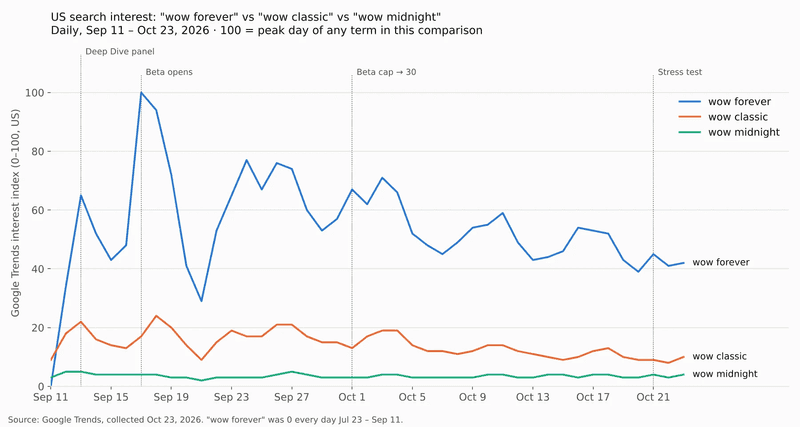
Figure 1. United States, daily, September 11 – October 23, 2026 (excerpt of a 93-day request). One request comparing "wow forever", "wow classic" and "wow midnight"; 0–100 relative to the peak in this request. Source: Google Trends, collected October 23, 2026, 12:58 UTC.
In this comparison:
- Zero before the reveal. "wow forever" was 0 on all 51 days from July 23 to September 11.
- Peak on beta day. The highest US value (100) fell on September 17, the day the beta opened (beta dates: September 17 – October 23). Within this US request and period, the beta opening drew more search interest than the reveal week.
- Weekly pattern. Weekly US values were 100 (Sep 13–19), 95, 100 (Sep 27–Oct 3), 81, 73 and 65 for Oct 18–24, which was incomplete at collection, so that last comparison is preliminary.
- Relative to neighbors. Since September 12, "wow forever" averaged 55.7 vs 14.4 for "wow classic" and 3.5 for "wow midnight". "wow classic" ranged from 7 to 11 before September 12 and peaked at 24 afterwards.
Shape of the curve by market
| Market | Last-7-day mean (Oct 17–23) vs that market's own peak day |
| United States | −55% |
| Canada | −55% |
| Australia | −62% |
| United Kingdom | −64% |
Computed within each country's series from a single four-location request, so the ratio doesn't depend on cross-country scaling. "−55%" compares a 7-day average with a single peak day; it isn't a day-to-day decline.
Interpretation: search patterns differed across markets, but cross-country comparisons should be interpreted only within a consistently normalized Google Trends query, and the indices don't represent comparable numbers of searches. All four markets show a beta-period peak followed by lower relative search interest through October 23, ahead of the November 4 launch.
Why US peaks differ: the US peak is 100 in Figure 1 but scaled to 83 in the four-market request, because in that request Canada's peak day is the maximum. Different requests, different scaling.
Keyword clusters
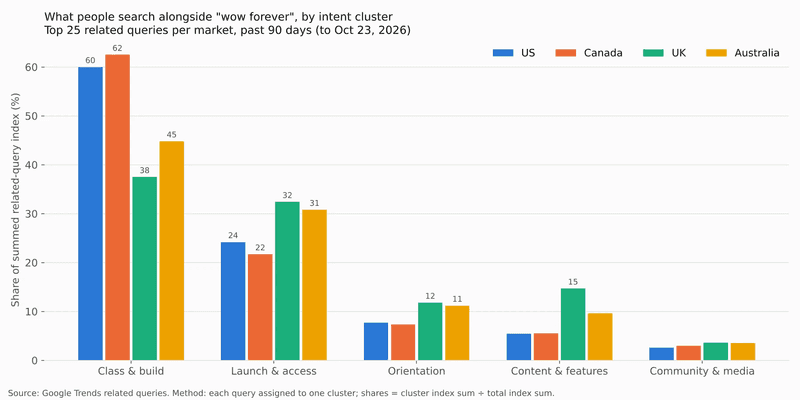
Figure 2. Share of summed top-25 related-query scores by cluster, "Past 90 days" to October 23, 2026. One request per market; rising lists excluded. Not a share of searches.
Method: each top-25 related query was assigned to one cluster by whole-word rules. For example, a class name, "talent(s)", "racials", "bis" or "tier list" goes to Class & build; "what is", "wow classic" or "changes" goes to Orientation. A cluster's share is its summed scores ÷ all 25 scores.
| Cluster (share of summed top-25 scores) | US | Canada | UK | Australia |
| Class & build (talents, hunter, shaman, druid, racials, bis) | 43.9% | 47.4% | 37.5% | 44.8% |
| Launch & access (beta, release date, launch, servers, down) | 24.2% | 21.7% | 32.4% | 30.8% |
| Orientation (what is wow forever, wow classic, changes) | 23.9% | 22.4% | 11.8% | 11.2% |
| Content & features (skyborne, races, pvp, professions, patch notes) | 5.4% | 5.5% | 14.7% | 9.6% |
| Community & media (reddit, wowhead, tournament) | 2.6% | 3.0% | 3.6% | 3.5% |
One decimal; unrounded shares sum to 100%.
The All-in-One Platform for Effective SEO
Behind every successful business is a strong SEO campaign. But with countless optimization tools and techniques out there to choose from, it can be hard to know where to start. Well, fear no more, cause I've got just the thing to help. Presenting the Ranktracker all-in-one platform for effective SEO
We have finally opened registration to Ranktracker absolutely free!
Create a free accountOr Sign in using your credentials
What the sample shows:
- In our sample of the top-25 related queries, class-and-build terms account for the largest share of summed scores in every market. This shouldn't be read as a share of total search volume.
- "wow classic" is a top related query in the US and Canada, which is why Orientation is large there: many searchers were comparing Forever with Classic.
- "what is wow forever" appears in every market's top list (scores 29–35), six weeks after the reveal.
- In the UK, Content & features (PvP, Skyborne) carries more weight than in North America.
- "reddit wow forever" (or "wow forever reddit") appears in all four lists.
Caveats: near-duplicates ("talent" and "talents") both count; queries outside the top 25 and below Google's display threshold are invisible.
Launch vs evergreen intent
| Type | Examples from the related-query lists | Expected lifespan (editorial judgment) |
| Event-bound | beta end time, stress test duration, name reservation | Days |
| Launch-window | release date, launch, servers, down, patch notes | Weeks around launch |
| Evergreen | talents, classes, racials, professions, leveling, tier list | Months; refreshed by patches |
In the US past-7-days list, the fastest-rising entries included stress-test questions ("wow forever stress test time", +4,950%) and a PvP tournament ("who won the wow forever tournament", +4,600%). In that week's top-25, Launch & access made up 40.0% of summed scores and Class & build 38.3%, compared with 24.2% and 43.9% over 90 days. (Method: the first 25 entries of the "top" list as displayed, same whole-word rules, rising list and "Breakout" values excluded, no deduplication.)
Guide terms vs commercial terms
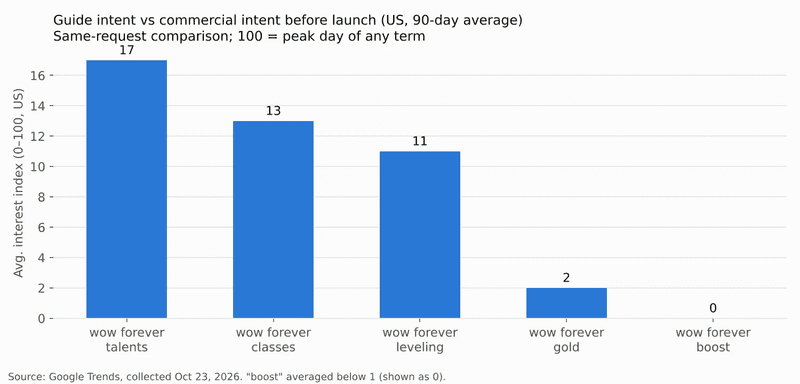
Figure 3. United States, "Past 90 days" (93 daily points to October 23, 2026); five terms in one request; mean of daily values. Source: Google Trends.
| Term (US) | Mean of 93 daily values | Range, Oct 17–23 |
| wow forever talents | 16.6 | 15–33 |
| wow forever classes | 12.7 | 20–24 |
| wow forever leveling | 10.7 | 14–32 |
| wow forever gold | 2.3 | 4–5 |
| wow forever boost | 0.1 | 0–1 |
Observations:
- Leveling interest coincided with beta progression changes. "wow forever leveling" stayed at 7 or below before September 17 and reached its highest values on October 2–4 (43, 52, 46), shortly after the beta level cap rose to 30. The data can't isolate the reason for the increase.
- The selected commercial phrases registered low relative interest in this pre-launch comparison. That doesn't establish absolute demand for paid services: synonyms, other phrasings, other languages and queries below Google's display threshold aren't captured.
Sample search results
On October 23, 2026, we ran three queries through a web-search tool (not a live Google US results page; no ranking positions are claimed).
| Exact query sent | Results returned | Composition |
| WoW Forever system requirements minimum recommended Blizzard support | 9 | 4 single-topic or fan sites, 2 game-service blogs, 1 esports media site, 1 PC retailer blog, 1 tool site |
| WoW Forever beta leveling time to 60 hours /played | 9 | 1 official forum thread, 8 store or game-service blogs |
| wow forever vs classic | 9 | 5 gaming media pages, 2 official forum threads, 1 account-service blog, 1 community post |
What this snapshot suggests (not proven for Google US): for some technical and time-estimate queries, results were dominated by new single-topic sites and commercial blogs rather than established guide sites. A publisher with primary sourcing may find room, but this needs checking in a live Google US results page before planning around it.
Implications for publishers
- Treat class and build content as a hypothesis to validate. Treat class-and-build guides as a content hypothesis suggested by this top-related-query sample; validate search volume, ranking difficulty and post-launch demand before allocating production budget.
- Answer the basics. "What is WoW Forever" and Forever-vs-Classic comparisons were still prominent six weeks after the reveal.
- Plan launch pages for a short life. Update high-performing launch pages with post-launch information; consolidate or redirect only when the target page satisfies the same user intent. Don't automatically redirect a news page to an evergreen guide.
- Check market differences in your own data. In this sample, UK and Australian related queries leaned more toward access and features; verify for your markets.
- Measure commercial intent separately. For example, a WoW Forever Leveling Boost page represents a commercial-intent landing page; its performance should be evaluated separately from informational guide queries, using post-launch data and absolute volumes.
- Expect event-driven spikes. In this data, the largest spike followed a playable milestone (the beta) rather than the announcement. Launch day and the December 9 raid unlock are candidate events to monitor.
Afterword: what absolute volumes added (October 26)
Step 9 of our method says to add absolute volumes before committing budget. Three days after the Trends snapshot, a keyword tool (Ahrefs, US) reported monthly search volume for two Forever topics that sit in our small Content & features cluster: "wow forever dungeons" at 9,964 in September and 4,433 in October 2026, and "wow forever pvp" at 3,861 and 1,494. "Dungeons" didn't appear in any market's top-25 related queries, and "pvp" appeared in the Canadian, UK and Australian lists but not the US one, yet each had thousands of monthly US searches. This is the gap between the two kinds of data in practice: related-query shares describe what co-occurs with a seed term, not how much demand a topic has. These are third-party estimates from a different tool and period; they aren't part of the reproducible Trends package.
How to reproduce this analysis
- Fix your terms and markets before you start; write down exact strings.
- Put terms you want to compare in one request. Values from separate requests aren't comparable.
- Record parameters: date and time (UTC), timeframe preset, geo, category, search type, terms vs topics.
- Export the raw series and note the first and last data points (presets don't always match calendar counts).
- Pull related queries per market; keep top and rising lists separate.
- Cluster with written whole-word rules. Test them: substring rules can misfire, for example "class" matching "classic".
- Compute shares from unrounded values and show rounding.
- Treat incomplete weeks as preliminary.
- Add absolute volumes from a keyword tool before committing budget.
- Re-run after launch with the same parameters and compare.
Cluster template:
| Market | Rank | Query | Score | Cluster | Rule matched |
| US | 2 | wow classic | 47 | Orientation | wow classic |
| US | 5 | wow forever talents | 26 | Class & build | talent(s) |
FAQ
Is "wow forever" more searched than "wow classic"? In this US Google Trends term comparison from September 12 to October 23, it had about 3.9 times the relative interest. That isn't 3.9 times as many searches; Trends doesn't provide absolute volumes.
When did interest peak? In the US comparison, on September 17, 2026, the day the beta opened.
What do people search alongside WoW Forever? Among the top related queries in this Trends sample, "wow forever beta" ranked first in all four markets, and class-and-build terms had the largest share of summed scores. This isn't a complete list of search intents.
Is there demand for WoW Forever boosting? The exact phrases tested ("boost", "gold") had low relative interest before launch. That doesn't measure absolute demand; a keyword tool and post-launch data are needed.
Can I reproduce this study? Yes. The data package contains the raw values and scripts that produce every number and chart here. A fresh Trends request will differ slightly, because Google Trends samples data and recalculates as new days are added.