
Intro
Every directory submission service promises the same thing, and so does every free list of 500 places to submit your startup. More listings, more backlinks, better rankings. The promise is not exactly false. It is just measuring the wrong thing.
I run Nick Launches, a product discovery directory, which means I am on both sides of this. I approve other people's listings and I submit products by hand, and I also sell a paid submission service, so treat everything I say about paying for this with the skepticism that deserves. After a few hundred submissions I stopped counting how many I had done and started checking three things before spending time on any of them.
This post covers what actually decides whether a directory listing does anything, how to check it in about a minute per directory, what the free route gets you, the real time cost of doing it yourself, and what a paid service does and does not buy.
Why "500 Directories" Lists Stopped Working
Submission count is a satisfying metric because it is countable. That is exactly why it is misleading.
Run the arithmetic instead. One hundred listings where seventy are no-follow, sitting on pages Google last fetched in 2023, are worth less than fifteen do-follow listings on pages that get crawled every week. The seventy are not neutral. They cost you the hours you could have spent on the fifteen.
There is a second thing going on, and it is the part most posts about directory backlinks skip. For a young domain, the useful thing a directory gives you is not link equity. It is a crawl path. Google has to discover your URL before it can judge it, and on a new site it often simply has not.
I learned that the expensive way. I pushed 200 URLs through Google's Indexing API and got zero discovery out of it. That is not a bug, it is documented behaviour: Google's own Indexing API quickstart states the API can only be used to crawl pages with either JobPosting or BroadcastEvent embedded in a VideoObject. Everything else is ignored. IndexNow is real but it reaches Bing and Yandex, not Google. A sitemap is a suggestion, and Google may be working from a copy of yours that is weeks old.
The All-in-One Platform for Effective SEO
Behind every successful business is a strong SEO campaign. But with countless optimization tools and techniques out there to choose from, it can be hard to know where to start. Well, fear no more, cause I've got just the thing to help. Presenting the Ranktracker all-in-one platform for effective SEO
We have finally opened registration to Ranktracker absolutely free!
Create a free accountOr Sign in using your credentials
Links from pages Google already crawls are one of the few levers left that work on discovery directly. Which is why a directory Google has abandoned is not a weak backlink. It is nothing at all.
Three Checks Before You Submit Anywhere
These take about a minute each, and the first two do almost all of the work.
1. Is the link do-follow?
Find an existing listing on that directory, ideally for a product similar to yours, and read how it links out. Do not check the homepage. Check the page your listing will actually live on.
curl -s "https://directory.example.com/tools/some-existing-product" \
  | grep -oE '<a[^>]+rel="[^"]*"[^>]*>' | head
You are looking for nofollow, ugc or sponsored in the rel attribute on the outbound link. Google's guidance on qualifying outbound links says links carrying those values will generally not be followed, though the pages may still be found by other routes. In plain terms: the listing may still get your brand in front of people, it just will not do the ranking job you submitted for.
One catch worth knowing. Plenty of modern directories render listings client-side, so curl returns an empty shell and you conclude wrongly. If you get nothing back, open the listing in a browser and read the rel attribute off the rendered DOM instead.
2. Has Google kept the listing pages?
This is the check almost nobody runs, and it decides everything. A directory can have a strong homepage and a listings section Google has effectively given up on.
site:directory.example.com/tools/
If the site advertises 12,000 listings and Google returns 40, your submission is going into a room nobody visits. Then check whether anyone still maintains the place:
curl -sI "https://directory.example.com/sitemap.xml" | grep -i "last-modified"
A sitemap that has not moved in a year answers the question on its own.
3. Is it in your category?
Being listed beside your actual competitors is a topical signal. Being listed in a general dumping ground between a crypto casino and a diet app is not. This sounds obvious and it is still the check people skip, because relevance feels like something you can judge at a glance and it is not.
Sorted this way, a few hundred directories fall into repeating clusters:
| Directory type | Typical link | Listing pages still crawled | Verdict |
| Aged niche directories in your exact category | do-follow | yes | submit these first |
| Large general startup and SaaS directories | mixed | yes | worth it, expect a review queue |
| AI tool aggregators launched in the last 18 months | often do-follow | rarely | only if the category genuinely matches |
| "Submit to 500 sites" bulk lists | no-follow | no | skip |
| Paid listings with no editorial review | do-follow | varies wildly | verify before paying |
The third row is the one that surprises people. A lot of new AI directories do hand out do-follow links, because they are competing for submissions. It does not help you yet, because nothing on those domains gets crawled. They have your problem, not the solution to it.
What the Free Route Actually Gets You
Worth being concrete about what a listing is, since "get listed on 100 directories" hides a lot of variation.
On Nick Launches, submitting is free and the listing does not expire. It runs on a weekly cycle rather than a single launch day, so a product stays on the current week's board for seven days instead of competing for one 24-hour window. Week 32 of 2026 carried 92 launches.
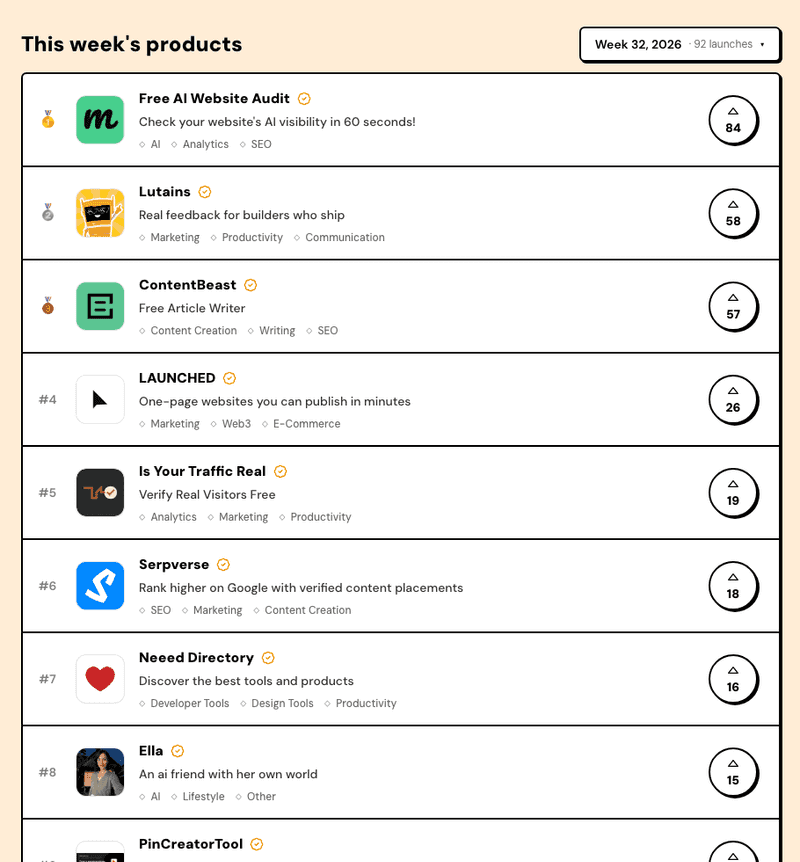
Three details matter more than the launch count:
- Categories, not just a firehose. 40+ of them, and the large ones are large: 494 products in AI, 452 in Productivity, 205 in Developer Tools, 204 in Marketing. Category pages are where the topical relevance from check 3 comes from.
- The leaderboard ranks builders, not products. Launch count and votes accrue to the person, so shipping repeatedly compounds instead of resetting every time.
- A verified badge. Listed products get an embeddable badge, checked before it counts. That is a trade, and worth taking deliberately: a badge-gated listing can quietly disappear when you redesign your footer.
That is the honest scope of a listing. It is a listing, a backlink and a stream of discovery visitors. It is not distribution, and anyone selling it to you as distribution is selling something else.
The 170-Directory Catalog, Free to Use
Running three checks per directory is fine. Running them across two hundred directories, and keeping the results current as directories die, is the part that eats the weekend.
The All-in-One Platform for Effective SEO
Behind every successful business is a strong SEO campaign. But with countless optimization tools and techniques out there to choose from, it can be hard to know where to start. Well, fear no more, cause I've got just the thing to help. Presenting the Ranktracker all-in-one platform for effective SEO
We have finally opened registration to Ranktracker absolutely free!
Create a free accountOr Sign in using your credentials
Since the catalog had to exist anyway, it is published rather than gated. The catalog of launch directories currently holds 170 entries, each carrying domain rating, traffic level, backlink strength, pricing model, category focus and link type, with filters for pricing and niche.
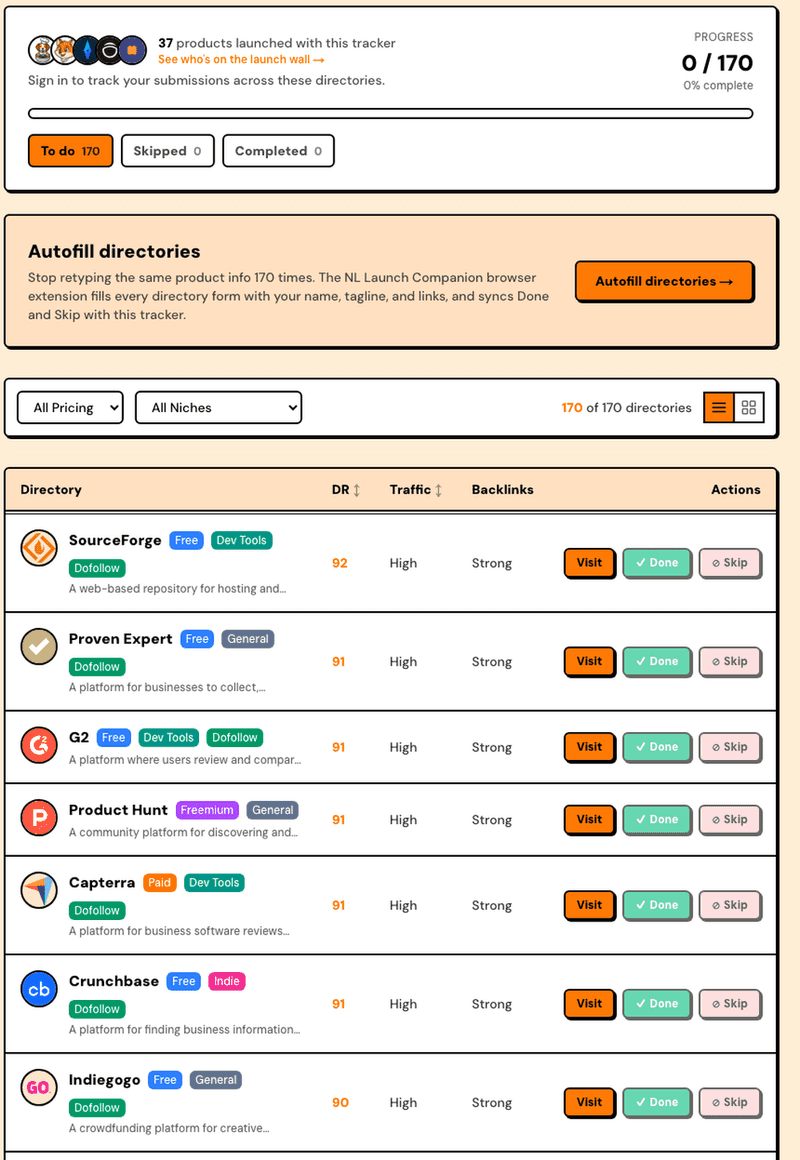
Two practical parts:
- Progress tracking. Every row has Visit, Done and Skip, so the list doubles as the place you record what you already submitted. 37 products have been run through it so far.
- A browser extension that autofills the forms. Retyping the same name, tagline and links 170 times is the actual work, and the extension fills each form and syncs Done and Skip back to the tracker.
Re-verify anything before you act on it. Directories change their rel attributes without announcing it, which is why the checks above stay useful even when someone hands you a sorted list.
Querying a Directory From Your Own Stack
If you manage submissions for more than one client, doing this through a browser is the slow path.
Nick Launches exposes a public API and an MCP server, so the directory is queryable from a script or straight from an AI coding tool. You can pull the current week's launches, look up a category, or check whether a product is already listed, without opening the site.
Anyone reading this blog already has the other half of that setup. Ranktracker shipped its own MCP server and an API included with every plan this year. Wiring both into the same agent means the loop of "check which directories we submitted to, then check whether those pages moved anything" stops being a manual reporting job.
Doing It Yourself Versus Paying Someone
Here is the time cost, measured on my own submissions rather than estimated.
| Step | Time per directory | Across 100 directories |
| Running the three checks | 1 to 2 min | 2 to 3 hours |
| Filling the submission form | 4 to 8 min | 7 to 13 hours |
| Confirming the email, verifying the account | 2 to 5 min | 3 to 8 hours |
| Chasing approvals and re-submitting rejections | varies | 5 to 15 hours |
| Recording where you actually got listed | 1 min | 2 hours |
Call it 20 to 40 hours of copy-paste for 100 directories, and most of it is not skilled work.
Do it yourself first. Genuinely. Take the free catalog, filter to your niche, run the three checks on the top thirty rows, and submit those by hand. You will learn more about your own link profile in one afternoon of this than from any report, and thirty listings that pass the checks will do more than three hundred that do not. If you have more time than money, which is most people early on, stop reading here and go do that.
What $99, $149 and $199 Actually Buy
Disclosure: I run Nick Launches and I sell the service described in this section, so I am not a neutral party in it. The three checks above work identically whether you pay anyone or not.
Paying is a straight time calculation. If 20 to 40 hours of your time is worth more than the fee, outsourcing is rational arithmetic. If it is not, it is not.
That is the case the directory submission service I run is built for. Three one-time tiers:
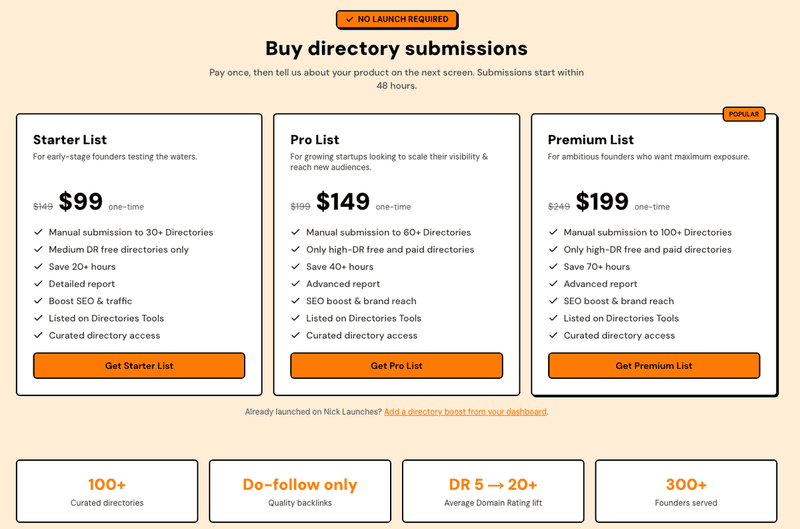
- Starter, $99. Manual submission to 30+ directories, medium-DR free directories, detailed report.
- Pro, $149. 60+ directories, high-DR free and paid directories, advanced report.
- Premium, $199. 100+ directories, same directory quality, advanced report.
Every tier is submitted by hand, not by a bot filling forms. Only directories that give do-follow links are used, which is check 1 applied before your money is spent rather than after. Work starts within 48 hours and completes in 7 to 14 days depending on tier. The report lists every submission with its link and status, which matters more than it sounds: it is the thing that lets you audit the work instead of trusting it.
The All-in-One Platform for Effective SEO
Behind every successful business is a strong SEO campaign. But with countless optimization tools and techniques out there to choose from, it can be hard to know where to start. Well, fear no more, cause I've got just the thing to help. Presenting the Ranktracker all-in-one platform for effective SEO
We have finally opened registration to Ranktracker absolutely free!
Create a free accountOr Sign in using your credentials
What it does not do, stated plainly:
- It does not promise rankings. Nobody can, and a service that does is telling you something about itself.
- A listing is still a listing. It is a backlink and a discovery surface, not distribution and not a launch.
- It does not replace the checks. It runs them for you.
How to Tell Whether Any of It Worked
Submissions without measurement is how people end up believing directories do nothing, or believing they do everything. Both are conclusions drawn from no data.
Three things worth watching, and the sequence matters because they happen in this order:
-
Did the links get found? Point Ranktracker's Backlink Monitor at your domain and watch new referring domains appear over the two to six weeks after submission. Directory links show up unevenly: the well-crawled ones land in days, the rest may never register at all, and that split is exactly the signal you want.
-
Are they the links you were promised? Run your own profile through a backlink checker and compare what is actually live against the report you were given, whether that report came from a service or from your own spreadsheet. Do-follow count is the number to check, not total count.
-
Did anything on your own site improve as a result? New referring domains often surface crawl and indexing problems that were already there. A site audit run at the same time tells you whether the newly discovered pages are actually in a state worth discovering.
Then track a small set of real keywords, not your brand name. Directory links move discovery quickly and rankings slowly, and if you only measure the second one you will conclude nothing happened while the first one is still in progress.
FAQ
Do directory submissions still work for SEO in 2026?
A much smaller subset than the big lists suggest. The ones that work are do-follow, still crawled, and topically relevant to your product. The ones that do not work are not neutral, because they cost you hours.
Is a paid directory submission service worth it?
Only if your time is worth more than the fee. The work itself is 20 to 40 hours of form-filling for 100 directories. Nothing a service does is something you cannot do yourself, so the question is purely whether you want to spend the weekend.
Are no-follow directory listings useless?
No. They still put your name, tagline and URL in front of people, and they add consistency to your brand footprint across the web. They just will not do the ranking job most people submit for, so know which one you are getting before you spend the time.
How many directories should I submit to?
Fewer than the lists suggest and chosen more carefully. Thirty listings that pass the three checks will do more than three hundred that do not.
How long before a directory backlink does anything?
Discovery can happen within days on a directory that is crawled often. Any ranking effect is slower and depends on everything else about your site. Treat directories as a discovery and consistency play, not a ranking shortcut.
Can I get the same result for free?
Yes, and for most early-stage products that is the right call. Free catalogs of directories exist, including the one linked above, and the three checks in this post are the whole method. Paying buys back time, not access.
Check Two Directories Before You Submit to Two Hundred
The question was never how many directories you submitted to. It is how many of them sit on pages Google still visits.
Take whatever list you are working from right now and run the three checks on the top two rows. If both come back no-follow on a sitemap that has not moved since last year, you just saved yourself a weekend, and you now know exactly what to ask any submission service before handing it money.
And when a post tells you there are 500 directories you absolutely must be on, it is counting. It is not filtering.

