
Intro
You have probably been told to gather more reviews and watched the stars add up, then wondered whether any of it actually moves you in search ranking. The doubt is fair. Product reviews SEO gets sold as a guaranteed ranking hack, but it is not one. What reviews really do is subtler and more useful once you see where it happens.
This guide covers where online reviews genuinely help and where they do not. First, how they feed organic rankings and earn those star snippets. Then how they shape Google Shopping, and how AI answer engines pull from them to build answers.
Do Product Reviews Help SEO? The Straight Answer
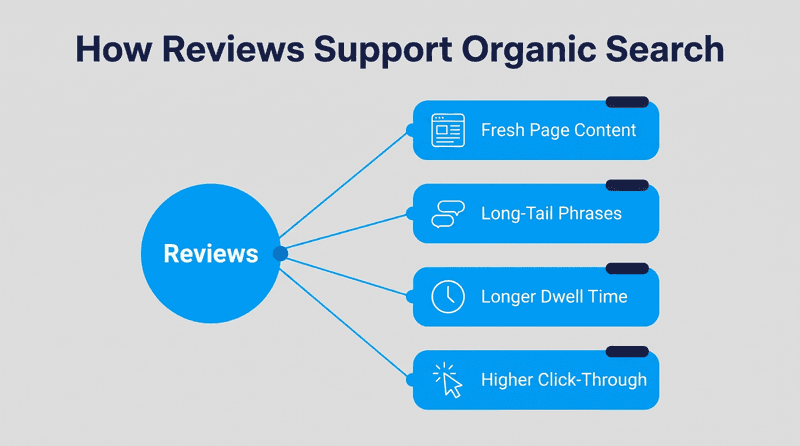
The short version is yes, but the reason matters more than the yes. Reviews do not flip a ranking switch; they change the things Google already measures. That is the honest frame for product reviews SEO, and it is the one that leads to better decisions.
Before a shopper even reaches you, reviews shape the decision. BrightLocal's 2025 survey found 74% of consumers read reviews on two or more review sites before choosing a business. That habit is why reviews influence buying decisions long before a ranking algorithm gets involved.
Yes, But Not As A Direct Ranking Boost
There is no rule in Google's systems that reads more reviews, higher rank. Reviews help because they strengthen signals that already count. They add fresh user-generated content and pull in buyer language you would never write yourself, and they keep people reading.
Treat them as a direct ranking factor, and you will be let down. Treat them as fuel for the signals that already matter, and product reviews SEO strategy starts to pay off. The shift is subtle, but it changes everything you do next.
It also changes what you optimize for. You stop counting stars and start caring whether reviews are detailed and readable by a crawler. If you want the mechanics of how reviews influence your rankings, they run through the three effects below.
Fresh Buyer Language Keeps Product Pages From Going Stale
A product description gets written once and then stays there untouched. Reviews keep the page changing. Every new one adds text, and search engines notice pages that update on their own.
The All-in-One Platform for Effective SEO
Behind every successful business is a strong SEO campaign. But with countless optimization tools and techniques out there to choose from, it can be hard to know where to start. Well, fear no more, cause I've got just the thing to help. Presenting the Ranktracker all-in-one platform for effective SEO
We have finally opened registration to Ranktracker absolutely free!
Create a free accountOr Sign in using your credentials
For a catalog with thousands of near-identical products, that steady trickle of new wording is often the only thing separating one page from a near-duplicate.
It compounds, too. A page with 50 high-quality reviews reads very differently to a crawler than the same page with three. That volume becomes a body of text no competitor can copy, because it came from your customers and nobody else's.
Reviews Rank You For Long-Tail Phrases You Would Never Write Yourself
Your copy says the product is durable. A reviewer says it survived a drop onto a tile floor and still worked. That second version matches how people actually search, and reviews produce that phrasing at scale without you guessing. It is how one product page ends up ranking for dozens of long-tail phrases you never targeted.
The catch with long-tail search is that the winning pages are rarely the ones with the most keywords crammed in. They are the ones that leave no follow-up question unanswered.
Reviews do a lot of this work, but they are not always enough on their own. Some products need detailed supporting content next to the reviews, the kind that teaches rather than rates. Get both on the page, and you cover far more of the long-tail search queries than either could alone.
This matters most in the food and beverage industry. A review can say a product tastes great, but it rarely explains how to store the product or prepare it safely. With unfamiliar or specialty items, that missing guidance is usually the exact reason a shopper hesitates or sends the order back.
Picture someone buying specialty meat cuts like sweetbreads they have never cooked before. Star ratings will not tell them how to clean it or how long it keeps in the fridge. Without that, the sale stalls, and a confused buyer after checkout often turns into a return.
The All-in-One Platform for Effective SEO
Behind every successful business is a strong SEO campaign. But with countless optimization tools and techniques out there to choose from, it can be hard to know where to start. Well, fear no more, cause I've got just the thing to help. Presenting the Ranktracker all-in-one platform for effective SEO
We have finally opened registration to Ranktracker absolutely free!
Create a free accountOr Sign in using your credentials
That gap is what genuinely thorough supporting content fills. A detailed resource like this guide to preparing sweetbreads is a clear example. It explains which glands the cut comes from and ranks quality by source.
A page like that answers the whole question, so it earns the how-to searches a bare product listing never could. Pair that depth with honest reviews, and the page owns both sides of the long-tail intent – the how-to and the is-it-any-good. That combination is what holds these rankings for years.
How Reviews Affect Dwell Time And Click-Through
Two things happen once reviews are on a page. People stay longer because they scroll and read them, and a star rating in the results makes the listing more tempting than a plain blue link. Neither is a magic signal on its own.
Over time, though, more clicks and longer visits are exactly the behavior Google rewards. A page that consistently earns the click and holds attention tells the engine it deserves the spot. Reviews do both jobs at once, without you writing a single extra word.
How Review Schema Turns Ratings Into Star Snippets
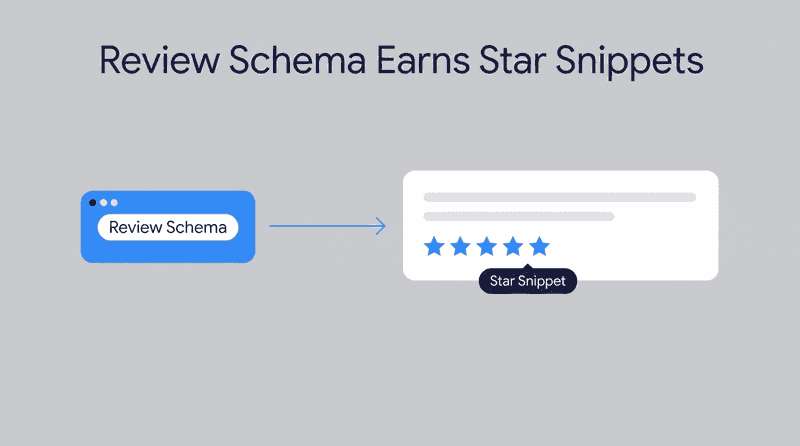
Those stars in the search results do not appear on their own. They come from structured data, and getting it right is the difference between a plain listing and one that stops the scroll.
What Review And AggregateRating Markup Actually Does
Schema is code you add to a page that tells search engines what your content means. For reviews, two types matter. Review markup describes a single rating, while AggregateRating rolls up the average and the total review count.
Add it correctly, and Google can show the star rating and the number of reviews right in the result. The markup itself stays invisible to shoppers, but its effect on the listing is not. That extra line of stars is often the reason one result gets the click.
Use JSON-LD for it, the format Google recommends. And keep it in the page source rather than injected later by a script a crawler might miss. Before you wait on search to catch up, Google's Rich Results Test will confirm the markup is valid and preview the stars you should expect to see.
Product Reviews Vs Seller Reviews (Two Different Snippets)
These get mixed up constantly. Product review markup rates a specific item and can produce stars on that product's result. Seller ratings rate your business as a whole and show up beside your site name, usually in ads. They use different schema and appear in different places, so decide which one you want before marking anything up.
| Review Type | What It Rates | Where The Stars Show | How It Is Fed |
| Product reviews | A single product | Organic product result | Review and AggregateRating markup on the product page |
| Seller reviews | Your whole store | Beside your site name and in ads | Merchant Center seller-rating feed |
Why Google Ignores Some Rating Markup
Marking up ratings does not guarantee stars. Google drops them when reviews look self-serving, such as a company reviewing its own products, or when the markup does not match what a shopper sees on the page. If your page shows a 4.6 average, the schema has to say 4.6 too.
Invent ratings or markup an unreviewed product, and you risk a manual penalty, not a rich result. A few checks keep your stars eligible:
- Only mark up reviews a real customer actually left on that page.
- Match the schema average and count exactly to what shows on-page.
- Never add rating markup to a product with zero reviews yet.
- Drop any self-created or staff ratings, since Google reads them as spam.
How Reviews Power Google Shopping And Product Listings
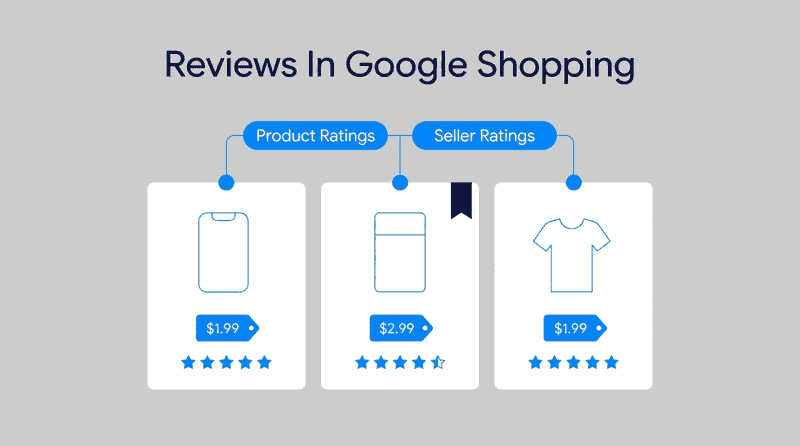
Search is only one surface. When people shop on Google, reviews turn into a number that is right under your product, next to every rival. This is where product reviews SEO extends well past the classic results page.
Product Ratings In The Shopping Tab And Free Listings
In the Shopping tab, products line up side by side, each with a price and a star rating. A missing rating stands out, and not in a good way. Ratings here get pulled from your reviews through the Merchant Center, and they apply to free listings too. So this is not only a paid-ads concern.
There is a knock-on effect on ad spend as well. A rated listing tends to earn a better click-through, which can pull your cost per click down over time. The same reviews that help you organically are working in the paid grid too, off one collection effort.
Seller Ratings And The Merchant Center Review Feed
Two rating streams feed Google Shopping. Product ratings come from reviews tied to specific items, and seller ratings come from your store's overall service reputation. Both flow in through the Merchant Center.
The source is either Google's own Customer Reviews program or an approved third-party review partner. Without one of those connected, your products can show up starless while rivals show a 4.7. Connecting a feed is usually a one-time setup that keeps paying off.
Why Rated Listings Pull Clicks Away From Unrated Ones
Put two identical products side by side, one with a 4.8 and 300 reviews and one with nothing, and the choice is made before anyone reads a description. Reviews are the single biggest factor in that split-second call.
Bazaarvoice's 2025 Shopper Preference Report found that 52% of shoppers name real customer reviews as the biggest factor in their final purchase decision. On a crowded Shopping grid, a strong rating is what stops the eye and earns the tap.
Keep Ratings Above Google's Display Threshold
Google will not show a star rating until a product has collected enough reviews, and the exact bar moves. A single review does nothing here. This is why a handful of reviews across a large catalog means no stars appear anywhere at all.
The fix is to concentrate review collection on your best-selling items first, so they clear the threshold and start showing stars. Once those win visibility and clicks, work down the catalog. Half-covered pages help far less than a smaller set that actually displays reviews and ratings.
How Reviews Feed AI Discovery And Answer Engines
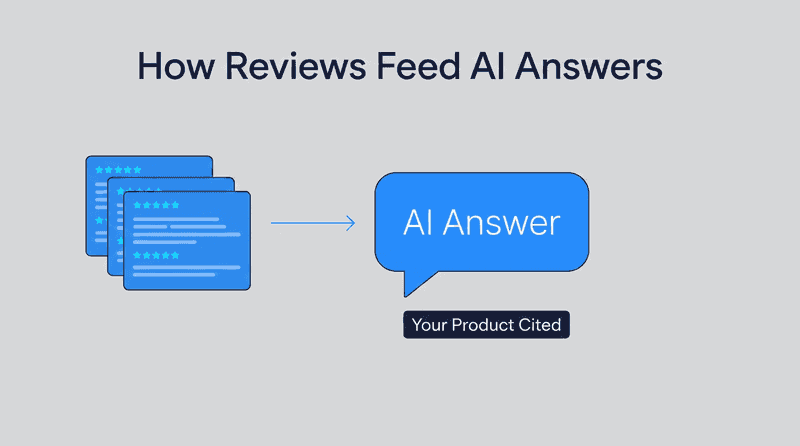
Shoppers increasingly ask an AI assistant instead of scrolling a page of results. Those answers get built from somewhere, and review text is a big part of the source material. That is why product reviews now play a much bigger role in product marketing strategies than they did a few years ago.
Why AI Overviews And LLMs Lean On Review Text
When an AI tool weighs up whether a product is worth buying, it needs opinions and specifics, not your marketing copy. Reviews are exactly that – real language about how something performed.
Deloitte's 2025 data shows 47% of shoppers plan to use AI to summarize reviews before they decide, so your review text is already feeding the answer they read. This is the newest front in product reviews SEO, and most stores are not paying attention to it yet.
It is not only chatbots, either. Google's AI Overviews increasingly summarize product opinions right in the results, drawing on the same review text. The store that gives these systems clear and specific reviews to quote is the one that ends up named in the answer.
What Gets Your Products Cited In AI Answers
AI engines favor sources they can read and trust. That means reviews in crawlable text on your own pages, not hidden inside a script-heavy widget or a screenshot. It also rewards volume and recency, since a handful of old reviews gives a model little to work with.
Optimizing for ChatGPT and Perplexity starts with making your review content readable in the first place. A few things make the difference:
- Render reviews as plain HTML text, not an embedded script or image.
- Keep a steady flow of recent reviews instead of one stale batch.
- Encourage specifics like fit, size, and real conditions of use.
- Leave full review text on the page rather than a truncated preview.
Review Depth Beats Star Averages For AI
A 4.8 average tells a model almost nothing. What it can use is a review explaining that a jacket ran small but handled rain on a three-day hike. Detail and context are what get quoted, because they answer the specific thing a person asked. Prompt reviewers to describe real use, and you hand AI something worth repeating.
How To Collect And Use Reviews So They Actually Help SEO
 How To Collect And Use Reviews So They Actually Help SEO
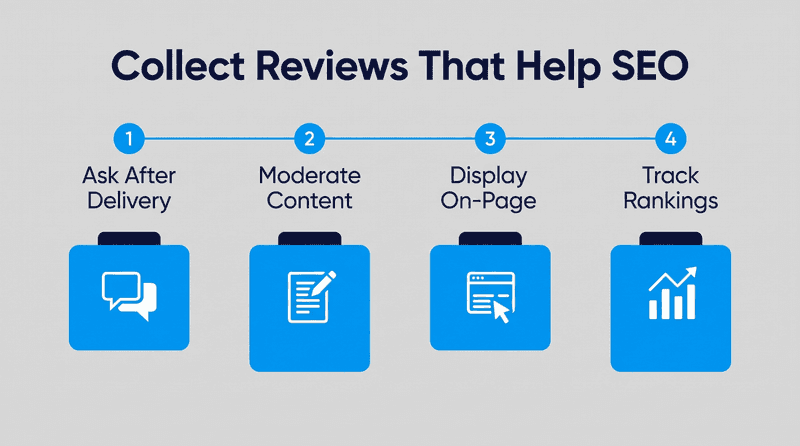
Knowing reviews help is one thing. Getting enough of the right ones and putting them where they count is the part that actually has an impact on the product reviews SEO.
How To Collect And Use Reviews So They Actually Help SEO
Knowing reviews help is one thing. Getting enough of the right ones and putting them where they count is the part that actually has an impact on the product reviews SEO.
1. Ask At The Right Moment And Make Leaving One Effortless
Most customers will leave a review if you ask at the right time and make it easy. The right time is usually a little after delivery, once they have actually used the product. The easy part means a direct link straight to the form, with no login and no 10-field survey in the way.
Some brands also use eCommerce gamification, such as badges or points, to make leaving a review feel more rewarding without changing the review itself.
Doing this by hand falls apart fast. The request slips your mind or the timing drifts, and reviews arrive too slowly to matter. The fix is automation that fires the ask on a schedule tied to delivery, then sends one reminder if the first email goes unanswered.
If you are running a WooCommerce store, this is the sort of workflow a dedicated review tool can take off your plate. Reviewbird, for example, lets you schedule review requests and reminders around completed or fulfilled orders. It also supports custom review questions and structured review markup, so the reviews you collect are easier for both shoppers and search engines to use.
The tool is not the point. Automating the ask and getting the output into readable markup is what turns a slow trickle into enough reviews to count. Whichever route you choose, those two jobs are what separate a dead review strategy from one that earns visibility.
2. Put Reviews Where Crawlers And Buyers Both See Them
Reviews hidden in a third-party dashboard do nothing for your SEO rankings. The ones that help are on your own product pages, in crawlable text an engine can read. Keep your Google Business profile and one major third-party profile active too, since shoppers cross-check them. But your own site is where the SEO value lands.
- Show full review text on the product page, not a scored badge alone.
- Avoid pasting identical reviews across many product URLs at once.
- Keep one strong off-site profile rather than five thin, neglected ones.
3. Handle Negative Reviews Without Killing Trust
A page of nothing but five stars reads as fake, and shoppers know it. A few critical reviews add credibility, and they give you fresh content plus honest language engines value. Respond to the fair ones in public and fix what is broken, then leave them up. Deleting bad reviews is the fastest way to make the positive reviews look staged.
There is an SEO angle people miss here. A public reply adds more fresh, keyword-relevant text to the page, and it shows both shoppers and crawlers that the store is active. A thread of questions and honest responses reads as richer content than a lone review sitting by itself.
One challenge is making recurring feedback easy for the whole team to work through. If product issues and support notes are scattered across email threads or spreadsheets, the same conversations keep starting from scratch.
The All-in-One Platform for Effective SEO
Behind every successful business is a strong SEO campaign. But with countless optimization tools and techniques out there to choose from, it can be hard to know where to start. Well, fear no more, cause I've got just the thing to help. Presenting the Ranktracker all-in-one platform for effective SEO
We have finally opened registration to Ranktracker absolutely free!
Create a free accountOr Sign in using your credentials
Many teams pull those insights into a modern SharePoint intranet, where product managers, support, and marketing can all review the same information. A visual page builder such as ShortPoint is useful here as it lets a non-technical person assemble with drag-and-drop blocks.
Pages are much easier to organize with dashboards, cards, and sections that teams can actually scan instead of avoiding another wall of text. The point is not prettier documentation. It is making recurring customer feedback visible enough that the next improvement actually happens.
4. Track Whether Reviews Are Actually Moving Your Rankings
Reviews are a slow signal, so measure rather than assume. Watch the rankings and star-snippet visibility of the specific pages where you added reviews, before and after. A rank tracker that monitors SERP features will show whether those pages start pulling stars and climbing, which tells you the work is paying off and where to push next.
Give it a real window before judging. Star snippets and ranking shifts from fresh reviews can take weeks to settle, so checking daily will only frustrate you. Set a baseline, then compare a month later against similar pages you left untouched.
Conclusion
One idea matters most here. Stop chasing reviews for a ranking jump and start treating them as raw material that three discovery systems now run on. The winners are not the stores with the highest star average. They are the ones whose reviews are detailed and readable everywhere it counts, so every surface works in your favor at once.
We built Ranktracker for this kind of measurement. Rank Tracker follows your relevant keywords with daily updates, and the SERP Checker shows which search engine results are winning stars. The Web Audit flags the gaps holding your pages back. Over 140,000 users rely on it to see what is moving. Create your free account now.

