
Intro
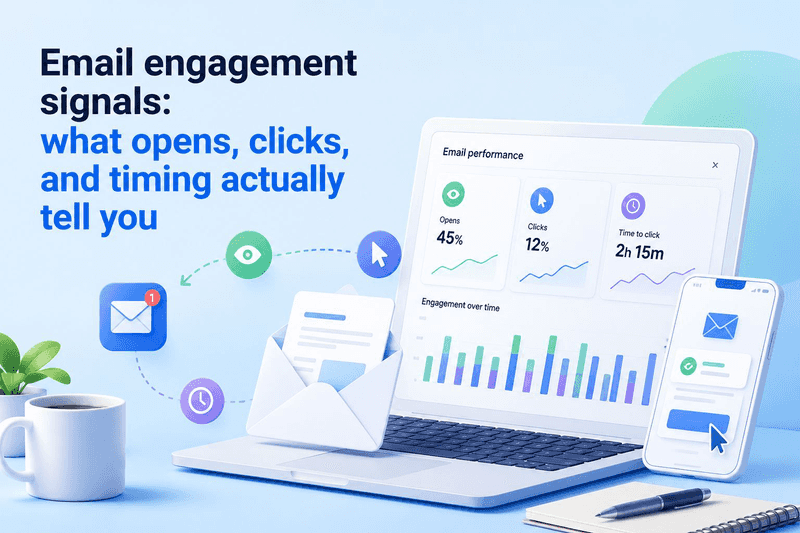
Most marketers check open rates the same way they check a delivery notification. Either the package arrived or it didn't. Email opened. Move on.
But the "opened" checkmark is one of the least useful signals your campaign generates - not because opens don't matter, but because a binary yes/no strips out everything interesting: when it was opened, how many times, from which device, whether anyone clicked, and what any of that pattern actually suggests about the reader's intent.
Sales teams have known this for years. A prospect who opens your proposal email three times in the 24 hours before a call is behaving very differently from someone who opened it once on Tuesday and hasn't been back since. These are not the same "open." Treating them identically means walking into the call with the same pitch when one person almost certainly needs something different.
This post breaks down the engagement signals worth reading - and how to use them to actually improve what happens next.
Why "opened" on its own is nearly meaningless
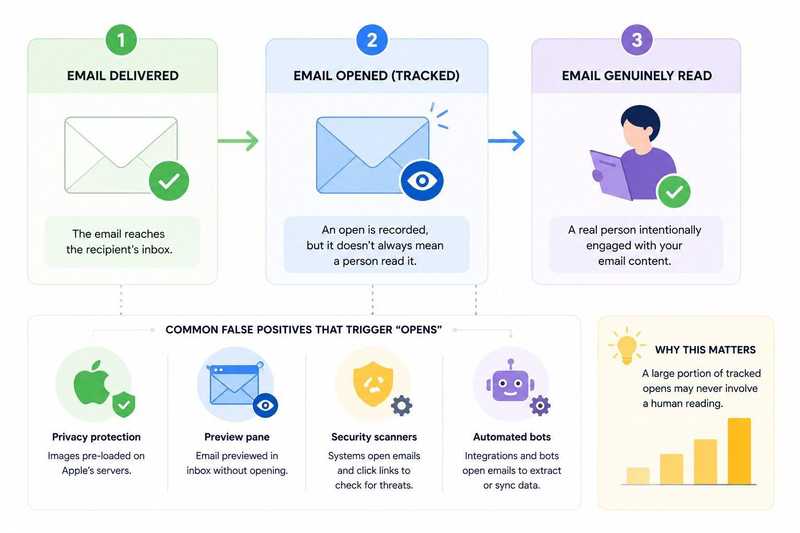
Let's start with a practical problem. Apple's Mail Privacy Protection (MPP), rolled out in 2021, pre-loads email images on Apple's servers the moment an email is delivered - regardless of whether the recipient actually reads it. This means any Apple Mail user appears to have "opened" your email even if they never looked at it.
Apple Mail holds roughly 50–60% of mobile email clients in the US. That's a significant chunk of your "opens" that may never have involved a human being looking at a single word you wrote.
The All-in-One Platform for Effective SEO
Behind every successful business is a strong SEO campaign. But with countless optimization tools and techniques out there to choose from, it can be hard to know where to start. Well, fear no more, cause I've got just the thing to help. Presenting the Ranktracker all-in-one platform for effective SEO
We have finally opened registration to Ranktracker absolutely free!
Create a free accountOr Sign in using your credentials
Add Microsoft Outlook's preview pane (which registers an open after a few seconds of hover), corporate email security scanners that click every link automatically to check for malware, and you have an "open rate" that's part behaviour signal, part technical noise.
Does this mean you ignore opens entirely? No. It means you stop treating a single open as confirmation that a real person is engaged, and start looking at patterns instead.
The four engagement patterns that actually tell you something
Multiple re-opens in a short window
If someone opens your email three times in an hour, something specific is happening. They went back to re-read it. That almost never happens with emails people are passively ignoring.
This pattern is especially meaningful on pricing emails, proposals, or any message that requires a decision. Multiple opens within 24–48 hours of a call or deadline suggests the prospect is actively evaluating what you sent. That's your signal to walk into that conversation ready for a more detailed discussion - not a high-level overview.
Single send, multiple views = someone is weighing something. Treat that differently.
Opens from two cities or two devices in quick succession
Your contact is based in London. Your email was opened in Manchester five minutes later. That almost certainly means it was forwarded.
This is one of the most underused signals in outbound email. Internal forwarding happens constantly - a manager sends your email to a colleague, a VP shares it with legal or finance - but it's invisible in your CRM unless you're looking at the open geography and timing. When you see this pattern, there's a second decision-maker in the conversation that you don't know about.
The All-in-One Platform for Effective SEO
Behind every successful business is a strong SEO campaign. But with countless optimization tools and techniques out there to choose from, it can be hard to know where to start. Well, fear no more, cause I've got just the thing to help. Presenting the Ranktracker all-in-one platform for effective SEO
We have finally opened registration to Ranktracker absolutely free!
Create a free accountOr Sign in using your credentials
The right response is not to immediately email the second city. It's to acknowledge the dynamic on the next touch. "If you've been sharing this with your team, happy to put together something that works for a wider audience" is more useful than acting like the forward never happened.
Click vs open: the intent gap
An open tells you the email arrived and the subject line was interesting enough to tap. A click tells you the content was interesting enough to act on.
These are fundamentally different signals. Clicks are harder to fake (most security scanners click links, but the pattern usually looks robotic - every link, instantly, in sequence). A human click on one specific link - your pricing page, your case study, your booking link - is a genuine behavioural signal.
If your open rate is 45% but your click rate is 0.8%, the problem isn't the subject line. The content, offer, or call-to-action isn't earning the click. That's a very different fix than adjusting the preview text.
If your click rate is proportionally healthy relative to opens - say 15–20% click-to-open rate - the campaign is working from a content standpoint, and the lever to pull is improving how many people see it in the first place (deliverability, subject line, send time).
One open, nothing since
Opened once, four days ago, no clicks, no reply. This is the most common engagement pattern and the least useful for forecasting.
It could mean genuine consideration. It could mean an accidental tap in a notification. It could be MPP. You genuinely cannot tell, and you shouldn't assign too much weight to it.
The healthiest interpretation: the email wasn't compelling enough to generate a second interaction. That's a content or targeting feedback signal, not a sales signal. Follow up, but don't treat this prospect as warm based on that one open.
Clicks are a cleaner signal than opens
Clicks require intent in a way that opens don't. Nobody accidentally clicks your pricing page link. Nobody's email client pre-loads a click. When someone clicks a specific link in a cold or marketing email, they make a decision.
This is why experienced email marketers weight clicks significantly higher than opens in their lead scoring models. A click on a booking link is worth 10x a passive open. A click on a case study that's vertically relevant to the prospect is a meaningful signal that the content matched the need.
In practice, this means designing your emails so that clicks are meaningful and measurable. One email, one primary CTA. If you have three links pulling in different directions, a click on any of them tells you less because you can't interpret which offer resonated.
Timing reveals intent that the click alone doesn't
When something gets clicked matters almost as much as whether it got clicked.
A click at 9:47am on a Wednesday, three days after you sent the email, suggests the recipient put it aside and came back to it deliberately. A click within 90 seconds of delivery often means the email was already in view - inbox priority real estate.
Combining timing with re-open data gives you a rough prioritisation model:
| Pattern | What it suggests | Response |
| 3+ opens in 24 hours, click on pricing link | Active evaluation | High-priority follow-up; come with specifics |
| Forwarded (dual location), no click yet | Internal review in progress | Follow up acknowledging that others may be involved |
| Click within 2 mins of send | High-intent, in-inbox engagement | Immediate or same-day follow-up |
| One open, 5+ days ago, no click | Weak signal | Standard follow-up cadence; don't prioritise |
| No open after 7+ days | Delivery or disinterest issue | Check deliverability; consider list verification |
The engagement signal problem nobody solves first: bad list data
Here's where most teams get this completely backwards.
You can build a sophisticated engagement model - multi-open weighting, click scoring, timing flags - and it won't mean anything if the emails aren't reaching real people in the first place.
Invalid email addresses don't just bounce. They damage your sender reputation over time by driving your hard bounce rate above the 2% threshold that ISPs use to flag aggressive or careless senders. When your reputation degrades, ISPs start routing more of your emails to spam or promotions tabs. Your open rate falls. Your clicks fall. And you start attributing the decline to copy quality, subject lines, or targeting - when the actual problem is a list that was never verified.
This is especially common with:
- Lists older than 6 months - email addresses decay at roughly 22–30% per year through job changes, domain shutdowns, and account deletions
- Lists imported from external tools - Apollo, LinkedIn exports, and purchased data can carry 10–20% invalid or stale addresses
- Lists built at events or via lead magnets - disposable email addresses are common when people trade an email for a download
A list that looks clean can contain thousands of addresses that haven't been deliverable for months.
Verifying your list before you start reading signals
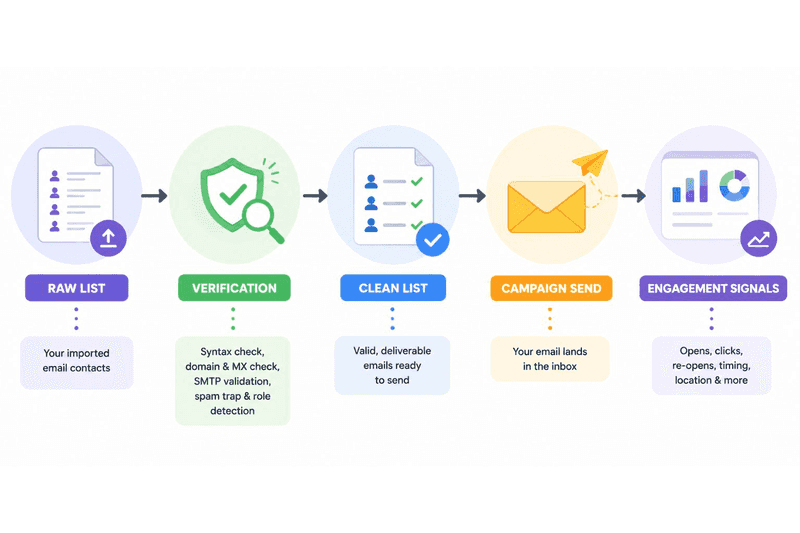
The fix is straightforward: verify your list before any send, and re-verify lists that have been sitting idle for more than 90 days.
The All-in-One Platform for Effective SEO
Behind every successful business is a strong SEO campaign. But with countless optimization tools and techniques out there to choose from, it can be hard to know where to start. Well, fear no more, cause I've got just the thing to help. Presenting the Ranktracker all-in-one platform for effective SEO
We have finally opened registration to Ranktracker absolutely free!
Create a free accountOr Sign in using your credentials
MailValid’s Email list verification runs multi-layer checks on every address.
- Syntax check - catches malformed addresses
- Domain and MX record check - confirms the domain has working mail exchange records
- SMTP mailbox verification - confirms the specific inbox exists and accepts email, without sending a message
- Enrichment flags - identifies disposable addresses, catch-all domains, and role-based emails (
info@,noreply@) that deliver but rarely convert
The result is a segmented list: addresses you can confidently send to, addresses to suppress immediately, and addresses in a grey zone (catch-all domains) that you can test at lower volume.
At MAILVALID: $0.001 per email, verifying a 10,000 email contact list costs $10. The cost of sending unverified and damaging your domain reputation is measured in weeks of deliverability recovery.
Once you've verified, the engagement signals you read are signals from real people. That's when open pattern analysis, click scoring, and timing flags actually mean something.
Building a simple engagement scoring model
You don't need specialist software to weigh engagement signals sensibly. A basic model that helps you prioritise follow-up:
Assign scores per event:
| Event | Score |
| Email opened once | +1 |
| Email opened 2+ times | +3 |
| Email opened from 2+ locations | +4 |
| Link clicked | +8 |
| Pricing or booking link clicked | +12 |
| Reply received | +20 |
| Opened within 2 hours of send | +2 |
Prioritise follow-up based on total score:
- Score 15+ - Follow up within 24 hours; high-intent signals present
- Score 5–14 - Standard follow-up cadence; engaged but not conclusive
- Score 1–4 - Low priority; one-touch follow-up before archiving
- Score 0 - Check deliverability before assuming disinterest
Adapt the weights to your product and sales cycle. A business with a high-ACV, long consideration sale should weigh pricing page clicks more heavily. A low-friction product can weight booking clicks as near-conversion signals.
Key takeaways
Reading email engagement well is less about adding more tracking and more about interpreting the patterns you already have with more precision.
- A single open is a weak signal. Multiple opens in a short window are meaningful.
- Dual-location opens almost always indicate internal forwarding - there's a decision-maker you haven't met.
- Clicks are a stronger signal than opens because they require deliberate intent.
- Timing adds context to clicks - a purposeful return to an email days later means more than an instant tap.
- None of this matters if your list contains invalid addresses degrading your sender reputation. Verify first, then read the signals.
The teams that consistently get replies and meetings from cold and marketing email aren't just writing better copy. They're sending to verified lists, reading engagement patterns with more nuance, and following up based on actual behavioural signals rather than the binary checkmark.

