
Intro
You are about to hand someone a monthly retainer and wait 4-6 months to find out if they are any good. That is the reality of hiring an SEO agency. And it is why knowing how to evaluate an SEO agency before you sign anything matters more than almost any other vendor decision you will make this year.
A wrong pick costs you the retainer plus half a year of lost ground that your competitors used to get in front. And that is exactly what we are going to sort out here. You will get 18 questions you can ask the SEO agency that reveal far more than the proposal itself. We also have a red flags section at the end that covers when to stop the conversation entirely.
How to Evaluate an SEO Agency: 18 Questions That Show What You are Really Signing Up For
Evaluating SEO agencies goes deeper than flipping through a case study PDF. Case studies are curated. The questions below aren't – they bring out answers that reveal how an agency actually runs when the sales pitch is over.
Phase 1: The Foundational Questions You Should Ask the SEO Agency
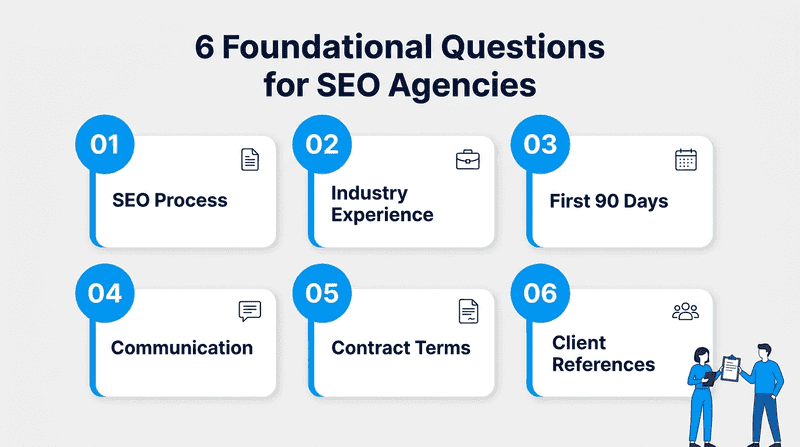
1. What Is Your SEO Process From the First Month Through Month Six?
You are trying to find out if they have an actual methodology or just a basic idea of "audit first, then optimize." The second version isn't a process. It is what someone says when they haven't thought past the sales call.
A strong answer maps it month by month. Month one is the technical audit and baseline data. Month two is the keyword strategy and on-page plan. Months three through six should show execution picking up with defined markers along the way.
If they describe the first month in detail and then get fuzzy about what follows, they'\ have probably only gotten that far with most clients.
2. Which Industries and Business Sizes Have You Worked With?
An agency that did local SEO for dental practices for five years operates nothing like one running enterprise SaaS campaigns. Neither approach is wrong – they are completely different skill sets. What you need to know is whether their default approach maps to your business.
Ask for two or three names in your industry or a similar vertical. If every example is a company ten times your size, the strategies they reach for first probably won't scale down.
The same applies in reverse. Agencies that have helped design-led businesses build online visibility work differently than those focused on paid lead generation – and neither will tell you that unless you ask.
3. What Does the First 90 Days Look Like in Concrete Deliverables?
Some agencies spend the first three months "strategizing" and deliver a slide deck at the end of it. Others have completed the technical audit by week three and content live by week eight. You want to know which one you are dealing with.
The All-in-One Platform for Effective SEO
Behind every successful business is a strong SEO campaign. But with countless optimization tools and techniques out there to choose from, it can be hard to know where to start. Well, fear no more, cause I've got just the thing to help. Presenting the Ranktracker all-in-one platform for effective SEO
We have finally opened registration to Ranktracker absolutely free!
Create a free accountOr Sign in using your credentials
Real answers come with specifics. Scripted ones don't. They should tell you roughly when the audit wraps and when the keyword map comes through. They should also know roughly when the first round of execution starts.
"It depends on the audit" is technically true. But an experienced agency can still give you a pretty clear picture of what the first 90 days becuase they have done it dozens of times.
4. How Do You Handle Communication and How Often Will We Hear From You?
The work itself might be excellent, but if you can’t see what is happening for weeks at a time, the relationship corrodes. Communication cadence is one of the top reasons agency contracts end early – not bad results, but silence between reports.
The answer you want includes a weekly status update (even a short one) and a monthly strategy call with whoever is actually doing the work on your account. Updates you get are secondhand if everything comes from an account manager who doesn't touch the SEO campaigns.
5. What Are the Contract Terms and What Happens If We Want to Leave?
A 12-month contract protects the agency… not you. Annual client churn for SEO agencies is 38%. More than a third of these relationships end before the year is up. No exit clause means you are basically funding something you have stopped believing in.
Get a month-to-month setup or at least a 90-day exit option. And ask directly what happens to the content they created and the accounts they have been working on if you decide to leave. Add it before you sign if the contract doesn't specify.
6. Can You Provide References From Two or Three Current Clients?
Case studies are marketing materials. References are real people telling you what the real experience actually was – whether the agency responded when something didn’t work and whether the SEO results matched what was promised. They will also tell you if the team you were sold on was the team that actually showed up.
Any hesitation here is a problem. An agency with strong client relationships will connect you with references without flinching. Skip the "are you happy" questions when you get on the phone with those references. Ask what happened the last time something went wrong. That answer tells you everything.
Phase 2: The AI Readiness Questions You Should Ask the SEO Agency
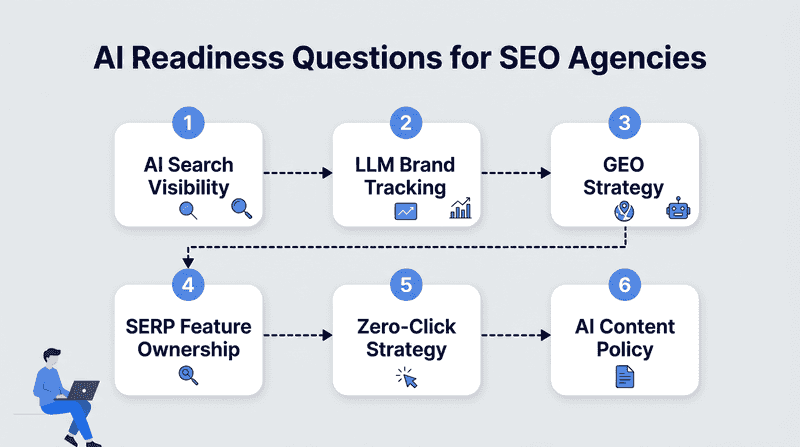
7. How Do You Measure AI Search and LLM Visibility?
61% of agencies are actively adding AI-search optimization to their service menus. But adding a line item to a sales page and actually delivering results in AI search are two different things. If your SEO partner can't describe a specific method for checking whether your brand shows up in AI-generated answers, they are not doing this work.
They might talk about it on their website. They might mention it in the pitch. But the moment you ask for the measurement process, the gap between marketing and execution becomes obvious.
The All-in-One Platform for Effective SEO
Behind every successful business is a strong SEO campaign. But with countless optimization tools and techniques out there to choose from, it can be hard to know where to start. Well, fear no more, cause I've got just the thing to help. Presenting the Ranktracker all-in-one platform for effective SEO
We have finally opened registration to Ranktracker absolutely free!
Create a free accountOr Sign in using your credentials
What you want to hear is a named process with a defined cadence – not "we monitor it." The answer should describe which LLM platforms they query and how frequently they run those checks. They should also explain how they document changes over time.
Before you even get to the reporting stage, there should be a clear operational process behind the measurement. AI search visibility is not something agencies can reliably evaluate through occasional spot checks or a handful of manual searches. Responses change based on the platform, the prompt, the context of the query, and updates to the underlying model.
Without that foundation, any visibility claims become difficult to validate and even harder to improve over time. Agencies that have invested in building a dedicated AI search optimization service with trained SEO teams and proprietary monitoring workflows will describe a repeatable system they have already run across multiple clients.
They typically have documented testing frameworks and benchmark reports, along with standardized prompts, that help them evaluate visibility across different AI platforms. Their teams know how to track brand mentions, citation frequency, answer inclusion rates, and changes in competitive visibility over time.
That is different from an agency that ran a few ChatGPT queries last month and called it a good SEO strategy.
8. Do You Track Brand Presence Across ChatGPT, Perplexity, and Gemini?
Each of these platforms sources information differently and surfaces brands in different contexts. Your company might appear consistently in Perplexity's cited results but be completely absent from ChatGPT's conversational answers – and the fix for each gap is not the same.
An agency that talks about "AI visibility" as one monolithic channel hasn't spent enough time using these platforms.
A good answer gets specific. It names the platforms and explains how each one operates. Ask them to pull up a sample brand presence check from a current client across at least two platforms. The proof is in what they can show you. If there is nothing to show, they are still learning SEO fundamentals.
9. What Is Your Approach to Generative Engine Optimization (GEO)?
GEO is a different discipline from traditional SEO. You have to structure content specifically so that large language models can extract it and cite it in AI-generated responses.
The formatting rules are different. The schema requirements are different. The way authority gets evaluated is different. An agency that describes its GEO approach using the exact same language as its regular content strategy hasn't separated the two.
You should hear specific techniques in the answer: adding statistically cited claims that LLMs can quote directly and using definitional formatting that AI crawlers parse more reliably. Structured data designed for machine readability is another marker of a serious GEO practice.
If their SEO content approach sounds identical for Google and ChatGPT, it shows that they haven’t broken the approach out properly.
10. How Do You Measure Ownership of SERP Features – Featured Snippets, People Also Ask, Image Packs, Video Packs?
A blog post at #4 that also owns the Featured Snippet and two People Also Ask boxes is capturing more attention than a #1 result with no SERP (Search Engine Results Page) features at all. If the agency only tracks traditional ranking position, they are measuring a fraction of how your brand actually shows up on the results page.
Their reporting should break down SERP feature ownership per keyword – which features your site holds and which ones competitors control. It should also flag unclaimed features worth targeting.
If they show you a search engine ranking report that lists positions without any feature-level data, their visibility measurement is incomplete. The full picture of a search result in 2026 extends well beyond the blue insert link position.
11. How Are You Adapting Content Strategy for Zero-Click Searches?
A growing percentage of Google searches now end without a single click to any website. The answer shows up inside the SERP itself – in a Featured Snippet or an AI Overview. Knowledge Panels capture another chunk. An agency that still only looks at organic clicks is blind to this entire category of brand visibility.
What you want is a two-part answer. First, how they capture value from zero-click queries through SERP feature ownership. Second, how they measure the brand awareness impact of those impressions, even when nobody clicks through. If they seem surprised by it, they are still behind the curve.
12. What Is Your Position on AI-Generated Content for Search Engine Optimization?
There isn’t one “correct” setup. Some agencies start with AI drafts and then fully rework them through editors. Others avoid it entirely. What matters is that they have thought about it critically and have a defined stance – because an agency without a strategic positioning on AI content in 2026 is making it up as they go.
The answer should explain where AI enters their workflow and where it doesn't. It should also address how they maintain E-E-A-T signals when AI assists in production – because Google's quality evaluators are specifically trained to assess whether content demonstrates genuine experience and expertise, regardless of how it was produced.
Phase 3: Reporting and Visibility Beyond Keyword Rankings You Should Ask the SEO Agency
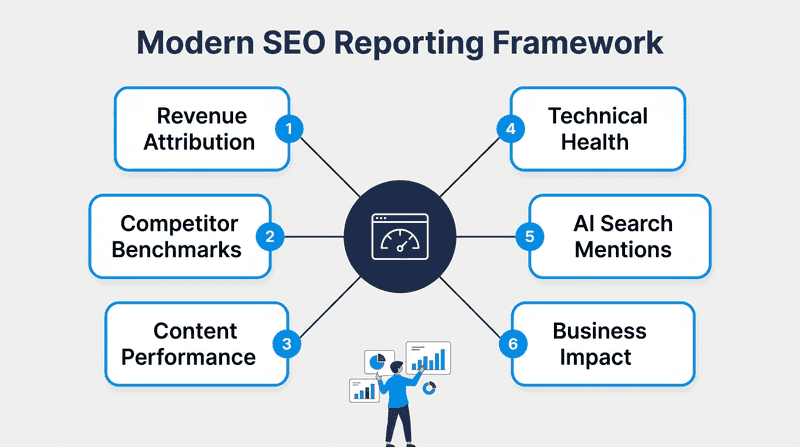
13. How Do You Attribute Organic Traffic to Revenue?
Traffic going up is not the same as revenue going up. An agency that shows you a graph with a rising line and labels it a win hasn't connected its work to your revenue. The question you are really asking is: can they trace a visitor from a Google search through your site to a form fill or a purchase?
The answer should describe a specific attribution setup – integration with your CRM or Google Analytics and UTM tagging for organic entry points. Conversion tracking that follows the full path from search to sale should be part of the standard setup. If their reporting stops at sessions and pageviews, they're measuring activity instead of outcomes.
14. What Competitor Benchmarking Do You Include in Reports?
15% organic traffic growth sounds good until you find out that your three closest competitors grew by 30% over the same period. SEO efforts measured in isolation are just a number. Site performance measured against the competitive set tells you whether you are actually gaining or losing ground.
A good reporting setup names your top competitors and tracks share-of-voice against them monthly. The data should break down by topic cluster – not just overall domain metrics – so you can see exactly which content areas you are winning and which ones competitors are pulling ahead on.
15. How Do You Track Content Performance Beyond Page Views?
5,000 visits with no conversions is a different kind of result than 800 visits that bring in 40 qualified leads. Most SEO companies report on the first number because it is easy. The second number – which pages actually move people toward a purchase – requires work to set up and more work to tie back to brand impact.
Their content reporting should include engagement depth (how far people scroll, how long they stay) and conversion attribution (which pages contributed to the pipeline this month). Volume alone doesn't tell you what is working. What matters is whether the content moved someone closer to paying you.
16. What Technical Health Metrics Appear in Your Monthly Reports?
Search rankings are built on top of technical infrastructure. If Core Web Vitals degrade or crawl errors increase after a site update, rankings drop. And you only find out when organic traffic falls off weeks later. An agency that monitors technical SEO health monthly finds these problems before they reach the rankings.
Their reports should include Largest Contentful Paint scores and crawl budget utilization at a minimum. Indexation coverage should also appear every month. If technical health data only shows up in the report after site speed has already gone down, the agency is reacting to problems instead of preventing them.
17. How Do You Report on AI Search and LLM Brand Mentions?
Traditional SEO dashboards don't capture whether your brand appears in ChatGPT responses or Perplexity citations. Gemini summaries are another blind spot entirely. Even the best SEO companies aren't attempting to measure this yet.
The ones that have started building or adopting proprietary frameworks designed specifically for this gap are taking it seriously. TechMagnate's PRISM is a good reference point for what this kind of reporting should be when it is done at scale.
It pulls brand visibility data from traditional Google results alongside AI-native search engines like ChatGPT and Perplexity, then maps how often a brand gets cited versus competitors across both channels in a single unified view.
That level of cross-channel measurement is still rare. But any agency serious about AI search should be able to describe their version of it – whether it is a proprietary build or a combination of third-party tools configured to track LLM mentions systematically.
18. What Business Impact Metrics Do You Tie Back to SEO?
Your CFO doesn't care about domain authority. They care about cost per lead from organic and whether SEO's contribution to the pipeline is growing or shrinking. 83% of companies plan to increase their SEO and marketing budget, but that budget only survives the next review cycle if the agency can prove the investment generates revenue.
The answer should frame results in business language. Cost per organic lead and organic's percentage of total pipeline are two that should be standard. Month-over-month revenue from non-brand search is a third. Those are the metrics that keep the retainer funded.
5 Red Flags in SEO Agency Evaluation That Should End the Conversation Immediately
Part of learning how to evaluate an SEO agency is recognizing when to walk away. These are the deal-breakers that tell you enough that the working relationship won't get better after signing.
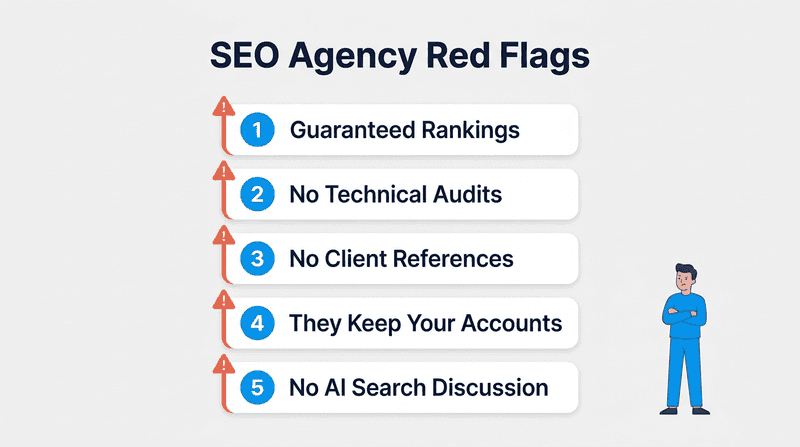
1. Guaranteed Rankings and First-Page Promises
Nobody controls Google's algorithm. An agency promising "page one in 90 days" or "guaranteed #1 rankings" is either willing to say anything to close the deal or planning to use link-building tactics that will get your site penalized. Google's own guidelines explicitly state that no one can guarantee a specific ranking.
The credible version of this conversation is different. It sounds like: "We've achieved these specific results for a business similar to yours over this timeline, and here's the White hat SEO strategy we'd take for your site." Specifics tied to real examples. No guarantees.
2. No Mention of Technical Audits or Site Health
An agency that starts talking about their content creation plans and link-building specialists before asking about your site's technical foundation is skipping the step that everything else depends on. If crawl errors or broken internal linking are dragging your site down, no amount of new content will fix it.
Technical fixes should come up in the first conversation – not as an upsell, but because a competent agency can't scope a SEO strategy without understanding what they are building on top of. If it never comes up, the agency probably doesn't include it.
3. Refusing to Share Past Client Results or References
NDAs exist, and some clients genuinely restrict what agencies can share. But an agency that can't connect you with a single reference or show an anonymized case study with real numbers isn't protecting confidentiality. They are hiding the absence of results worth showing.
A credible agency produces at least two references and two case studies without being pressured. If the only proof of their work is what they have published on their own website, that is a red flag – not trust and authority.
4. Ownership of Your Content and Accounts Stays With Them
Many agencies retain ownership of the content they create and the analytics accounts they configure. If you end the relationship, you lose the work product. This is hidden in the contract that most businesses don't read carefully enough. And it is expensive to discover after the fact.
Before signing, confirm in writing that all content and account access transfers to you in full when the engagement ends. If the agency resists this, they are building a lock-in mechanism. That is a billing strategy, not a partnership.
5. No Discussion of AI Search or LLM Visibility
An agency pitching SEO services without a single mention of AI search or LLM visibility is working from an outdated understanding of the space. AI Overviews appear on 15-30% of Google queries now. Pretending that doesn't affect organic strategy isn't a conservative approach – it is a gap in thinking.
Knowing how to evaluate an SEO agency means verifying that they have adapted to this shift. If their entire pitch centers on traditional search rankings and backlinks with zero acknowledgment of how AI is restructuring search, they are not equipped for where the SEO industry already is, let alone where it is heading.
Conclusion
Knowing how to evaluate an SEO agency comes down to one thing: the right agency makes the evaluation easy because they have already built the systems that earn trust before the contract is signed.
The All-in-One Platform for Effective SEO
Behind every successful business is a strong SEO campaign. But with countless optimization tools and techniques out there to choose from, it can be hard to know where to start. Well, fear no more, cause I've got just the thing to help. Presenting the Ranktracker all-in-one platform for effective SEO
We have finally opened registration to Ranktracker absolutely free!
Create a free accountOr Sign in using your credentials
The right SEO agencies worth your retainer don't need to be pushed for specifics. They describe a process and name their tools. They show you how they report on both traditional rankings and AI search visibility. They put you on the phone with clients who have been with them for over a year.
At Ranktracker, we built an all-in-one SEO platform that brings ranking data, keyword research, SERP analysis, backlink monitoring, and reporting into one place. You can monitor keyword positions across Google and other search engines, whether you want local search results or international visibility.
Our Keyword Finder helps you validate the strategy using a database of billions of competitive keywords, complete with search volume and difficulty metrics. If you want to understand who currently owns the search results, our SERP Checker lets you view search engine results from different locations around the world.
Get started for free and see exactly what your search visibility looks like.

