
Intro
You checked the landing page this morning. It loaded fast, the form worked, and the campaigns kept spending. That check tells you how the page behaves from your desk, on your network. It says nothing about the person who clicked your ad in Jakarta twenty minutes ago and stared at a blank screen, or the shopper in Germany who got blocked before the page loaded at all. The ad platform billed you for both clicks anyway. When a page is down, slow, or unreachable in one of the countries you target, you keep paying for visitors who never had a chance to convert, and no report calls it out directly. The fix is landing page monitoring that runs from the regions where you buy traffic, watches the failures that waste spend, and feeds straight into how your campaigns are scheduled. Building it takes an afternoon, not a project.
The silent way paid budget leaks
A page that goes down in one market fails loudly for the visitor and invisibly for you. The click still gets billed, the visitor sees an error, and your dashboard shows one more visit that didn't convert. Slow pages drain budget the same way. Google's research found that the probability of a bounce grows 32% as load time stretches from one second to three, and on paid traffic each bounce is a visit you paid for.
The disguise is what makes the leak expensive. No report says the page was unreachable in Brazil for four hours. You see conversion rates dip in one geo, cost per acquisition creep up over the week, maybe a landing page experience warning. By the time someone digs in, the money is spent and your quality signals in that market took a hit too. Catching the failure at minute five instead of day three is the entire job of monitoring.
Why a page can be fine for you and broken abroad
Most sites deliver pages through servers spread across regions, so the copy a visitor loads in Singapore comes from different infrastructure than the one you reach from your office. One regional server can misbehave while the rest stay healthy, and your local check keeps passing while a paying market waits on a spinner.
Region-specific problems stack on top. A cookie consent banner can break the layout only in the countries where it appears. A firewall rule can block an entire country without anyone deciding it should. A redirect can send Mexican visitors to the US page instead of the local one. Distance matters too: a page hosted in Frankfurt will always feel heavier in Melbourne, which is why serving content closer to visitors pays off; Ranktracker's guide to edge computing and latency covers that side. For a PPC team the takeaway is blunt: a passing check from your desk proves almost nothing about the markets you pay to reach.
What to monitor for ad landing pages
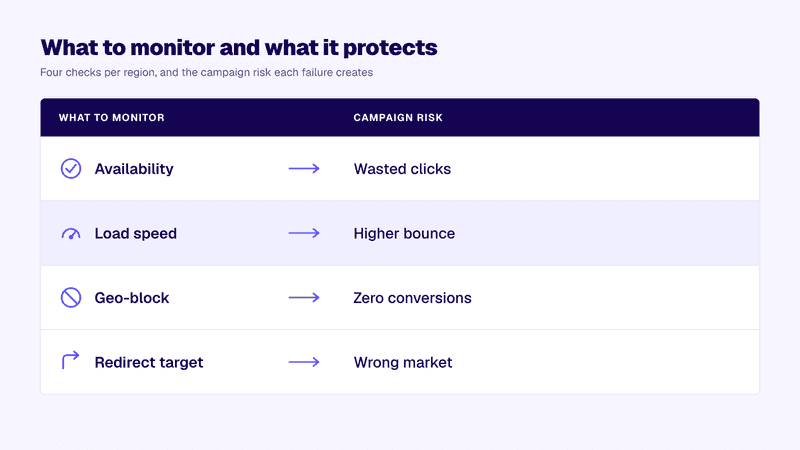
Four checks cover most of the paid-traffic risk.
Availability comes first: the final URL has to return the real page, not an error or an empty template. Speed comes second, measured the way Google measures it. The Core Web Vitals thresholds give you the targets, and the one to watch is LCP, the moment the main content becomes visible. Google reports that a good LCP, under 2.5 seconds, correlates with a 24% higher conversion rate, the metric your campaigns get judged on. That is why page speed for paid ads deserves per-region attention rather than one site-wide number.
The last two checks catch regional traps. Geo-blocking means a market gets denied or handed a stripped-down version of the page you built. Redirect drift means the final destination is not the URL your ad points to: visitors land on the wrong language or store, or tracking parameters get lost on the way.
The All-in-One Platform for Effective SEO
Behind every successful business is a strong SEO campaign. But with countless optimization tools and techniques out there to choose from, it can be hard to know where to start. Well, fear no more, cause I've got just the thing to help. Presenting the Ranktracker all-in-one platform for effective SEO
We have finally opened registration to Ranktracker absolutely free!
Create a free accountOr Sign in using your credentials
Source: Anonymous Proxies (original graphic)
Keep those pairings in mind when you set intervals: the failures tied to zero conversions justify the tightest ones.
Checking pages from every region you advertise in
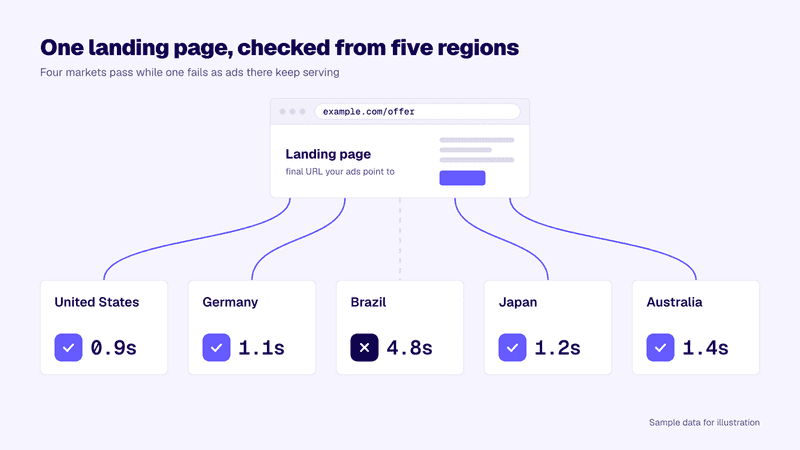
One rule drives the setup: checks must originate from the countries in your campaign targeting and request the exact final URL your ads use, tracking parameters included. A test from a city you don't advertise in answers a question nobody asked.
Two paths get you that coverage. Several website monitoring apps let you pick test locations, which works when their location list lines up with your geo targeting. When it doesn't, or when you want control over frequency and coverage, the direct route is running scheduled page checks from multiple regional IPs, which gives you fast, repeatable tests from every country on your media plan.
Set the cadence by spend. Markets carrying most of the budget get a check every five to fifteen minutes; smaller geos can run hourly. Record response times alongside pass or fail, because landing page uptime by region tells only half the story when a market is technically up at six seconds per load.
Source: Anonymous Proxies (original graphic)
The All-in-One Platform for Effective SEO
Behind every successful business is a strong SEO campaign. But with countless optimization tools and techniques out there to choose from, it can be hard to know where to start. Well, fear no more, cause I've got just the thing to help. Presenting the Ranktracker all-in-one platform for effective SEO
We have finally opened registration to Ranktracker absolutely free!
Create a free accountOr Sign in using your credentials
A board like this makes the problem obvious at a glance: four markets passing while one fails as ads there keep serving.
Setting alerts that protect campaigns
An alert earns its place only if someone can act on it within minutes.
Confirm before you notify. Require two consecutive failed checks from the same region, so one flaky test doesn't wake anyone for nothing. Independent checkpoints make that confirmation trustworthy. Some teams route these checks through datacenter IPs from a provider like Anonymous Proxies so each region reports independently.
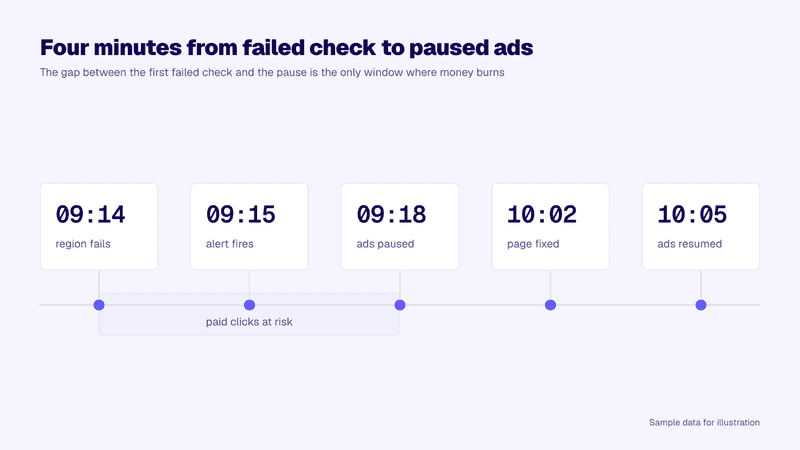
Then send the alert to whoever holds pause rights on the account, and put the region, the final URL, and the failure type in the message itself, so nobody opens three tools to understand it. Keep the response narrow: pause the affected geo and leave the rest of the campaign running.
The All-in-One Platform for Effective SEO
Behind every successful business is a strong SEO campaign. But with countless optimization tools and techniques out there to choose from, it can be hard to know where to start. Well, fear no more, cause I've got just the thing to help. Presenting the Ranktracker all-in-one platform for effective SEO
We have finally opened registration to Ranktracker absolutely free!
Create a free accountOr Sign in using your credentials
Source: Anonymous Proxies (original graphic)
That timeline is the target. The gap between the first failed check and the pause is the only window where money burns, and tight alerting holds it to minutes.
Tying monitoring to your ad scheduling
Monitoring and ad scheduling should share a clock. If a campaign in a market runs from 08:00 to 22:00 local time, run checks at full frequency inside that window and add one extra check shortly before ads switch on, so the day never opens on a broken page. Overnight, hourly is plenty.
Automation closes the loop. Most platforms support rules or scripts that pause a geo after repeated failures and resume it after a clean stretch. That automation depends on consistent measurement: a region's history only means something when every check comes from the same address, which is what fixed regional IPs your checks can reuse provide. Same address and route on every run, so a change in the numbers points at the page rather than the tester.
Done well, this turns a regional outage into a contained event that pauses its own traffic before anyone has to notice.
FAQ
How often should you check landing page uptime by region?
Set the interval by what an hour of downtime would cost. Markets carrying real budget justify checks every few minutes; the long tail can run hourly and still catch problems the same day.
Is page speed for paid ads different from organic page speed?
The metrics are the same, but the cost of failing them is higher. A slow load on organic traffic loses a free visitor, while on paid traffic it loses one you were billed for, so treat the thresholds as per-region limits.
Do small-budget regions need monitoring too?
Yes, at a lighter cadence. An hourly or daily check costs close to nothing and still catches the geo-block or broken redirect that would otherwise waste that region's budget for weeks.
Protecting every click you pay for
Every click you buy lands somewhere, and it only returns the bid if the page loads for the person behind it. Checking availability, speed, and redirects from the exact countries in your targeting turns invisible regional failures into signals you can act on. Wiring those signals into alerts and scheduling rules shrinks a bad morning in one market to a few paused minutes. The spend stays pointed at pages that work, which is the whole reason you bought the traffic.

