
Intro
You signed off on the German landing page last Tuesday. Clean translation, euro pricing, the spring promo front and center. Then the campaign went live and conversions came in at half the forecast. The uncomfortable part: you approved that page from your own desk, on your office network, through the CDN edge closest to you. A customer in Munich clicking the same ad gets whatever your geo stack decides to serve a German IP at that moment. Maybe it's the page you approved. Maybe it's a forced redirect to the US version, dollar prices, or a promo that never activates outside your home market. Nobody on your team catches it, because nobody on your team loads the page the way that customer does. This guide fixes that with a repeatable QA process you can run before every launch, market by market, without filing a single dev ticket.
Why your team never sees what overseas customers see
Modern sites make dozens of decisions per request: the CDN picks an edge server, the geo-IP module picks a currency, redirect rules pick a language version, the consent platform picks a banner. Every decision hinges on the visitor's IP and browser settings, and yours never change: home country, office network, a cookie jar full of previous sessions.
So when you preview a page, you're previewing one outcome out of many. Search for how to see my website in another country and most advice says to switch your browser language. That changes one input. The server still sees your real IP and keeps serving the home version. This primer on international SEO explains how those layers get built; the same systems that personalize pages by geography are the ones hiding problems from the people who approved them.
The geo elements that silently break (redirects, currency, offers, hreflang)
Four elements cause most of the damage, and none of them throw an error anyone monitors.
| Element | Typical failure | What the visitor gets |
| Geo redirects | One rule sends all EU traffic to one English page | German ad, English page, instant bounce |
| Currency | Fallback fires when the geo lookup misses | A Dutch visitor sees dollar prices |
| Offers | Promo engine scoped to the home market | Ad promises 20% off, page shows full price |
| Hreflang | Tags point at outdated or mismatched URLs | Mexican searchers land on the Spain page |
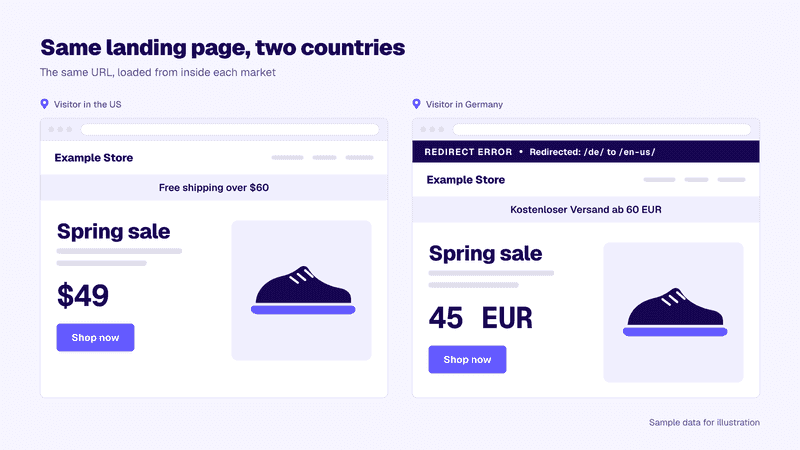
Treat hreflang as a campaign risk rather than an engineering detail: when tags contradict your redirects, paid and organic traffic land on different versions of the same offer, and cost per acquisition splits in ways no dashboard explains. If your setup grew organically across markets, an audit of your international SEO infrastructure usually surfaces these conflicts before they cost money. The mockup below shows how far two renders of one page can drift.
Source: Anonymous Proxies (original graphic)
Building a per-market QA checklist
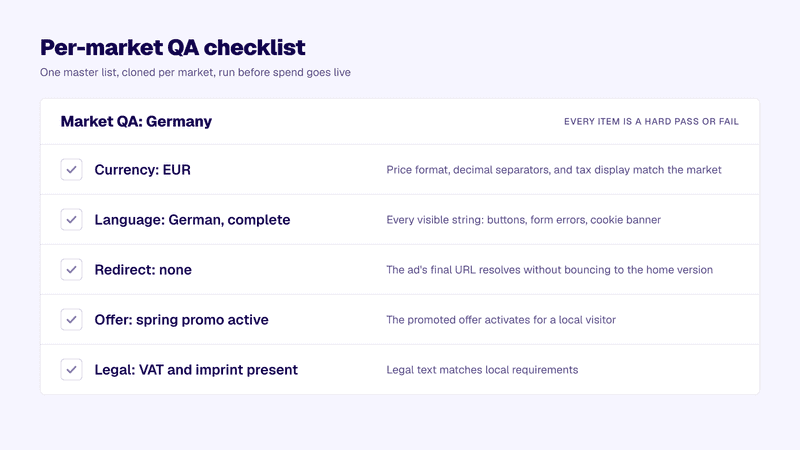
One master checklist, cloned per market, run before spend goes live. Every item is a hard pass or fail:
- Currency, price format, decimal separators, and tax display match the market
- Every visible string is in the target language: buttons, form errors, cookie banner
- The ad's final URL resolves without bouncing to your home version
- The promoted offer activates for a local visitor
- Legal text matches local requirements: VAT display, returns policy
- Local payment methods appear at checkout
- UTM parameters survive every redirect
Two habits turn the list into working international landing page QA. First, save evidence: one dated screenshot per market per run. Second, keep a standing set of local exit points, through a service like anonymous-proxies.net, that any marketer can use for spot-checks without waiting on another team. The graphic below condenses the five checks most teams start with.
Source: Anonymous Proxies (original graphic)
How to load your own pages from inside each market
The checklist only works if your test request looks like a customer request. Three methods, ranked by fidelity.
The All-in-One Platform for Effective SEO
Behind every successful business is a strong SEO campaign. But with countless optimization tools and techniques out there to choose from, it can be hard to know where to start. Well, fear no more, cause I've got just the thing to help. Presenting the Ranktracker all-in-one platform for effective SEO
We have finally opened registration to Ranktracker absolutely free!
Create a free accountOr Sign in using your credentials
Browser tricks. Changing Accept-Language or emulating a device changes request headers and nothing else. The server still geolocates your real IP. Fine for layout checks, useless for geo QA.
Consumer VPNs. Closer, but VPN exits sit in datacenter ranges many commercial sites recognize and treat differently. You end up testing how your site handles VPN traffic, which is a different question.
Residential connections. Routing the request through a real household ISP in the target market reproduces the customer's context. That's the point of a rotating residential setup: seeing your landing page the way an in-country visitor loads it, rendered by the same geo logic and redirect rules a paying visitor triggers.
The routine takes five minutes per market: fresh browser profile so old cookies don't skew the result, connection pointed at the target market, then click the live ad URL with tracking parameters intact and work the checklist top to bottom.
Catching campaign-killing localization bugs
Once you load pages from inside each market, a class of bug appears that passes every internal review:
- Mixed-language pages where the template translated but the CMS content didn't
- Forms that reject local phone formats or postal codes
- Page prices that stopped matching ad copy after a currency table update
- A consent banner covering the CTA on common local devices
- Payment methods missing for the region, like iDEAL in the Netherlands
Localization testing at this level is mechanical on purpose: you compare what the ad promised against what a local connection receives, field by field. Extend the same comparison to search, since the snippet a local searcher sees is part of the promise too. A local SERP checker covers that side without another browsing session. Vantage point consistency matters just as much. Teams running this weekly often standardize on one provider, Anonymous Proxies among them, so results stay comparable between checks.
Who should own this QA and how often
Give the job one owner per market: the campaign manager who spends that market's budget feels a broken page first, so the incentive lines up. Engineering gets involved once there's evidence: exact URL, test location, timestamp, screenshot.
| Trigger | Scope |
| New market launch | Full checklist, every item |
| Landing page or template change | Full checklist for affected markets |
| Weekly | Spot-check the top three spend markets |
| Platform or plugin update | Redirects and currency only |
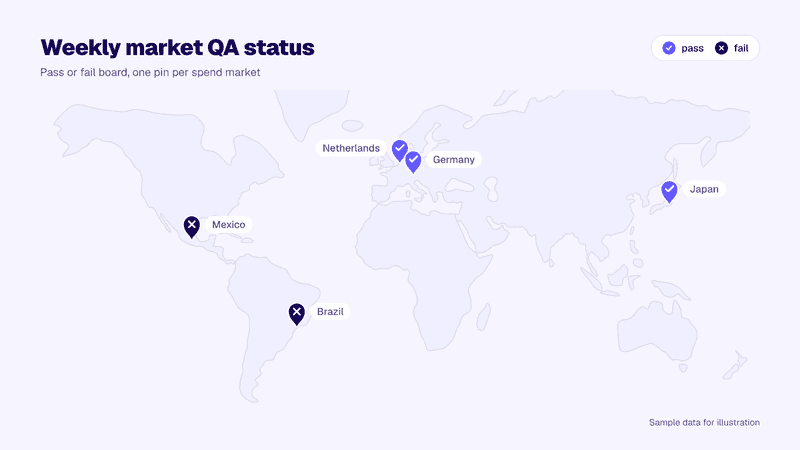
Report results as a pass or fail board per market; the board below is the whole reporting layer most teams need. A red pin gets fixed before the next budget review.
Source: Anonymous Proxies (original graphic)
FAQ
Can I just use a VPN for this?
For a rough look, sure. For QA you'll act on, no: VPN exits are datacenter IPs many sites treat differently, so your result stops matching what a household connection receives.
Do ad platform preview tools show the real landing page?
They render your ad inside a simulated results page. Everything after the click (redirects, currency, offer state) depends on your server's response to the visitor's IP, and preview tools never send that request.
How many markets should we check?
Every market with active spend, ordered by budget. A weekly five-minute spot-check on the top three catches most regressions before they burn real money.
Shipping pages your global audience can actually use
The gap between the page you approve and the page an overseas customer receives is a QA problem, and QA problems have process answers. Load pages through genuine local connections, run the same per-market checklist every time, and keep dated evidence so a failure becomes a ticket instead of an argument. Give each market one owner with budget on the line, let a simple pass or fail board carry the reporting, and localized campaigns stop underperforming for reasons nobody can see.

